

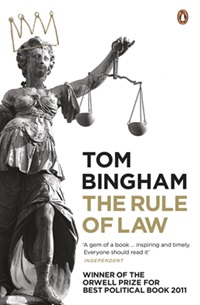
Accountability, or the orchestrated illusion of it, lies at the bleeding heart of our modern socio-political malaise. From the crumbling courthouses of collapsing democracies to the gilded executive chambers of unrestrained autocrats, the question resounds with anguished urgency: who watches the watchers? The truth is brutish in its simplicity—those with power, more often than not, slip the leash of responsibility with surgical precision, dancing between legalism and evasion like phantoms cloaked in immunity. It is in this fraught landscape of moral abandonment and juridical erosion that Lord Tom Bingham’s The Rule of Law emerges—not as mere commentary, but as a civilisational litmus test, and perhaps, as one might provocatively claim, a secular Bible of legal rectitude, whose rejection would spell our collective moral annihilation.
Indeed, Bingham’s vision is as elemental as it is radical: “The core of the existing principle is… that all persons and authorities within the state… should be bound by and entitled to the benefit of laws publicly made, taking effect (generally) in the future and publicly administered in the courts”. This deceptively simple sentence is, in truth, a clarion cry against the perversion of legality into instruments of tyranny. What does it mean for all to be bound by the law, when heads of state and corporate titans so often conscript law itself as a defence against consequence?
Lord Bingham acknowledges this despair without sentimentality. He begins by tracing the historical sinews of the rule of law, from Magna Carta to modern rights discourse, but does so not with triumphalist nostalgia, but with sober recognition of how each gain was not gifted, but wrested. He declares with sobering force, “Be you never so high, the law is above you,” quoting Dr Thomas Fuller. Yet one might justifiably ask: Is that still true? Or has justice become so infinitely malleable that its application, like wealth, accrues to those already insulated by privilege?
The book’s treatment of legal equality—ostensibly the keystone of a functioning democratic order—reads at times like a eulogy. Citing Dicey’s classic formulation, Bingham reminds us: “Every man, whatever be his rank or condition, is subject to the ordinary law of the realm”. But this assertion is undermined by our lived reality, where legal immunity is too often the reward for institutional loyalty. The rule of law, Bingham insists, must not be “law by discretion,” a dictum that becomes especially powerful in an age where executive orders, national security exceptions, and emergency powers eclipse due process.
And it is here that the book becomes a provocation: Can one still speak of the rule of law in good faith when the law itself has become a stage-managed farce? When the law is invoked not to protect the vulnerable, but to legitimise surveillance, criminalise dissent, or suppress minority rights, it ceases to be a guardian of justice and becomes, instead, its most articulate assassin.
Bingham is unflinching in his critique of governmental evasion. Reflecting on the government’s decision to suspend a Serious Fraud Office investigation into BAE Systems’ alleged bribery due to diplomatic pressure from Saudi Arabia, Bingham notes that the decision “was held by one court to be contrary to the rule of law,” though the Law Lords would later dissent. This episode is instructive: the legal system knew the stench of impropriety but ultimately folded under the weight of political convenience. It is a quintessential case of what Bingham calls “the rule of law in retreat”—a retreat that continues unabated in our age of euphemistic authoritarianism.
What is perhaps most revelatory is Bingham’s admission that even defining the rule of law has become contentious. Scholars like Judith Shklar have derided it as mere “ruling class chatter,” and Brian Tamanaha calls it “an exceedingly elusive notion” that functions like ‘the Good’—everyone praises it, but no one agrees on what it entails. Bingham does not flinch from these criticisms; rather, he uses them to illuminate the fragility of legal culture itself. In doing so, he exposes how easily the phrase “rule of law” can be co-opted as rhetoric while being gutted in practice.
Still, Bingham dares to assert that the rule of law must be universal, resistant to the claims of cultural relativism or executive necessity. He reveres the principles of open access to law, equality before it, predictability of enforcement, and transparency of trial. “To no one will we sell, to no one deny or delay right or justice,” he quotes Magna Carta—not as antiquarian pageantry, but as a rebuke to contemporary governments who treat justice as a commodity to be auctioned to the highest bidder.
Yet the book’s most tragic insight is its implicit recognition that law without institutional integrity is a weapon, not a shield. When judicial independence is eroded, when legislatures legislate inequality, when enforcement favours the powerful, the law becomes the very instrument of oppression it was designed to prevent. “Wherever law ends, tyranny begins,” Bingham quotes John Locke. And we must ask—has the law already ended in spirit, if not yet in form?
Indeed, one might argue that The Rule of Law should be required reading for every citizen, not just every lawyer. It is no overstatement to call it a modern civic catechism—a book not just about law, but about the ethical infrastructure of democracy. To understand it is to understand how dangerously close we are to the precipice. As Bingham notes, “The hallmarks of a regime which flouts the rule of law are… the midnight knock on the door, the sudden disappearance, the show trial, the confession extracted by torture, the gulag and the concentration camp.”
If law is not the guardian of humanity, then it becomes humanity’s most efficient destroyer. And when the rule of law becomes a hollow invocation, the outcome is not merely injustice—it is existential collapse. In this sense, The Rule of Law is more than a book. A warning. A manifesto. And possibly, a funeral hymn for a principle we pretend to uphold but no longer live by.