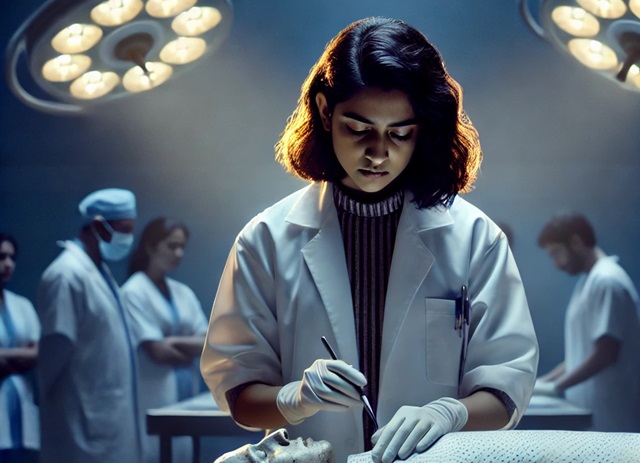
In the quiet, antiseptic confines of the neurology lab at the hospital in Kolkata, Aditi stood with her fellow students. The smell of formaldehyde was thick in the air, mingling with the hum of fluorescent lights overhead. The cadaver lay still on the stainless steel table, a silent teacher beneath the draped white sheet. Aditi’s heart pounded, her fingers trembling slightly as they clutched the scalpel, yet she knew this moment was a rite of passage—her first cut, her first lesson in the human mysteries within.
The others had each taken their turn, their cuts clean, their focus unwavering under the watchful eye of Dr. Rao, their supervising professor. But for Aditi, something about this felt both sacred and surreal. She closed her eyes for a moment, bringing her hands together at her chest. Namaste, she whispered inwardly, a tribute to the spirit of the person who had given their body to science, to learning.
The time had come. She lifted the scalpel to make the incision, her hands steadier now as she let instinct take over. She lowered the blade to the head, parting the skin with the quiet respect she felt for this life once lived. But as she moved around the neck, something glinted under the light, catching her gaze—a small, faded birthmark, just below the hairline. A familiar shape.
Her breath caught, the blood draining from her face. She knew this mark, this delicate, crescent-shaped birthmark, a faint etching she had traced a thousand times as a child, nestled on her mother’s neck. Her knees weakened. Her mother, who had been taken so suddenly months ago, her mother who had worked tirelessly, who had held calloused hands to Aditi’s cheeks, soothing her whenever she felt lost or afraid. Her mother, who had given everything she had so that Aditi could be here, pursuing a dream that felt impossible for a child of a laborer.
But here, in this sterile room, with her classmates surrounding her and Dr. Rao’s sharp eyes trained on her every move, Aditi was expected to remain clinical, professional. She forced her breathing steady, forced her face blank as she fought against the tidal wave of emotions threatening to rise. She mustn’t cry, not here. This was her mother’s final gift to her, her silent offering.
The blade lowered once more, and she continued with the dissection, her hands moving with a gentle reverence. Her classmates glanced at her, sensing her hesitation, but she steeled herself. In her mother’s death, just as in her life, she had chosen to give—to be there for Aditi one last time, to offer herself to her daughter’s hands and her dream.
When the lesson was done, they covered her mother’s body with care, preparing it for burial. Aditi’s hands felt hollow, her heart a knotted mass of gratitude and grief, aching with the knowledge of what her mother’s final sacrifice had meant. She followed the others as they walked to the burial ground outside the hospital. She watched as they lowered her mother’s body, so still now, into the earth, the woman who had once moved mountains for her daughter, who had toiled through sleepless nights and endless days so that her daughter might rise.
As the soil covered the mound, Aditi knelt, unable to hold back the tears any longer. She remembered her mother’s hands, rough and warm, brushing back her hair, her voice murmuring, “You will be great one day, my Aditi. A healer.”
Now, in the silence of the burial ground, as she gazed at the patch of earth beneath which her mother lay, Aditi felt an overwhelming surge of love and resolve. She would honor this gift, this extraordinary act of love that even death could not diminish. Her mother had lived for her, worked for her, and now, in the end, had given herself for her.
With a heart broken open by love, Aditi whispered her thanks to the earth, promising to carry her mother’s legacy forward with every patient she would ever heal.