


by Durga
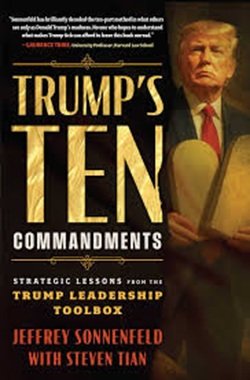
Jeffrey Sonnenfeld’s Trump’s Ten Commandments arrives with the air of a field manual masquerading as analysis, a taxonomy of power distilled into ten stark “rules” that purport to decode Donald Trump’s political and commercial success. From the outset, Sonnenfeld insists that these are not moral injunctions but strategic imperatives, “Trump’s own rules for gaining, wielding, and keeping power… startlingly effective and street-savvy” (p. xiii). The provocation lies not merely in cataloguing these behaviours but in the author’s insistence that what many interpret as incoherence is, in fact, a system: “Where others see chaos and unpredictability, I see Trump getting exactly what he wants by intentional design” (p. xv). This claim anchors the book’s central wager—that Trump’s conduct, however norm-breaking, is rational within its own logic. Yet the question that shadows the text is whether Sonnenfeld is describing a coherent strategy or retrofitting coherence onto what may be more contingent, improvisational, and even contradictory behaviour.
The book’s conceptual core rests on a rejection of ideology as an explanatory framework. Sonnenfeld contends that “ideology has never been the correct prism through which to understand the notoriously flexible and unideological Trump” (p. xvii), instead advancing a behavioural model rooted in instinct, opportunism, and personal dominance. This move is both analytically liberating and politically evasive. On one hand, it frees the analysis from the tired binaries of left and right; on the other, it risks depoliticising actions that have profound ideological consequences. By framing Trump as “dumb as a fox… guided by an indisputable canniness” (p. xvi), Sonnenfeld constructs a figure whose apparent ignorance becomes a form of strategic intelligence. The effect is double-edged: it challenges liberal condescension but also risks mythologising a kind of anti-intellectual cunning that evades accountability.
The “hub-and-spokes” model of leadership encapsulates this logic of personal centrality. “Everything—everything—is about Donald Trump, and Donald Trump only” (p. 3), Sonnenfeld writes, describing a system in which “all power derives from him” and subordinates are deliberately set against one another (p. 5). This is a compelling description of a personalised regime of authority, yet it also raises questions about sustainability and institutional capacity. If “there can be only one decision-maker—Trump himself” (p. 8), the model appears less like a strategy than a structural weakness, one that depends on constant vigilance and control. Sonnenfeld acknowledges the brutality of this system—“loyalty is a one-way street” (p. 7)—but stops short of interrogating its long-term consequences. The analysis remains descriptive rather than evaluative, as though the mere identification of the pattern suffices.
Nowhere is this tension more evident than in the treatment of negotiation. Sonnenfeld characterises Trump’s approach as aggressively zero-sum: “Somebody must always lose for him to win, because in Trump’s world, win-wins don’t exist” (p. 21). This is paired with a relentless instrumentalism—“What can I get from you right now?” (p. 22)—and a willingness to weaponise legal systems, with Trump boasting, “I did it to make his life miserable” (p. 24). The author presents these tactics as effective, even ingenious, yet offers little reflection on their corrosive implications for trust, governance, or international relations. The underlying assumption is that effectiveness justifies analysis, if not admiration. But effectiveness for whom, and at what cost? By foregrounding tactical success while bracketing normative judgment, Sonnenfeld risks reproducing the very logic he seeks to analyse.
The book’s discussion of “divide and conquer” extends this logic into the geopolitical realm, where alliances are recast as threats rather than assets. Trump’s aversion to collective structures—“he has never… met an alliance he particularly liked” (p. 38)—is framed as a deliberate strategy to prevent constraint. Sonnenfeld’s most striking, and perhaps most contentious, move is to liken this impulse to that of “history’s greatest revolutionaries like Mao, Lenin, and Stalin” (p. 41). The comparison is provocative, but analytically thin. It gestures towards a shared disruptive energy without engaging the vastly different ideological, historical, and moral contexts of these figures. The result is a rhetorical flourish that risks inflating Trump’s significance while flattening historical complexity.
If the book occasionally overreaches in its analogies, it is more persuasive in its examination of Trump’s economic practices. The notion that Trump’s deals follow a “Heads I win, tails you lose” logic (p. 58) is supported by a litany of examples, from risk offloading to aggressive branding. Sonnenfeld’s catalogue of Trump-branded products—“Trump Steaks, Trump Vodka… Trump NFTs” (p. 62)—reads less like a business portfolio than a case study in the commodification of persona. Yet even here, the analysis is ambivalent. The author notes that Trump’s wealth might have been greater had he passively invested in the market (p. 60), a detail that undercuts the narrative of unqualified success. This raises a deeper question: is Trump’s genius strategic, or is it performative, sustained by spectacle rather than substance?
The chapters on personal interaction and media strategy further complicate this picture. Sonnenfeld emphasises the disjunction between public bombast and private charm, noting that Trump “can be charming and flattering, if not mesmerizing” (p. 72). This duality is presented as a tool for converting critics into allies, reinforcing the idea that relationships are fluid and transactional. Yet the analysis borders on fascination, if not admiration, when describing Trump’s ability to engage on a personal level. The same ambivalence appears in the discussion of the “Wall of Sound,” where chaos is reinterpreted as “manageable chaos of Trump’s own creation” (p. 81). The metaphor of a “controlled burn” suggests intentionality, but it also obscures the possibility that some fires may be neither controlled nor strategic.
Perhaps the most unsettling aspect of the book is its treatment of truth and narrative. Sonnenfeld’s account of the “sleeper effect” is chilling in its implications: “If one repeats an assertion relentlessly… those untruths become conventionally accepted ‘fact’” (p. 95). The sheer scale of misinformation—“30,573 false or misleading claims” (p. 96)—is acknowledged, yet the emphasis remains on effectiveness rather than ethical consequence. The creation of “an alternative reality, ‘Trump’s World’” (p. 99) is described with a kind of analytical detachment that borders on normalisation. In this respect, the book mirrors its subject: it observes without fully confronting the moral stakes.
The chapters on insult and grandeur complete the portrait of a politics rooted in spectacle and domination. Trump’s insults are “calculated, calibrated, and… effective” (p. 105), reducing opponents to caricatures and transforming politics into entertainment. Meanwhile, his self-presentation as a singular saviour—“I alone can fix it” (p. 112)—is framed as a deliberate cultivation of myth. Sonnenfeld’s comparison to historical figures who fashioned their own greatness is suggestive, but it also risks legitimising the very narcissism it describes. The observation that Trump “democratizes the performance of luxury” (p. 118) is particularly revealing, hinting at the populist appeal of conspicuous excess. Yet this insight is not fully developed into a critique of the socio-economic conditions that make such performances resonate.









