


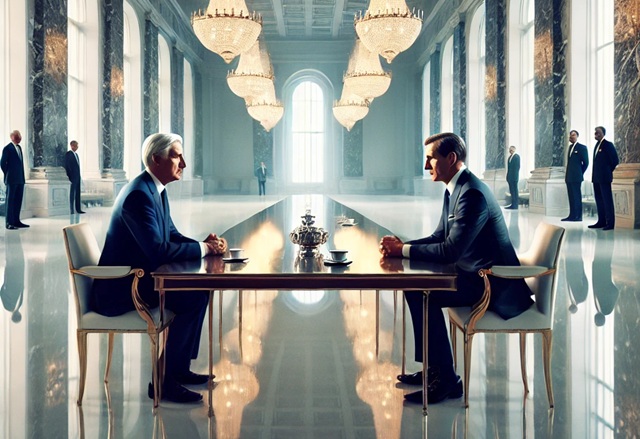
The room exuded an air of deliberate neutrality. A grand hall in Geneva, adorned with silent chandeliers and walls that had borne witness to treaties and treacheries alike. The two leaders sat across from each other, their diplomatic entourages mere spectators to what was an intricate game of strategy and subterfuge.
President Alexander Renard of the formidable Commonwealth of Arcadia—silver-haired, hawk-eyed, and meticulous in rhetoric—folded his fingers before him. His adversary, Chancellor Viktor Grigorev of the steel-fisted Ostregard Federation, leaned back with an expression of languid ease, his cold blue eyes belying a mind as calculating as any statesman’s in history. Between them, the future of the small but resource-rich nation of Zeytuna hung in the balance.
It was a country occupied by Ostregard forces for nearly a year, following a supposed request for “stability” from a puppet government. Arcadia, ever the self-proclaimed champion of order, had demanded a withdrawal. Now, here they sat, shaping history with words sharpened like blades.
Renard began; his tone clipped yet regal. “History teaches us, Chancellor, that occupation is a temporary measure—a bridge between war and a settlement. The Treaty of Versailles sought to ensure peace through the reorganization of Europe, but its architects failed to recognize that enduring peace stems from self-determination, not forced subjugation.” He leaned forward slightly, watching for a flicker in Grigorev’s expression. “Zeytuna’s sovereignty is not a privilege you grant; it is an immutable right.”
Grigorev smirked, his voice as smooth as silk wrapped around a dagger. “Ah, but self-determination is a fickle beast, is it not? The American Declaration of Independence was a defiance of established governance, yet the Union crushed the South’s attempt at the same. You speak of sovereignty, yet where was Arcadia’s regard for it when you restructured the Great Eastern Territories in ‘78? Let us not insult each other with selective morality.”
Renard inclined his head, as though to acknowledge a well-played move on the chessboard. “The Great Eastern Territories were integrated under a mandate of progress. We invested in infrastructure, governance, and prosperity. Zeytuna, on the other hand, has seen its industries siphoned, its people made supplicants rather than citizens. Surely, you cannot call that liberation?”
Grigorev took a sip of his tea, the slightest twitch at the corner of his lips betraying amusement. “My dear President, you mistake pragmatism for malice. The Romans understood that true dominion lay not in conquest but in assimilation. When Pompey entered the Levant, he did not withdraw at the first cry of dissent. He secured order. What is governance if not the ability to bring order to the unruly?”
Renard’s tone hardened. “And when order is indistinguishable from tyranny? The British held India under similar justifications, yet the inevitable dawn of independence shattered their illusion of control. No power, however mighty, can hold a nation against its will forever.”
Grigorev chuckled. “And yet, Arcadia’s fleets are already positioned in the Gulf of Zeytuna, under the guise of ‘monitoring stability.’ One might wonder whether your concern for sovereignty extends only to those nations not within Arcadia’s strategic purview.”
Renard smiled, a predator’s patience in his expression. “Observation and intervention are separate concepts, Chancellor. However, should Arcadia be forced to act, history will not look kindly upon those who defy the consensus of nations.”
Grigorev set down his cup, finally leaning forward, his gaze sharp. “And yet history is not written by consensus, President. It is written by those who endure. Do not mistake sentiment for strength. You wish to force our withdrawal? Then tell me, what price are you truly willing to pay?”
A pause hung in the air. Then Renard spoke, his words measured. “A compromise. A staged withdrawal over six months, during which Arcadia will assist in stabilizing Zeytuna through economic and logistical aid, ensuring neither anarchy nor undue influence from any one power.”
Grigorev raised an eyebrow. “And what of Ostregard’s investments in Zeytuna? We have secured vital industries, and I hardly think our shareholders would take kindly to being robbed in broad daylight.”
Renard allowed himself a small smirk. “Compensation. In exchange for the withdrawal, Arcadia will facilitate a trade agreement granting Ostregard preferred access to Zeytuna’s mineral exports—at a fair but favorable rate. You retain economic leverage, but the occupation ends.”
Grigorev feigned contemplation, though Renard could see the calculations flashing behind his gaze. This was a deal that would allow Ostregard to save face while maintaining a foothold in the region—perhaps even setting the stage for a future return under different means.
Finally, Grigorev exhaled, his expression unreadable. “You propose an interesting resolution, President. Perhaps you are more Machiavellian than your noble speeches suggest.”
Renard smiled. “Machiavelli advised that power must be wielded wisely, but he also noted that reputation is its own kind of weapon. A fair agreement serves us both more than a prolonged dispute.”
But Renard also knew that negotiations were never about what was spoken aloud. If you know the enemy and know yourself, you need not fear the result of a hundred battles. Grigorev postured strength, but in doing so, revealed his own need for an exit that did not resemble defeat.
Grigorev inclined his head slightly, acknowledging the move for what it was—a checkmate in the guise of diplomacy. Appear weak when you are strong, and strong when you are weak. This was no act of benevolence from Arcadia, nor was Ostregard’s acceptance an act of submission. Both men knew that in the midst of chaos, there is also opportunity. Today, diplomacy had prevailed, but the game was far from over.
As the aides moved forward with documents for signatures, both men knew the ink of diplomacy was but a temporary stain upon the parchment of ambition.










