


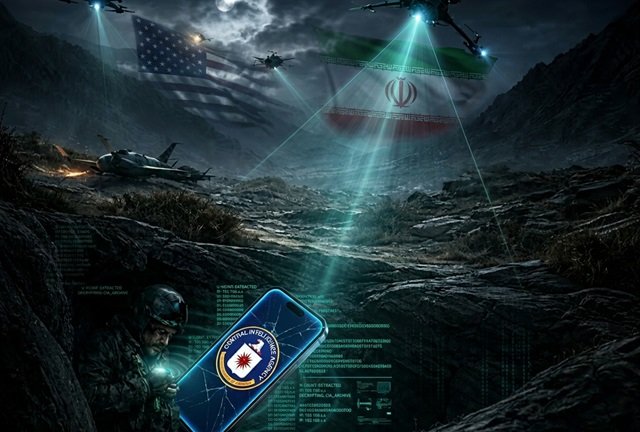
In a dramatic rescue mission last week, a U.S. weapons systems officer, publicly known as ‘Dude 44 Bravo,’ survived two days in southern Iran after his F-15 jet was shot down. According to a report by the New York Post, the CIA employed a classified technology called Ghost Murmur to pinpoint his location. The system reportedly uses long-range quantum magnetometry to detect the electromagnetic fingerprint of a human heartbeat and combines it with artificial intelligence to isolate individual signals, even in challenging environments.
Developed by Skunk Works, Lockheed Martin’s secretive advanced development division, Ghost Murmur was designed to detect extremely faint heartbeat signatures at distances previously thought impossible. A source familiar with the technology explained that the name is deliberate: “Murmur” refers to a heart rhythm, while “Ghost” signifies locating someone who has effectively vanished. The pilot’s survival in a mountainous, sparsely populated area of Iran created an ideal operational scenario, as the low electromagnetic interference and minimal human activity reduced noise, allowing operators to confirm the presence of a living body. The cold desert floor at night further enhanced detection through thermal contrast.
The technology reportedly works best in remote, low-clutter settings and requires intensive data processing. Normally, heartbeat signals are so weak that they can only be measured with sensors pressed directly against the chest. Ghost Murmur, however, harnesses advances in quantum magnetometry to detect these signals from significant distances, potentially transforming search and rescue operations in hostile or inaccessible regions.
According to the report, the rescue mission’s success hinged on a critical moment when the airman briefly emerged from his crevice to activate a Combat Survivor Evader Locator beacon. The beacon’s signal enabled Ghost Murmur to capture the electromagnetic signature of his heartbeat, confirming his precise location and guiding U.S. teams to him. Without this technological edge, locating the downed officer amid Iranian patrols and mountainous terrain would have been far more uncertain.
While the U.S. government has not officially confirmed Ghost Murmur, CIA Director John Ratcliffe hinted at the existence of extraordinary intelligence capabilities during a recent briefing. “The agency deploys exquisite technologies that no other intelligence service in the world possesses,” he said, noting that some capabilities fall under covert action authorities and cannot be fully disclosed. Analysts suggest that Ghost Murmur could represent a new era in intelligence and operational capability, combining advanced quantum science with artificial intelligence to save lives in hostile territories.
The airman’s recovery has been hailed as a high-risk success, with President Trump publicly declaring, “We got him,” emphasizing the operation’s significance. The mission not only demonstrates the CIA’s ability to act in extreme conditions but also signals the potential for future use of cutting-edge detection technologies in search and rescue, counterterrorism, and intelligence-gathering missions worldwide.
Experts caution, however, that while Ghost Murmur offers extraordinary capabilities, it is not omnipotent. Its effectiveness diminishes in densely populated or highly electromagnetically cluttered areas, and successful deployment requires meticulous preparation, data processing, and environmental suitability. Still, the operation has sparked interest in military and intelligence circles for its novel application of quantum physics to real-world challenges, suggesting a shift toward technologies that can detect human presence in ways previously relegated to science fiction.
The rescue of ‘Dude 44 Bravo’ underscores the risks faced by U.S. personnel operating in hostile regions and the lengths to which agencies are willing to go to ensure their safety. It also highlights the growing integration of advanced technology, artificial intelligence, and intelligence operations, offering a glimpse of how covert missions may evolve in the coming years. While many details remain classified, the reported success of Ghost Murmur has drawn international attention and raises questions about the future of battlefield tracking, surveillance, and rescue operations.









