The renewed threat of a US troop withdrawal from Germany has stirred political anxiety on both sides of the Atlantic, but as reported by Die Ziet, the reality behind the rhetoric is far more complex. While Germany remains heavily reliant on American military power, the United States also depends significantly on its presence in Germany to sustain global operations. The current dispute, fueled by sharp exchanges between German Chancellor Friedrich Merz and US President Donald Trump, highlights not only diplomatic strain but also the strategic interdependence that defines the transatlantic alliance.
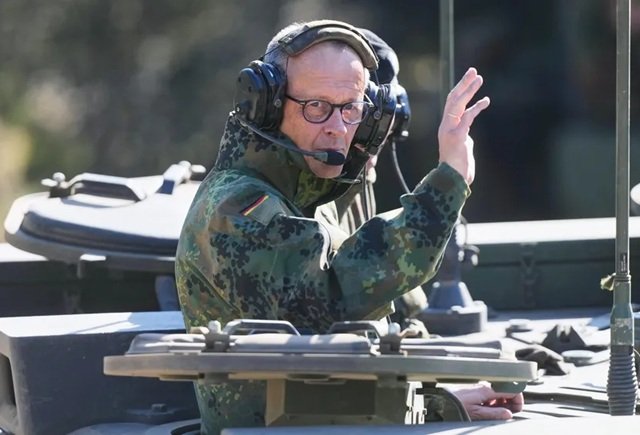
At a military training ground in Munster, Chancellor Merz recently attempted to project strength and confidence. Surrounded by armored vehicles and advanced military displays, he spoke about defense and cooperation with the United States. Yet the demonstration itself revealed the limits of Germany’s readiness. The Bundeswehr showcased drones, robotic systems, artillery, and coordinated battlefield scenarios, but much of the equipment presented is not yet fully operational. Procurement delays continue to slow modernization, and in some cases, systems were operated by defense industry personnel rather than soldiers, underscoring the gap between ambition and reality.
This gap is central to Germany’s current position. Despite increased defense spending, the country is not yet capable of defending itself without US support. Merz has pledged to build the strongest conventional army in Europe, but such a transformation will take years, if not decades. Until then, Germany’s security remains closely tied to American military capabilities, particularly in areas such as intelligence, logistics, and nuclear deterrence.
The political backdrop has made this dependence more uncomfortable. President Trump has reacted sharply to criticism from Berlin, particularly regarding US foreign policy decisions involving Iran. His threats to withdraw American troops from Germany have amplified concerns about the stability of the alliance. However, these threats may be more political than practical, as the United States has strong incentives to maintain its military footprint in Germany.
Germany is one of the most important locations for US forces outside the United States. More than 39,000 American troops are stationed there, forming a significant portion of US military personnel in Europe. The country hosts critical infrastructure, including major air bases, command centers, and logistical hubs that support operations across Europe, Africa, and the Middle East. Facilities such as Ramstein Air Base play a central role in coordinating missions and maintaining global readiness.
Replacing these assets would be extremely difficult. The United States is currently investing billions of dollars into its German bases, including expanding medical and operational facilities. There are limited alternatives elsewhere that could accommodate such a large and complex military presence. Relocating troops and equipment would require significant time, resources, and political coordination, making a large-scale withdrawal unlikely.
Germany’s role as a host nation further strengthens its importance. The government has consistently supported US operations, allowing bases to be used for international missions and maintaining open airspace when needed. This cooperation has made Germany a reliable partner, reinforcing its position as a cornerstone of US military strategy in Europe.
At the same time, the American presence provides Germany with essential security guarantees. The US nuclear umbrella remains a critical element of deterrence, particularly in light of ongoing tensions with Russia. While European nations have explored alternatives, including closer coordination with France and the United Kingdom, these efforts have yet to produce a viable replacement for American capabilities.
Institutional constraints within the United States also limit the possibility of a major troop reduction. Congress has established minimum troop levels for Europe, making it difficult for any administration to significantly decrease the military presence without legislative approval. Additionally, the financial and logistical burden of relocating forces would be substantial, further reducing the likelihood of drastic action.
The broader global context adds another layer of complexity. The United States is engaged in multiple regions, from the Middle East to Latin America, and relies on its European bases to support these operations. Moving large numbers of troops out of Germany would disrupt established systems and weaken operational efficiency at a time when global military commitments remain high.
Within Germany, some analysts argue that the government should respond to US pressure with greater calm and confidence. While the Bundeswehr’s shortcomings are evident, Germany’s strategic value gives it leverage that is often underestimated. A more measured approach could help stabilize relations and prevent unnecessary escalation in an already tense political environment.
Most experts believe that a complete withdrawal of US forces from Germany is unlikely. More realistic scenarios involve limited redeployments or symbolic reductions rather than a fundamental shift in strategy. Even so, such moves could carry political weight and influence perceptions of the alliance’s strength.
The current dispute illustrates the delicate balance at the heart of transatlantic relations. Germany depends on American military power, while the United States relies on Germany’s infrastructure and geographic position to project influence globally. Neither side can easily disengage without significant consequences.
As tensions continue, the challenge for leaders in both countries will be to manage disagreements without undermining a partnership that has been central to European security for decades. The threat of troop withdrawal may dominate headlines, but the underlying reality is one of mutual dependence—one that neither Washington nor Berlin can afford to ignore.