US President Donald Trump has reignited his campaign for greater control over Greenland, declaring that the strategically important Arctic island “should be controlled by the United States and not Denmark” as tensions rise between Washington and its NATO allies.
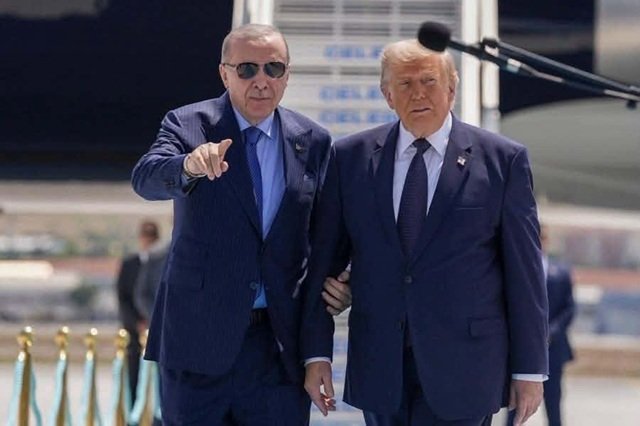
Trump made the remarks in Ankara ahead of a meeting with Turkish President Recep Tayyip Erdogan, who is hosting a NATO summit focused largely on managing relations with the American leader. His arrival in the Turkish capital was marked by a formal reception, heavy security measures and a carefully organised diplomatic schedule, but Trump quickly returned to issues that have repeatedly strained relations with European partners.
The Greenland dispute has become one of the most sensitive issues between the United States and Denmark, a NATO ally and member of the European Union. Trump has repeatedly expressed interest in acquiring the Arctic territory, arguing that it is strategically important for American security.
“That is what damaged my relationship with NATO because Greenland does not benefit Denmark, Denmark does not invest money to really help Greenland, but it is an important part for the United States,” Trump said before his meeting with Erdogan at the Presidential Complex in Ankara.
Trump has previously suggested that he would not rule out military action to take control of Greenland, although pressure from European allies defending Denmark appears to have shifted his approach towards political pressure and possible long-term arrangements. Despite that change in tone, he has not completely abandoned the possibility of using force, even though Denmark remains a member of NATO.
European governments and officials in Brussels have continued to view the Greenland issue as unresolved. Washington maintains that the island is essential to its national security interests, while Denmark and its European partners have rejected the idea that Greenland’s future could be determined without their involvement.
The renewed comments come as NATO allies attempt to prevent the alliance’s summit in Ankara from becoming a public confrontation over disagreements between Washington and Europe. The meeting was carefully prepared and shortened in an effort to reduce the possibility of clashes, but Trump’s opening remarks revived long-standing disputes over defence spending, military commitments and political loyalty.
Trump criticised European allies over what he described as a lack of support for US actions abroad. He pointed specifically to disagreements over his administration’s conflict with Iran and European reluctance to support a mission aimed at reopening the Strait of Hormuz.
“We have invested trillions of dollars in NATO. Why? To protect European countries and others,” Trump said. “One would think they would be very willing to do something to help us, and they really were not.”
The US president has repeatedly argued that Washington has carried a disproportionate burden in defending Europe and has questioned whether European countries would support the United States during a crisis. He has said countries including Italy, Germany and France had failed to stand with Washington, warning that he would respond to what he considers a lack of loyalty.
Trump’s relationship with Italian Prime Minister Giorgia Meloni has also faced tensions after Rome declined to support his position on Iran. The dispute had included personal attacks from Trump, including a social media post suggesting he needed a restraining order against the Italian leader. However, during his latest remarks, Trump appeared to soften his position, describing Meloni as “a good person” while maintaining that he believed Italy had made a mistake.
Beyond Greenland and political disputes, the broader disagreement centres on NATO’s future security structure. The United States has urged European countries to take greater responsibility for their own defence and has announced plans to review its military presence in Europe.
Washington has also indicated that it may reduce some strategic capabilities previously available for European operations, including aircraft and other military assets. The administration has criticised European defence spending, despite NATO members reaching record levels of military investment and committing to increase defence spending to 5% of gross domestic product by 2035.
The United States has announced a six-month review of its forces in Europe and said it will assess the “commitment and loyalty” of its allies. European governments and Canada have responded by working to strengthen their own defence capabilities and address potential gaps in the continent’s security framework.
In an effort to demonstrate increased investment, NATO used the Ankara summit to highlight the role of the European defence industry. A major defence industry forum was integrated into the summit programme, featuring representatives from hundreds of companies, NATO member states and partner countries.
The event showcased major defence agreements worth 12 billion euros, including purchases of drones, surveillance aircraft and advanced fighter jets. The announcements were designed to demonstrate that European allies are increasing their ability to develop and acquire key military capabilities within the continent rather than relying exclusively on Washington.
NATO Secretary General Mark Rutte presented the contracts during a highly produced event featuring large screens displaying fighter aircraft, alliance operations and military technology. The announcements included new aircraft programmes, upgrades for existing fleets, surveillance systems, drone projects and satellite initiatives.
A European military official attending the forum said the agreements were not the result of sudden negotiations but part of defence programmes that had been developed over time. However, the official described the announcements as important steps to ensure European forces do not fall behind technologically.
Rutte compared NATO’s cooperation with the defence industry to a team sport, saying that success depends not on one individual member but on collective strength, preparation and resources.
As NATO leaders continue their discussions in Ankara, Trump’s renewed focus on Greenland and his criticism of European allies have placed renewed pressure on the alliance. The summit now serves as a test of whether NATO members can maintain cooperation while addressing deep disagreements over security priorities, defence spending and the future balance of responsibility within the alliance.