


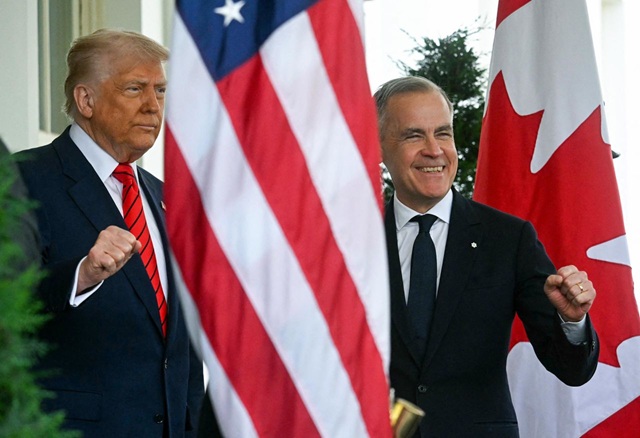
U.S. President Donald Trump on Saturday threatened to impose a sweeping 100% tariff on all Canadian goods entering the United States if Ottawa proceeds with a newly announced trade deal with China, dramatically escalating tensions between the two longtime allies. In a series of statements, Trump warned that closer economic ties between Canada and Beijing would put the country’s economy and sovereignty at risk, while signaling a willingness to use punitive trade measures to block such a move.
Writing on his Truth Social platform, Trump said China would “eat Canada alive” if a trade agreement goes forward, claiming Beijing would devastate Canadian businesses, social cohesion and its broader way of life. He added that any deal with China would trigger an immediate and comprehensive tariff response from Washington, targeting all Canadian products shipped south of the border.
Canadian Prime Minister Mark Carney’s office did not immediately respond to requests for comment. Carney traveled to China earlier this month in an effort to reset strained bilateral relations and concluded a trade agreement with Canada’s second-largest trading partner after the United States. At the time, Trump appeared supportive of the initiative, telling reporters at the White House on January 16 that striking a deal with China was “a good thing” and encouraging Carney to pursue it.
That conciliatory tone has since evaporated. Relations between the two leaders have deteriorated rapidly in recent days, particularly after Carney publicly criticized Trump’s pursuit of Greenland, a move that drew international attention and sharpened diplomatic friction between Washington and Ottawa.
Trump on Saturday accused China of seeking to use Canada as a conduit to bypass U.S. tariffs, suggesting Beijing would attempt to funnel goods through Canadian territory into the American market. Referring to Carney as “Governor,” echoing his past remarks about Canada becoming the 51st U.S. state, Trump said Ottawa would not be allowed to serve as a “drop off port” for Chinese exports.
If carried out, the threatened tariff would represent a dramatic escalation in U.S. trade policy toward its northern neighbor. Such a move would sharply raise existing duties and place heavy strain on Canadian industries deeply integrated with U.S. supply chains, including metal manufacturing, automotive production and machinery, sectors that rely heavily on cross-border trade.
The dispute comes against a backdrop of increasingly pointed exchanges between the two leaders on the global stage. Speaking this week at the World Economic Forum in Davos, Switzerland, Carney argued that the era of a rules-based global order was effectively over and called on so-called middle powers to cooperate more closely to avoid being dominated by larger states. While he did not name Trump or the United States directly, Carney warned that countries not “at the table” risk being “on the menu,” a remark that drew a standing ovation from many world leaders and business executives in attendance.
Trump responded during his own Davos appearance by asserting that Canada “lives because of the United States,” a claim Carney firmly rejected days later. Speaking in Quebec, the Canadian prime minister said the two countries had built a strong partnership in economic, security and cultural terms, but stressed that Canada’s success was rooted in its own national identity rather than dependence on Washington.
Since then, Trump has further hardened his stance, revoking Canada’s invitation to join a proposed Board of Peace aimed at addressing international conflicts and the future of Gaza. The shift marks a striking turnaround from the cordial relationship the two leaders initially projected after Carney’s election last year, when Trump predicted bilateral ties would remain strong.
The latest flare-up also casts uncertainty over the future of the trilateral trade agreement between the United States, Canada and Mexico, which is due for renegotiation in July. Trump recently dismissed the pact as “irrelevant,” adding another layer of unpredictability to North American trade relations.
As Ottawa weighs its economic interests in China against its vital relationship with Washington, Trump’s tariff threat underscores how rapidly geopolitical rivalries are reshaping even the closest alliances, with Canada now caught in the crosscurrents of intensifying U.S.-China competition.









