


Editorial
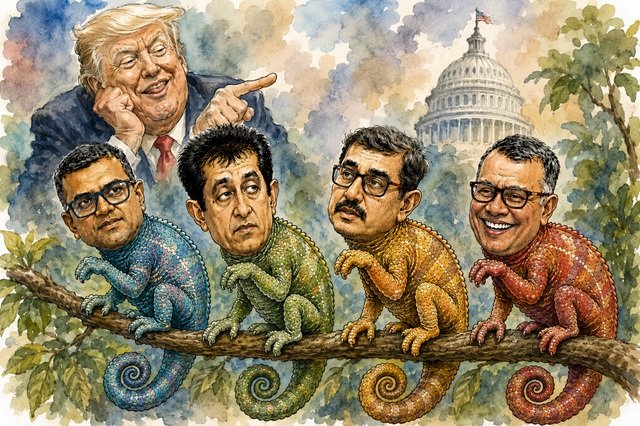
Public trust is not strengthened by triumphal announcements; it is earned through evidence, transparency, and accountability. That is why the recent attempts by Sri Lankan officials to portray the United States’ decision to impose a 10% tariff on Sri Lankan exports as an extraordinary diplomatic triumph deserve far greater public scrutiny than they have received. Outgoing Sri Lankan Ambassador to the United States Mahinda Samarasinghe publicly credited the outcome to President Anura Kumara Dissanayake’s leadership, the negotiating efforts of Finance Secretary Harshana Suriyapperuma, Central Bank Governor Nandalal Weerasinghe, Trade Secretary Vimalenthirarajah, Chief Economic Advisor and Board of Investment Chairman Duminda Hulangamuwa, himself, and the Embassy in Washington. Such claims are serious because they invite the public to believe that the 10% tariff represents a unique concession secured through exceptional diplomacy. Yet the official U.S. policy tells a more complicated story. President Donald Trump’s executive order established a 10% baseline tariff applicable to many countries, while higher rates applied to others under the broader reciprocal tariff framework. Unless the Sri Lankan Government can produce documentary evidence demonstrating that Sri Lanka was initially designated for a higher tariff and that negotiations specifically reduced it to 10%, presenting the outcome as a singular diplomatic victory is not an established fact but a political narrative. The burden of proof rests with those making the claim, not with citizens expected to accept it without question.
This is precisely where the quality of public discourse begins to deteriorate. Democracies depend upon informed citizens, not unquestioning audiences. When officials present ordinary policy outcomes as exceptional national achievements without producing supporting evidence, they risk treating the public as though it lacks either the capacity or the willingness to verify the facts. In Sinhala, there is a powerful expression, “අනුන්ගේ දරුවන්ට උප්පැන්න ලියා ගැනීම“—claiming parenthood of someone else’s child. It describes the act of taking ownership of an achievement that belongs elsewhere. Whether that description ultimately applies here depends upon evidence, but the comparison inevitably arises when politicians and political appointees attempt to claim credit for developments that appear to flow primarily from a broader policy adopted by another government. Citizens deserve better than carefully crafted political messaging designed to create impressions that extend beyond what the available evidence supports. They deserve honesty about what was achieved, what was not, and what remains uncertain.
The issue extends beyond one tariff announcement. It raises broader questions about the culture of governance and political appointments in Sri Lanka. Individuals entrusted with senior public responsibilities, including Mahinda Samarasinghe, Harshana Suriyapperuma, Nandalal Weerasinghe, Vimalenthirarajah and Duminda Hulangamuwa, occupy positions financed by the public purse. Their salaries, official travel, diplomatic missions, advisory structures and negotiating teams are funded by taxpayers. The standard by which their performance should be judged is not the number of congratulatory statements issued after an international decision but the measurable outcomes they produce and the evidence they can provide in support of their claims. Public office is not a platform for self-congratulation; it is a position of stewardship. Where concerns have been raised about governance, appointments or potential conflicts of interest, those concerns should be answered through transparency and disclosure rather than public relations. Accountability is demonstrated by facts, not by declarations of success.
What makes such episodes particularly disappointing is that they squander an opportunity to build genuine public confidence. If Sri Lanka’s delegation truly secured a country-specific concession from Washington, there should be no hesitation in publishing the documentary record, the negotiating timeline, and the evidence showing how the final outcome differed from the initial U.S. position. Such transparency would silence critics and strengthen confidence in the institutions involved. If, however, the 10% tariff simply reflects the baseline established under U.S. policy, then public officials should acknowledge that reality instead of inviting applause for an outcome that may not have been theirs to claim. Citizens are neither incapable of understanding complex policy nor unable to distinguish diplomacy from political marketing. Treating them as though they will believe any convenient narrative is not merely patronising; it erodes confidence in public institutions and diminishes the credibility of those entrusted to represent the country. The real measure of public service is not how effectively officials claim victories, but how honestly they explain them, how transparently they account for the public resources entrusted to them, and how faithfully they discharge the responsibilities for which the people ultimately pay.










Trump’s 10% Tariff: The Politics of Borrowed Victories is a penetrating and elegantly argued analysis that masterfully exposes the complexities of protectionist economics and geopolitical maneuvering. With intellectual rigor, lucid prose, and compelling insight, it challenges conventional narratives while illuminating the profound global consequences of politically expedient trade triumphs.
—- Anwar A. Khan, a direct witness of the brutal birth of Bangladesh from the direful Pakistani military regime from a very close proximity in 1971 and a frontline Freedom Fighter of the 1971 war field to establish Bangladesh.