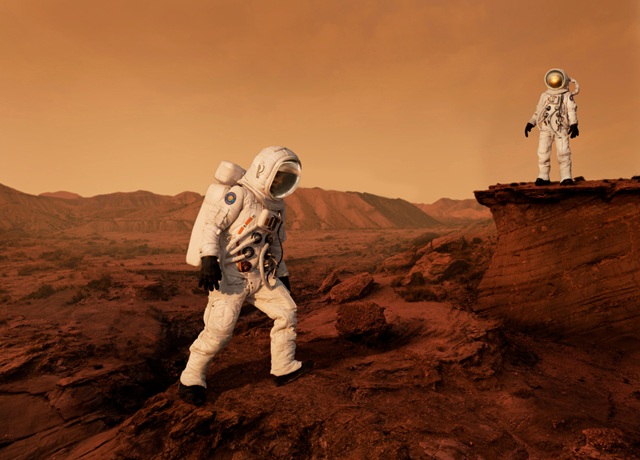
For decades, the idea of sending humans to Mars has captured the imagination of the public and fueled the ambitions of U.S. presidents. From John F. Kennedy’s moonshot to Donald Trump’s more recent declaration of “manifest destiny” on the Red Planet, the dream of humanity’s expansion into space has never seemed far off. But as The Times (UK) reports, turning this bold vision into reality raises the question: how long will it actually take to get a man to Mars?
In his inaugural address, Trump made an ambitious declaration: “We will pursue our manifest destiny into the stars, launching American astronauts to plant the Stars and Stripes on the planet Mars.” While his rhetoric was inspiring, it wasn’t a new idea. The pursuit of human space exploration, particularly to Mars, has been a goal of NASA for over three decades and long before Trump’s presidency.
In 1965, President Lyndon B. Johnson spoke about humanity’s destiny to reach Mars, echoing the earlier ambitions of President Kennedy. This vision continued through the years, with President George W. Bush’s 2004 Vision for Space Exploration calling for a return to the Moon as a stepping-stone to Mars. By 2010, President Barack Obama redefined this vision, prioritizing a phased pathway to Mars with crewed missions projected for the 2030s.
Trump’s administration furthered this focus on lunar exploration with the Artemis program, aiming to return humans to the Moon by 2027. However, the ultimate goal has always been Mars. Despite advances in lunar technology, as per the report by The Times, UK, the path to Mars remains riddled with substantial financial and technological challenges. Laura Forczyk, a space industry analyst at Astralytical, explained, “We’ve been developing technologies and launching new spacecraft since the 1960s, but what we don’t have is the budget, and that’s holding us back.”
As part of the commercial space race, Elon Musk’s SpaceX is making its own strides toward Mars. Musk has boldly outlined plans to develop a mega-rocket capable of taking 100 people to Mars at a time, though he acknowledges the risks involved. “It’s a high-risk endeavour, and you might not come back alive,” Musk admitted in 2016, emphasizing the harsh realities of the Martian atmosphere and radiation exposure.
In addition to Musk’s efforts, Jeff Bezos, with his Blue Origin company, also aims for human exploration beyond Earth. However, as per The Times, UK, while both Musk and Bezos possess vast fortunes, the financial burden of such a mission, when combined with the tight budgets of federal space programs, means the Mars mission will take time. The timelines set by Musk—sending uncrewed missions in just two years and humans in four to six—are widely considered unrealistic, especially given the technical setbacks, including the recent explosion of SpaceX’s Starship during a test flight.
While the dream of Mars has long inspired many, turning this vision into reality will require a coordinated effort involving both governmental agencies and private companies. The enormous investment needed to overcome the technical and logistical hurdles will be a major factor in determining whether humans will reach Mars within the next few decades. As Laura Forczyk put it, “It remains to be seen whether those priorities and urgency will change.”