


White nets now stretch above the entrances of police buildings in Pakistan’s northern border region, offering a striking example of how tactics developed on the Ukrainian battlefield are being adapted to a different conflict.
Resembling oversized fishing nets, the reinforced mesh has become an improvised defence against drones operated by Islamist militants in Khyber Pakhtunkhwa (KP), the province bordering Afghanistan. Security forces are increasingly confronting inexpensive unmanned aircraft that can be readily purchased, modified and used for both surveillance and attacks.
“These drones are easily available in markets, and with a bit of modification a kit for dropping shells can be installed. So it is quite easy and everyone has access to them,” Khyber District police officer Waqar Ahmad said.
“We have started installing these … nets to protect our personnel from aerial attacks and to reduce the risk of attacks involving drones.”
The bespoke nets are made from extra-durable thread and suspended several metres above the ground, between building facades and roadside concrete walls. Their purpose is to entangle incoming drones or catch munitions such as mortars and grenades before they reach the compounds below, potentially reducing damage if they explode.
Similar arrangements have appeared in some frontline Ukrainian cities, where nets are stretched across roads to create protective corridors against aerial attacks. In KP, they have been added to existing concrete barriers and other defences at police premises.
The urgency has grown as the Tehreek-i-Taliban Pakistan (TTP) has expanded its use of drones since 2024. Dozens of police officers have been killed in attacks on checkpoints this year, while a senior police officer in Peshawar said about 30 per cent of police stations still lack their own drone capabilities.
Drones are also readily available through specialised electronics shops in the province. AFP found them in around a dozen stores in shopping malls in Peshawar alone, highlighting the accessibility of technology that has become an increasingly important component of the militants’ arsenal.
Their role extends beyond attacks. A senior KP police officer said militants use drones to monitor “every movement” of their operations, creating serious difficulties for security forces attempting to counter them.
The TTP has described drones as an alternative to suicide attackers. A commander, who did not give his name, said a suicide attacker could reach only a gate, whereas a quadcopter could penetrate military and police compounds. He claimed the group possessed “thousands” of drones.
Police are attempting to close the gap through training, acquiring their own unmanned aircraft and deploying counter-drone equipment such as handheld jammers. Last month, the KP police UAV Division conducted its first-ever drone course, attended by 52 participants.
At one checkpoint, policeman Muhammad Aamir said the protective nets and boundary walls had “considerably” reduced the danger posed by drones and hand grenades. But residents remain concerned about continuing attacks. “We want some peace and security in this area,” said 48-year-old corn seller Gul Haleem, calling either for the police post to be removed or for authorities to eliminate the threat posed by the Taliban.
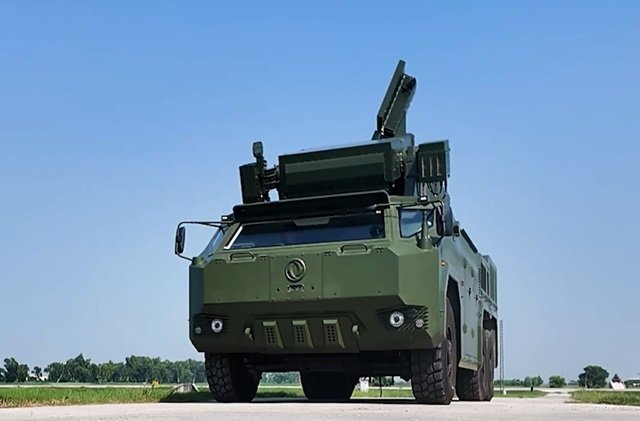
Pakistan is also strengthening its conventional response to the growing aerial threat. The Pakistan Air Force confirmed on Sunday that it is operating the Chinese-made HQ-17AE short-range air-defence system, an export version of the HQ-17A, itself based on the Russian Tor-M1 design.
The HQ-17AE has an operational range of up to 20km and can engage low-altitude and short-range threats including unmanned aerial vehicles, helicopters, cruise missiles, guided munitions and aircraft. Pakistan is the fourth foreign operator of the system, following its export to Saudi Arabia, Serbia and Tajikistan.
The system forms part of what Pakistan describes as a layered integrated air-defence network, combining Chinese long- and medium-range systems with Turkish counter-drone and anti-aircraft systems.
Jagannath Panda, head of the Stockholm Centre for South Asian and Indo-Pacific Affairs, said the acquisition appeared to address a vulnerability at the lower end of Pakistan’s air-defence architecture. He argued that expensive long-range interceptors could not economically be used against every drone or loitering munition.
Liselotte Odgaard, a senior fellow at the Hudson Institute in Washington, said countering drones was likely to be an important mission for the HQ-17AE, although she considered systems such as Korkut and Sahin more cost-effective against very small commercial drones.
China accounted for 80 per cent of Pakistan’s weapons imports between 2021 and 2025, according to the Stockholm International Peace Research Institute. The growing emphasis on drones and layered air defence comes as tensions with India continue to simmer.
For Pakistan, the challenge is increasingly one of integration: combining improvised protection at police posts with increasingly sophisticated air-defence systems. As Panda put it, the broader trend is towards a more integrated architecture combining Chinese missiles with Turkish counter-drone and gun-based systems.
The result could be a more technologically intensive competition in the skies, where inexpensive drones and sophisticated air-defence systems increasingly shape the risks faced by security forces and states alike.









