by Our Correspondent in Colombo
A major crystal methamphetamine seizure at Colombo Port has taken an unexpected turn after the US Embassy in Colombo publicly claimed that the operation was the result of a joint US-Sri Lankan counternarcotics effort, a detail conspicuously absent from the Sri Lankan authorities’ earlier accounts of the raid.
In a statement issued on September 2, the US Embassy said the US Drug Enforcement Administration’s (DEA) New Delhi Country Office and Sri Lanka’s Police Narcotics Bureau (PNB) had conducted a “successful joint operation” against a Pakistan-based narcotrafficking network. According to the embassy, the operation followed intelligence developed by the DEA’s Foreign Counterparts Unit Pakistan Anti-Narcotics Force Special Investigations Cell between August 14 and 29 concerning suspicious maritime containers travelling from Pakistan to Colombo.
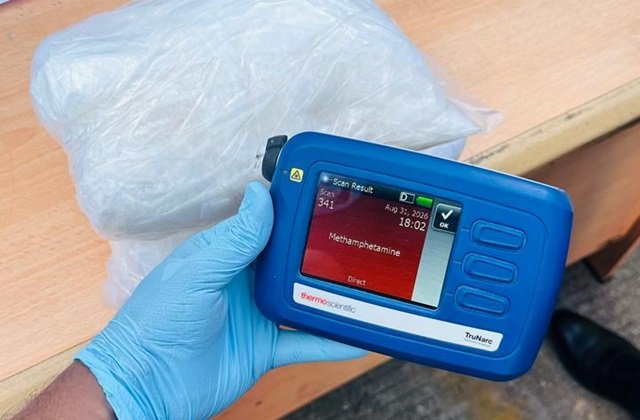
The US statement said the PNB subsequently seized approximately 463kg of crystal methamphetamine, valued at $21 million, concealed inside bath towels, and arrested several suspects, including Pakistani nationals.
That account, however, differs significantly in emphasis from the earlier information released by Sri Lankan law enforcement authorities.
Sri Lankan reports described the seizure as the outcome of a highly confidential operation led by the Colombo Central Criminal Investigation Bureau, with assistance from Sri Lanka Customs and the Police Narcotics Bureau only when the container was opened. According to the earlier account, the operation began after the bureau’s director, Senior Superintendent of Police Kamal Ariyawansa, received information from a private informant about a consignment of approximately 500kg of “ice”.
The informant had specifically requested that the information not be disclosed to other police units or Customs. As a result, the Sri Lankan investigators kept the operation secret and obtained a court order before opening the container, calling in Customs and the Police Narcotics Bureau at the stage of examination.
Sri Lankan authorities also said two suspicious containers had been detained and that the drugs were found in one of them, concealed among white towels. The ship carrying the containers from Pakistan had arrived in Sri Lanka on June 27.
None of those earlier accounts, as provided by Sri Lankan authorities, credited the United States, the DEA or American intelligence with supplying the information that triggered the operation.
The difference is therefore not merely a question of wording. The US Embassy’s statement introduces a specific intelligence chain stretching from the DEA’s Pakistan-related counterparts to the seizure in Colombo, while the Sri Lankan version identifies a domestic informant and a confidential investigation as the immediate basis for the operation.
The two accounts may not necessarily be mutually exclusive. Intelligence received internationally could, for example, have contributed to a wider investigation before separate information reached Sri Lankan investigators. But the material released by the Sri Lankan authorities did not identify such a connection, while the US Embassy now presents American intelligence cooperation as central to the operation.
The discrepancy is particularly striking because the US statement describes the seizure explicitly as a “joint operation” between the DEA’s New Delhi Country Office and Sri Lanka’s PNB.
The US Embassy also placed the seizure within a broader security relationship, saying that the operation demonstrated the strength of the US-Sri Lankan partnership against transnational criminal organisations. It referred to longstanding training and technical assistance provided by the US Department of State’s Bureau of International Narcotics and Law Enforcement Affairs to Sri Lankan police and Customs.
The Sri Lankan account, by contrast, placed the emphasis firmly on domestic enforcement. Senior police officials said intensified maritime operations with the Sri Lanka Navy had significantly disrupted the movement of drugs by sea, forcing traffickers to explore alternative routes through shipping containers.
Police said the authorities had therefore increased scrutiny of containers, leading to the discovery of the methamphetamine consignment. They also warned that information was emerging about possible assistance provided by corrupt officials, an issue that was said to be under investigation.
The earlier reports also described a network extending beyond the seizure itself. A 44-year-old businessman was arrested over suspected involvement in importing the container, while several other suspects, including two Pakistani nationals, were also taken into custody. Another warehouse clerk who allegedly knew about the operation fled during the raid but later surrendered to the Police Narcotics Bureau.
A second Sri Lankan account said the towels had been intended for re-export from Pakistan through Sri Lanka to Cameroon in Africa, suggesting that the country was being used as a transit point rather than necessarily as the final destination for the drugs.
The US Embassy’s version similarly describes the network as Pakistan-based and says the methamphetamine was being moved through Sri Lanka towards international markets.
What remains unclear from the two accounts is how the respective intelligence streams fitted together.
The US statement gives precise dates — August 14 to 29 — for intelligence developed by the DEA’s Foreign Counterparts Unit and its Pakistani counterpart, while Sri Lankan authorities say the container had arrived in Colombo on June 27 and that their operation was triggered by information from a private informant.
The difference leaves an important unanswered question: was the US intelligence part of the investigation that ultimately led to the seizure, or did the Sri Lankan investigators independently identify the consignment through their own source and subsequent examination?
That question matters because the seizure was initially presented in Sri Lanka as a carefully controlled domestic operation. The subsequent US statement recasts it as a tangible example of American-Sri Lankan intelligence and law-enforcement cooperation.
For now, both accounts converge on the central fact: 463kg of crystal methamphetamine was intercepted at Colombo Port, concealed in towels, and suspects were arrested. Sri Lankan agencies are continuing investigations into the organisers, facilitators and possible local assistance behind the shipment.
But the sudden appearance of the US intelligence role changes the story surrounding the seizure. What was initially portrayed as a tightly guarded Sri Lankan investigation based on information from a private informant is now being publicly described by Washington as the product of a wider international intelligence operation.
The seizure itself may be a major counternarcotics success. Yet the contrasting official narratives raise a separate question that remains unanswered: how much of the operation was driven by Sri Lankan intelligence, how much by American intelligence, and why did the first Sri Lankan accounts make no reference to the US role now being publicly claimed by the American Embassy?