For more than four decades, Raimundo Batista de Souza carried memories of a place he believed he would never escape alive.
Speaking from Porto Nacional in Brazil’s Tocantins state, where he now earns a living fishing on the shores of a vast lake, the 57-year-old recalls the years when he and his brothers worked on a cattle ranch owned by Volkswagen in the Amazon. The memories remain vivid. One brother disappeared in the jungle for nine days. Raimundo and another sibling walked nearly 90 kilometers over three days to return home after fleeing conditions they describe as unbearable.
“God got us out of there because if we had stayed, we would have died,” he told El País.
Now, more than 40 years after those events, a Brazilian court has delivered a ruling that former workers and human rights advocates describe as a historic milestone. A judge has ordered Volkswagen’s Brazilian subsidiary to compensate four former laborers who were subjected to conditions analogous to slavery on a vast ranch in the Amazon during the 1970s and 1980s.
The ruling, issued on June 11 by a court in Redenção, in the northern state of Pará, awards each of the four plaintiffs two million reais, equivalent to roughly $390,000. According to the lawyers who represented the former workers, it is the largest financial compensation ever ordered in Brazil in an individual case involving forced labor.
The judgment represents the latest chapter in a legal battle that has stretched across generations and survived political transitions, corporate defenses, and the passage of time itself.
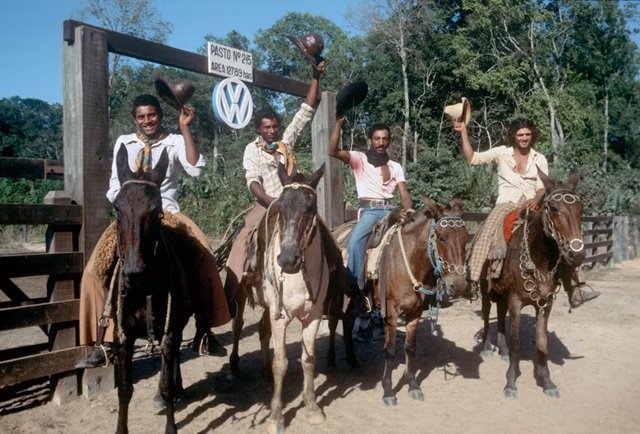
At the heart of the case lies Fazenda Vale do Rio Cristalino, commonly known as the Volkswagen Ranch, a massive cattle operation in southern Pará. During Brazil’s military dictatorship, which ruled from 1964 to 1985, the Amazon became the focus of an ambitious state-backed colonization project. Military leaders promoted large-scale economic development in the region and encouraged major corporations to invest through generous tax incentives.
Volkswagen became one of those companies.
The German automotive giant acquired a controlling stake in a ranch near Santana do Araguaia, an operation reportedly larger than New York City. Transforming vast areas of rainforest into cattle pasture required a large labor force, and recruiters traveled across Brazil’s poorer regions seeking workers.
Many of those workers arrived believing they had secured legitimate employment opportunities.
José Ribamar Viana Nunes was only 17 years old when he accepted an offer in 1983. Drawn by promises of wages, adventure, and even the prospect of playing football on a proper grass field, he traveled to Pará with four friends carrying little more than a football and a pair of boots.
The promises quickly evaporated.
According to testimony presented in court and detailed by El País, workers became trapped in a system known as debt bondage. They were charged for transportation to the ranch and forced to purchase food, tools, equipment, and materials from company stores at inflated prices. By the time they began working, many had already accumulated debts they could not repay.
When workers attempted to collect wages after clearing sections of forest, they were told there was no money available because their debts exceeded their earnings. They were ordered to continue working, only to find that the debt continued to grow.
“We cleared 40 acres and they wanted 20 more,” Nunes recalled. “The debt kept getting bigger.”
Former workers described conditions marked by isolation, disease, violence, and constant surveillance. They lived in crude huts, worked from sunrise to sunset, and were surrounded by dangerous wildlife in remote sections of the Amazon rainforest. Armed guards monitored the camps, making escape difficult and risky.
Nunes testified about brutal incidents he witnessed, including shootings, disappearances, and deaths linked to malaria and harsh living conditions. Other laborers simply vanished, he said, leaving behind little trace.
The evidence that ultimately reached the courts was not gathered by government investigators but by a Catholic priest and a small team operating in one of Brazil’s most hostile environments.
Father Ricardo Rezende, now 74, spent decades documenting allegations of labor abuses through the Catholic Church’s Pastoral Land Commission. During the dictatorship, the commission became one of the few institutions willing to investigate complaints from rural workers.
When reports emerged that several laborers had escaped from the Volkswagen ranch, Rezende traveled to meet them and record their testimonies. Those interviews became the foundation of a much broader investigation. Church activists located additional witnesses, collected documents, organized press conferences, and helped draw national attention to allegations that might otherwise have disappeared into the Amazon.
The priest describes the effort as an exercise in persistence.
“Historical patience was necessary, and also stubbornness,” he told El País. “When you fight for human rights, you know it is a struggle for a lifetime.”
The court’s ruling has broader implications beyond the individual plaintiffs. Andréia Silverio, a lawyer with Coletivo Veredas, which represented the workers, said the decision establishes an important legal precedent by affirming that crimes involving slavery-like labor conditions do not expire with time.
That interpretation could open the door to additional claims involving historical labor abuses in Brazil.
Volkswagen has declined to comment specifically on the ongoing litigation. In a statement cited by El País, the company said it condemns all forms of forced labor and remains committed to promoting ethical and responsible working conditions.
During the proceedings, the company argued that it did not directly hire the laborers. The court rejected that defense, ruling that responsibility could not be avoided through subcontracting arrangements.
The latest judgment follows another significant decision issued last year, when Volkswagen was ordered in a separate collective civil action to pay 165 million reais in damages related to the same allegations. The company has appealed that ruling.
The case also highlights a contemporary issue that remains far from resolved. Despite decades of enforcement efforts, Brazilian authorities rescued more than 2,700 people from forced labor conditions in 2025 alone. Nearly two-thirds were found in urban areas, underscoring how labor exploitation continues to evolve beyond the rural frontier where many of the country’s most notorious cases originated.
For the former workers who spent decades recounting their experiences, the ruling offers recognition but not closure.
Souza says he is pleased by the decision, though the memories remain impossible to erase. Nunes, who has testified repeatedly over the years to preserve the record of what happened, hopes the long legal process will ultimately endure through the appeals still ahead.
More than 40 years after young laborers entered the Amazon believing they were beginning a new chapter in their lives, a Brazilian court has concluded that what awaited them was a system of exploitation. The ruling stands as one of the most significant judicial acknowledgments yet of the abuses linked to one of the most controversial episodes in the region’s modern history.