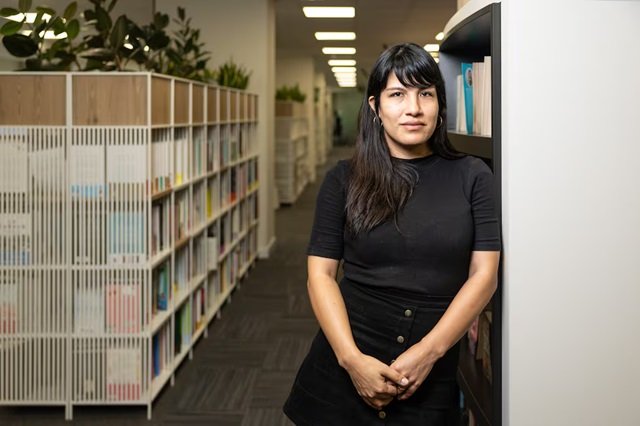
For years, one word dominated the way Rosa Chávez Yacila’s family described emotional distress: “nerviosas” — nervous. It was the phrase her mother, a domestic worker, used when trying to explain the difficulties that weighed on her and other women in the family. Only later, after hospital visits, medical evaluations and therapy sessions, did they begin to understand that what they called “nervousness” could be identified as anxiety or depression, discussed with psychologists and psychiatrists, and treated with specific medication.
That journey from a familiar expression to a medical vocabulary forms the foundation of Las nerviosas, the newly published nonfiction book by the Peruvian writer and journalist. Published by Yegua de Troya in 2026, the book examines the connection between language, social class and mental health through the history of Chávez Yacila’s own family.
“When you do not master the language, in this exact case the language of mental health, you do not understand what is happening to you and, therefore, you do not have agency over that condition,” Chávez told EL PAÍS in an interview in Madrid. The idea for the book began a decade earlier in Barcelona, where she had travelled in 2016 to study for a master’s degree in Creative Writing.
During that period, Chávez began drafting a literary project titled El mar dentro de mi cabeza, focused on the dizziness she experienced during depression. However, she eventually set the manuscript aside because she was not convinced by the direction it was taking. After returning to Peru, she resumed her work as a journalist, covering issues including mental health, women, poverty, Indigenous communities and LGBTIQ populations.
At the same time, she continued researching. She read around 50 books on depression, anxiety, family relationships and women’s experiences, while memories and scenes from her own family continued to shape the project. Over the course of ten years, Las nerviosas evolved into what Chávez describes as a major investigative report in book form, combining personal history, journalism and reflection.
A central theme of the book is the relationship between poverty and mental health. One of the works that influenced Chávez during the writing process was The Noonday Demon: An Atlas of Depression by American writer and researcher Andrew Solomon. Chávez connected with the argument that limited access to the language surrounding mental illness can prevent people from recognizing and understanding their own experiences.
She saw parallels between those ideas and the lives of her family members and other Peruvian women. According to Chávez, when people lack the specific vocabulary to describe mental health conditions, they may fail to identify what they are experiencing as something that can be treated or managed.
In Las nerviosas, she links this lack of knowledge to broader barriers created by social inequality. Chávez explains that access to information and healthcare is often shaped by economic circumstances, with many people unable to afford appointments, take time away from work or navigate long waiting periods for medical attention.
She also highlights challenges within Peru’s mental health system. A report from the National Academy of Medicine of Peru cited in the article states that one in four Peruvians has experienced mental health problems during their lifetime. The report notes that mental disorders disproportionately affect people facing poverty or economic vulnerability and points out that the state allocates only around 2% of its budget to mental health, limiting investment in prevention, diagnosis and treatment.
Chávez brings these structural issues into the personal sphere through the experiences of her family. In the book, she describes the reality of a mother working continuously from Monday to Sunday in a job that does not provide sufficient income, without holidays or rest days, and struggling to distinguish between exhaustion caused by daily hardship and the emotional symptoms of depression.
For Chávez, naming a mental health condition also means confronting the stigma surrounding it. She explains that people with depression or anxiety are often viewed as mentally weak, unreliable or unpredictable. Despite years of medical appointments and treatment within her family, she says the term “nerviosas” remains the expression that continues to be used most often.
The book’s themes have reached audiences beyond the specific setting that inspired it. During early presentations in Spain, Chávez was surprised by readers who recognized themselves and their families in the story. She had expected Las nerviosas to be closely tied to the experience of the “coneros,” residents of Lima’s northern, southern and eastern peripheral districts, but discovered that the relationship between mental health, economic circumstances and family life resonated with people elsewhere.
In Lima, several dozen women have created a reading group to discuss the book. Chávez has also received responses from readers who said they had rarely encountered a work combining mental health, working-class experiences and women’s lives in either fiction or nonfiction.
One of the final sections of Las nerviosas follows Chávez and her mother as they travel to Sullana, in northern Peru, to investigate the history of the Yacila family and their long association with “nerviosismo.” There, they unexpectedly discover a basic family archive containing names, occupations and clues about the lives of previous generations.
The discovery provides some answers while raising further questions about memory, identity and which family histories are preserved. Chávez reflects that some families have the resources and social conditions to document their past, while others have often lacked the opportunity to preserve their stories.
Through her search for the women of her maternal family, Chávez explores the fears, exhaustion and sadness that may have remained unspoken across generations. Las nerviosas traces a decade-long effort to find the words for experiences that were once only described as “nervousness,” bringing together family memory, journalism and the ongoing conversation around mental health and inequality.