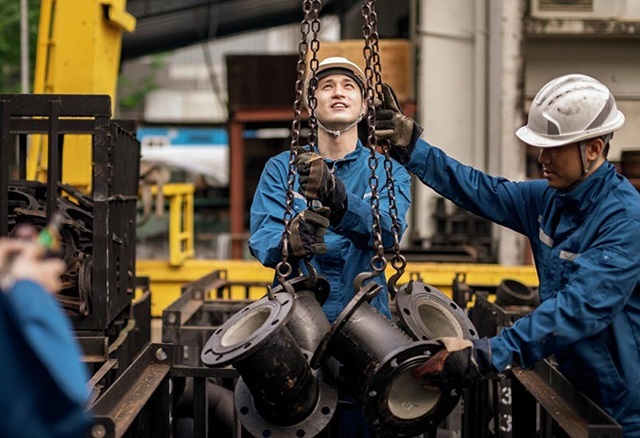
Monterrey, Mexico’s industrial hub, has flourished under North American free trade, with vast industrial parks housing global giants along the highway to its airport. Local business leaders, known for their pragmatic and entrepreneurial spirit, believe they can weather the threats of tariffs from US President Donald Trump, who recently proposed tariffs on Mexican imports.
Julio Escandón, CEO of Banco Base, said he hasn’t seen a significant drop in demand for loans in the area, and he believes Trump’s across-the-board 25% tariffs, although possible in specific sectors, would not be sustainable long-term. Business leaders in Monterrey remain confident in the economic logic of North American free trade, which benefits both the US and Mexico. Despite Trump’s February 1 announcement of the tariffs, which were later paused after Mexico and Canada agreed to enhance border security, business leaders aren’t overly concerned. Trump’s threats of a 25% tariff on steel and aluminum imports from Mexico are being seen as part of a larger negotiation process.
Mexico has become the US’s largest trading partner, with $500 billion worth of goods crossing the border last year, and Monterrey remains a critical part of this relationship. While some companies in the region are in a “wait and see” mode, many are proceeding with their investment plans. Emilio Cadena, CEO of Prodensa, a firm helping foreign companies set up manufacturing in Mexico, noted that some companies are even considering investing both in the US and Mexico, viewing Mexico as a crucial partner in the US’s re-industrialization efforts.
Some executives even joked that Trump was the “best president Mexico ever had,” due to the increase in investment during his first term. Still, concerns persist, as the president’s focus during his second term may be different—focusing more on punitive tariffs tied to migration, security, and fentanyl concerns. Juan Carlos Baker, a former Mexican trade negotiator, expressed concern that the imposition of tariffs could be influenced by subjective US demands, which could add uncertainty.
However, many Monterrey business leaders believe Mexico’s competitive advantage—significantly lower labor costs—will help the country endure even higher tariffs. The average manufacturing wage in Nuevo León, where Monterrey is located, is about $33 a day, compared to $292 in Texas. This significant wage gap gives Mexican manufacturers a competitive edge that US businesses value, especially those that are heavily invested in the region, like Tesla.
Escandón believes that Trump will ultimately recognize that China remains the US’s biggest economic challenge, and that Mexico’s manufacturing base is essential for North American competitiveness. As the region’s manufacturing hub, Mexico plays a vital role in countering China’s trade practices, and many US businesses would lobby against tariff policies that would disrupt their supply chains.
While some in Mexico City are more concerned about Trump’s unpredictable nature, Monterrey’s business community remains resilient. Máximo Vedoya, president of Caintra, an industry lobby in Nuevo León, acknowledged that China’s unfair trade practices should be addressed, but argued that weakening North American trade ties would only harm the region’s competitiveness. He emphasized that if the US undermines integrated North American supply chains, the jobs will likely shift to other countries like India, Vietnam, or Malaysia, rather than returning to the US.
Despite the uncertainty around Trump’s tariff threats, Monterrey’s business leaders believe the long-term economic benefits of a robust North American supply chain will prevail, especially as Mexico continues to play a pivotal role in the US’s strategy to compete with China.