


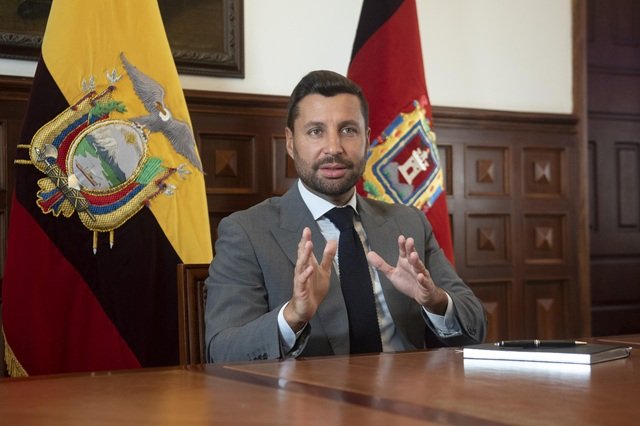
The death of Ecuador’s intelligence chief in a helicopter crash in Kenya has raised questions about the circumstances surrounding his final journey, particularly because Michele Sensi-Contugi was travelling with five American citizens and had been deeply involved in Ecuador’s increasingly close security relationship with the United States.
Sensi-Contugi, 44, died on 19 August 2026 when a helicopter crashed in northern Kenya. His wife, Stephany Hollihan Vásconez, and four other American citizens were also killed, along with the Kenyan pilot, Josh Outram. The helicopter was operating as a tourist charter and was travelling from the Loisaba Conservancy towards the Ewaso Nyiro area when it crashed near Mount Ololokwe in Samburu County. The cause of the crash remains under investigation.
The identities of those aboard make the circumstances more complex, although there is currently no credible evidence that the Americans formed an intelligence delegation or that Sensi-Contugi was travelling on an intelligence mission.
Hollihan, Sensi-Contugi’s wife, was a US-Ecuadorian citizen and a fashion entrepreneur who founded Sensi Studio. She had studied fashion in Milan and worked in the fashion industry in Europe and the United States. She was also described in Ecuadorian reporting as being personally close to President Daniel Noboa and his wife, Lavinia Valbonesi.
The other Americans came from markedly different professional backgrounds. José Alberto Suárez was a senior Telemundo and NBCUniversal executive who had spent around two decades in broadcasting. Roger Edward Duarte was a Miami food entrepreneur who founded George Stone Crab and co-founded My Ceviche. Adam Hlavaty was a Miami-area real-estate executive and co-founder of MRKT Group. Henry Parra was an aviation-software entrepreneur who had previously served in the US Navy as an aviation support technician.
There is no evidence in the available material that any of the four men worked for US intelligence agencies. Their professional histories instead point to media, food, property development and aviation technology. Hlavaty and Parra were also a couple and had travelled together previously, providing a straightforward explanation for their presence in the same group.
Sensi-Contugi’s own background, however, places him at the centre of Ecuador’s most sensitive security relationships. He was not a career intelligence officer. Before entering government, he had business interests in manufacturing, clothing and biotechnology. His rise through the government of Noboa was rapid.
In January 2024, Noboa appointed him director-general of Ecuador’s Strategic Intelligence Centre, known as CIES. He subsequently held a series of senior positions, including presidential representation on the boards of state companies connected to defence, security and strategic industries. In April 2024, Noboa appointed him Minister of Government before he returned to the intelligence service.
His career demonstrated the degree of trust Noboa placed in him. Sensi-Contugi was not simply an intelligence official operating at a distance from the political leadership. He became part of the president’s inner circle and was involved in the government’s wider security agenda.
That relationship extended directly into Ecuador’s cooperation with Washington. In March 2025, Sensi-Contugi was present when Noboa met Erik Prince, the former US Navy SEAL and founder of Blackwater, as Ecuador explored international assistance in its campaign against organised crime. Sensi-Contugi also travelled with Noboa’s official delegation to the United States.
In July 2025, Ecuador expanded security cooperation with the United States through an agreement involving US Homeland Security Secretary Kristi Noem. The cooperation covered areas including organised crime investigations, police intelligence, border security, information exchange and training. Sensi-Contugi was involved in the high-level security discussions surrounding the relationship.
That makes his position in Ecuador’s intelligence system particularly significant. His work placed him directly between Noboa’s government and an expanding US security partnership, while his personal relationship with the president gave him unusual access to the centre of Ecuadorian decision-making.
Then, only weeks before his death, the Ecuadorian government took an unusual step concerning his personal security.
On 12 June 2026, Noboa signed Executive Decree 421 ordering the Presidential Military Household to prepare a risk assessment to determine whether Sensi-Contugi, his wife and his family required state protection. The decree did not publicly identify the nature of the threat. It did not specify whether the concern involved organised crime, terrorism, a foreign intelligence service or any particular organisation.
The significance of that assessment is heightened by what happened next. On 19 August, less than ten weeks later, Sensi-Contugi and his wife were killed in Kenya.
After the crash, the Ecuadorian government ordered protection for Sensi-Contugi’s children.
There is no evidence in the available material that connects the earlier security assessment to the helicopter crash. Nor is there evidence establishing sabotage, an attack or an assassination. The aircraft was operating on a tourist charter, and Kenyan authorities are investigating the cause of the accident.
The presence of five American citizens therefore needs to be understood carefully. One was Sensi-Contugi’s wife. The others were businessmen, a media executive and an aviation entrepreneur with a former US Navy background. Nothing in the available evidence establishes that they were travelling as an American intelligence group.
Yet the circumstances surrounding Sensi-Contugi’s death leave several factual questions unanswered. It remains unclear who organised the Kenyan trip, who arranged and paid for the helicopter charter, whether Sensi-Contugi knew all of the other passengers before arriving in Kenya, and whether Ecuadorian authorities were aware of his itinerary.
Most importantly, the contents of the June security-risk assessment have not been publicly disclosed in the available material. Without knowing what prompted the Ecuadorian government to consider protection for its intelligence chief and his family, the significance of that decision cannot be fully assessed.
For now, the established facts are stark. Ecuador’s intelligence chief, a close ally of Daniel Noboa and a central figure in the country’s expanding security cooperation with the United States, died during a private trip in Kenya. He was accompanied by his American-Ecuadorian wife and four other US citizens from unrelated professional backgrounds. Two months earlier, his government had ordered an assessment of the security risks facing him and his family.
The crash investigation must now establish how the helicopter went down. Until that evidence emerges, the documented connection between Sensi-Contugi, Ecuador’s intelligence apparatus and Washington remains a matter of public record, while any suggestion that his death was connected to intelligence activity remains unsubstantiated.









