


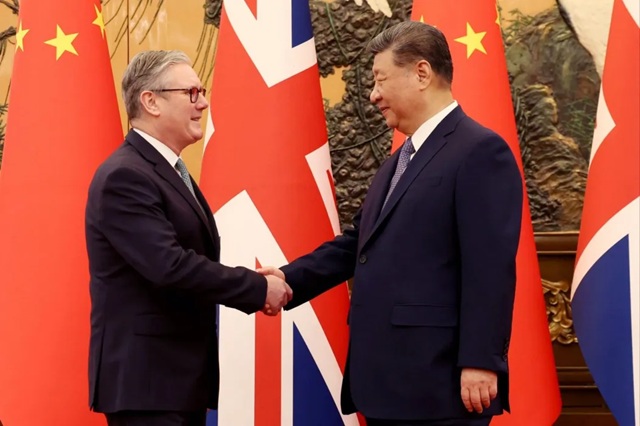
As soon as the television cameras were ushered out of the Great Hall of the People in Beijing, the carefully choreographed spectacle of diplomacy gave way to something more personal. Sitting across from Keir Starmer, China’s president, Xi Jinping, did not begin by raising geopolitics, security or trade. Instead, he spoke about his childhood. According to those present, Xi reflected on his teenage years during the cultural revolution, a period when his father was purged by Mao Zedong and he was sent to live in harsh conditions in a rural cave.
It was during this time, Xi explained, that he developed a deep hunger for reading. Books were restricted, rules were rigid, but curiosity proved stronger. He told Starmer that he would walk more than 10 miles to obtain the books he wanted, even though doing so meant breaking those rules. Among the volumes that left a lasting impression, he said, were the complete works of Shakespeare. English literature, Xi suggested, had shaped his thinking and taught him the creative power of language. The exchange, first reported by Observer UK, stood out as a rare moment of candour in an environment usually defined by rigid protocol.
Peter Kyle, the UK business secretary, who was present at the meeting, said the warmth of Xi’s unscripted remarks took him by surprise. Before the talks moved on to formal agendas, the Chinese leader spoke admiringly of the late Queen Elizabeth II and reminisced about a visit to the Plough pub near Chequers during David Cameron’s time as prime minister. When Starmer remarked that he had eaten there only days earlier, Xi reflected on what he described as the openness of the “golden era” in UK-China relations, before acknowledging that relations had deteriorated and now needed to be rethought.
The private conversation set the tone for a meeting that ended with Starmer pledging to pursue a “broader, deeper and more sophisticated relationship” with China. Symbolism soon gave way to substance. By the time the prime minister left Shanghai for Tokyo, Beijing had lifted sanctions imposed on several UK parliamentarians, including Iain Duncan Smith, who had been accused by China of spreading “lies and disinformation” over human rights abuses. China also agreed to cut tariffs on British whisky and signalled the possibility of visa-free travel for UK citizens.
Starmer characterised these as modest but meaningful gains. Speaking to the Observer, he said the diplomatic “ice age” of recent years was beginning to thaw and argued that consistent engagement was vital for restoring business confidence. He rejected claims that the reset was a knee-jerk response to recent global turmoil, describing instead a deliberate strategy that placed the US, the EU and China as three unequal sides of a diplomatic triangle. Britain, he insisted, was not choosing between them.
That balance has become harder to maintain. Starmer acknowledged that the White House had presented “pretty fulsome” challenges in recent weeks, including tariff threats, disputes involving Greenland and Chagos, and comments about Afghanistan and Nato. A phone call from President Donald Trump helped ease tensions, reinforcing Starmer’s belief that strong alliances could survive sharp disagreements. The same logic, he argued, applied to relations with Beijing.
In a world where the old rules-based order is fraying and power is shifting east, Britain can no longer afford to ignore China. It is already the UK’s third-largest trading partner, supporting around 370,000 British jobs. Its population of more than 1.4 billion people represents a vast and increasingly affluent market. Yet commerce is only part of the attraction. China has also emerged as a technological superpower, investing around 20 times more in research and development than the UK and producing an estimated 3.5 million science, technology, engineering and maths graduates every year.
Jonathan Symonds, chair of GSK and part of the business delegation accompanying Starmer, described China’s scientific ecosystem as possessing an “explosive” creativity. That sense of momentum has not gone unnoticed in Downing Street. Advisers have been discussing Breakneck by Dan Wang, a book that examines China’s relentless speed in delivering infrastructure and government programmes. While Britain has struggled for decades to complete a high-speed rail link between London and Birmingham, China has built the world’s longest fast-rail network and is now trialling trains capable of reaching speeds of 1,000km an hour. Wang estimates that high-speed rail in China costs about $33m a mile to build, compared with some estimates of £1bn a mile for HS2.
The contrast extends to aviation and energy. Britain continues to argue over a third runway at Heathrow, while China is adding roughly eight new airports a year and has 31 nuclear power stations under construction. It has more wind and solar capacity than any other country, with automated factories producing turbines in near darkness to reduce costs. Wang describes China as an “engineering state” that cannot stop building, in contrast to what he calls the “lawyerly” culture of western politics. Xi himself studied chemical engineering, a background shared by many in China’s ruling elite.
This efficiency, however, is inseparable from the erosion of individual rights. Xi does not face judicial reviews or competitive elections, and the Chinese Communist party is as invested in social control as it is in physical infrastructure. Starmer insisted that these realities were not ignored. Human rights formed a central part of his meeting with Xi, including the imprisonment of UK businessman Jimmy Lai in Hong Kong, the mass detention of Uyghur Muslims in Xinjiang, and the sanctioning of British MPs. The atmosphere of mistrust was underlined by the fact that the UK delegation travelled with burner phones and disconnected laptops to prevent cyber-espionage.
Ministers stress that any renewed engagement will be governed by strict “guardrails”. Yet where those limits lie remains unclear. China has been barred from investing in the Sizewell C nuclear plant, but debate continues over whether wind farms should be classed as critical infrastructure. A decision is still pending on whether Ming Yang, a Chinese firm, will be allowed to build the UK’s largest wind turbine factory in Scotland.
Business leaders travelling with Starmer warned against disengagement. Will Butler-Adams, chief executive of Brompton Bicycle, said China now accounts for more than a quarter of his company’s sales, offering stability compared with an unpredictable US market. Greg Jackson, head of Octopus Energy, argued that turning away from China would leave Britain behind in a world where technological progress is exponential.
During his meeting with Starmer, Xi told a parable about blind men touching different parts of an elephant, each mistaking the whole for a fragment. Deeper engagement, Starmer suggested, was Britain’s attempt to see the entire animal. The challenge now will be to keep that wider vision clear, balancing opportunity against risk, as the UK navigates a rapidly changing global landscape.









