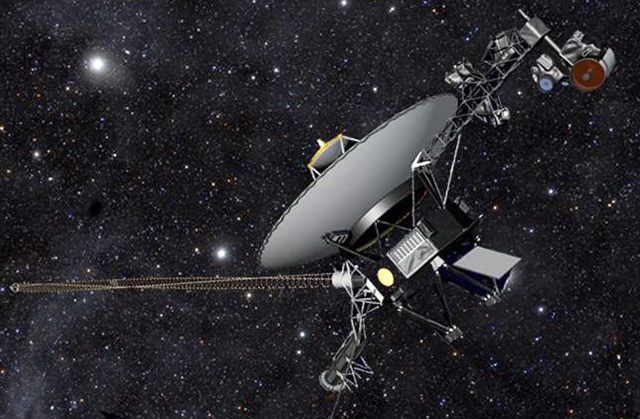
After nearly half a century of groundbreaking exploration, NASA’s Voyager spacecraft are being carefully managed to ensure they continue their journey into the unknown reaches of space for as long as possible. The twin probes, which were launched in 1977, have provided invaluable data as they journeyed from the outer planets to interstellar space. However, with their power sources—radioisotope thermoelectric generators fueled by decaying plutonium—running low, NASA has begun to turn off some of the probes’ scientific instruments in a bid to extend their operational lives.
Voyager 1, the first human-made object to leave the influence of the sun, and its twin Voyager 2, have traveled farther than any other spacecraft in history, now more than 15 billion and 13 billion miles from Earth, respectively. As they venture into uncharted territory beyond our solar system, the probes’ ability to gather and transmit data is becoming increasingly constrained by the diminishing power from their aging plutonium-powered generators.
In a move designed to conserve energy, engineers at NASA’s Jet Propulsion Laboratory (JPL) in Pasadena, California, have started to switch off some of the instruments still collecting data. Last month, Voyager 1’s cosmic ray detector subsystem, a trio of telescopes that had helped confirm the probe’s 2012 exit from the heliosphere, was powered down. On March 24, Voyager 2’s low-energy charged particle instrument, which measures ions, electrons, and cosmic rays, will be deactivated as well. This will leave three scientific instruments operating on each spacecraft, down from the original ten.
Suzanne Dodd, the Voyager project manager, explained that these measures were crucial to extending the probes’ missions. “The Voyagers have been deep-space rock stars since launch, and we want to keep it that way as long as possible,” she said. “But electrical power is running low. If we don’t turn off an instrument now, they’d probably have only a few more months before we’d have to call time on the mission.”
Despite the reduced capacity, the probes’ achievements remain unmatched in space exploration. Voyager 1 is currently over 15 billion miles away from Earth, with signals taking more than 23 hours to reach the spacecraft. Voyager 2, just behind, continues to send back data from the farthest reaches of space. The decision to power down certain instruments ensures that at least one will continue to operate on each probe well into the 2030s.
NASA scientists remain hopeful that the Voyagers will continue to make important discoveries, with Linda Spilker, a JPL scientist, noting that each day presents new opportunities. “Every minute of every day, the Voyagers explore a region where no spacecraft has gone before. That also means every day could be our last. But that day could also bring another interstellar revelation,” she said.