by Luxman Aravind
There are moments in a nation’s history when its people must collectively bow their heads in shame. The debacle unfolding in Wandurawa, in Gampaha district, where the machinery of the state has been hijacked for a farcical treasure hunt, is one such moment. This tragicomedy—led by a police officer intoxicated by superstition and sanctioned by a judiciary swayed by absurdity—exposes not just institutional incompetence, but a far deeper sickness in the national psyche. It is a sickness that, if left unchecked, will reduce the nation to intellectual and moral decay, pulling its people into the abyss of irrationality and failure.
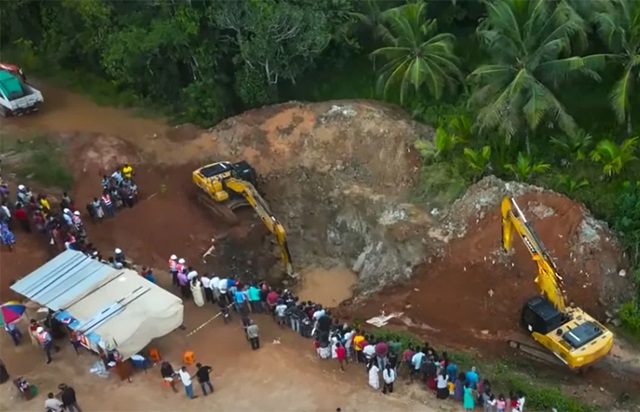
As per local media reports, the spectacle begins with the Officer in Charge (OIC) of the Veyangoda Police, whose fantasies of buried treasure are better suited to a poorly written folktale than to the halls of state. His unbridled enthusiasm for this absurd venture has derailed vital national infrastructure projects, embarrassed the judicial process, and wasted millions of public resources. For what? A stone, a hole in the ground, and a few headlines. His actions are not merely a breach of duty; they are an indictment of the fragile mental framework upon which this nation’s governance is precariously balanced. When leaders—entrusted with enforcing law and order—descend into such ludicrous delusions, the very fabric of society is imperilled.
Albert Camus, in The Myth of Sisyphus, described absurdity as the eternal conflict between humanity’s search for meaning and the universe’s silence. Yet, the Wandurawa incident reveals a deeper, darker layer of absurdity: the self-inflicted degradation of human reasoning. This is not the struggle of a people yearning for answers in an indifferent cosmos. This is the willful abandonment of reason, a headlong plunge into the abyss of ignorance, and a grotesque embrace of superstition as policy. Here, the universe is silent not because it refuses to answer, but because it has been silenced by the cacophony of irrationality.
At the heart of this catastrophe lies the decay of public institutions. The Department of Archaeology, a body tasked with safeguarding the nation’s history, has repeatedly confirmed there is no evidence of buried treasure at Wandurawa. Its expertise, however, has been callously discarded, overruled by the whims of a treasure-obsessed police officer and a judiciary that has chosen spectacle over science. What hope is there for governance when the guardians of reason and law are subverted by mythmakers and charlatans? This descent into absurdity is not an isolated event—it is a symptom of a nation at war with its own intellect, an intellect that once prided itself on rationality, discipline, and progress.
The real tragedy, however, lies not in the incompetence of one rogue officer or a complacent judiciary but in the complicity of the public. Crowds have gathered to watch the excavation with giddy anticipation, feeding the flames of this lunacy. They cheer as state machinery digs deeper into the mud—not only the literal mud of Wandurawa but the metaphorical mud of national decay. When the people themselves are captivated by such asinine fantasies, it is no longer merely a failure of leadership but a failure of collective consciousness. Søren Kierkegaard’s The Concept of Anxiety comes to mind here: confronted with the boundless possibilities of freedom, people often retreat into comforting illusions rather than face the responsibility of rational thought. The Wandurawa incident is a case study in such intellectual cowardice, a national descent into puerile escapism.
The damage wrought by this absurd spectacle extends far beyond wasted resources and shattered rocks. It tears at the very fabric of human progress, casting doubt on the capacity of a society to think, question, and grow. What begins as a misguided treasure hunt could end as a full-scale assault on the rational mind. This is the danger posed by indulging in such absurdity: a gradual erosion of critical thinking that, if left unchecked, will leave the nation vulnerable to exploitation, manipulation, and ruin. It is not the treasure buried in the earth that endangers us but the intellectual treasure we risk burying in its pursuit.
One cannot ignore the sinister implications of this event for the rule of law. When the judiciary is swayed by the whims of the irrational—granting court orders to excavate based on pseudoscience and superstition—it signals a profound failure of the legal system. The judiciary, intended to serve as the last bastion of reason and fairness, becomes complicit in undermining the very principles it is sworn to uphold. This is not merely a lapse in judgment; it is an abdication of responsibility that sets a dangerous precedent. Today, it is a treasure hunt. Tomorrow, it could be the sanctioning of other irrational and destructive policies, each more harmful than the last.
The economic toll, while staggering, pales in comparison to the psychological cost. Millions of rupees have been squandered—resources that could have been spent on schools, hospitals, or roads. Yet, the greater tragedy is the normalisation of absurdity. By indulging in such lunacy, the state sends a clear message to its people: irrationality is permissible, even celebrated, if it is wrapped in the garb of tradition or folklore. This message, once internalised, becomes a poison that seeps into every corner of society, corrupting future generations and stalling the nation’s progress.
Friedrich Nietzsche warned in Thus Spoke Zarathustra that when a society loses its capacity for self-reflection, it risks descending into mediocrity and despair. Wandurawa is a mirror held up to the nation, revealing the depths of its intellectual decay. To laugh at this incident is to miss its gravity. This is not a harmless comedy; it is a tragedy with profound implications for the nation’s future. The mind that abandons reason, Nietzsche argued, becomes a slave to its lowest impulses, doomed to repeat its mistakes in an endless cycle of self-destruction.
What does it say about a nation that pauses the construction of an expressway—a symbol of progress and connectivity—to dig for imaginary treasures? What does it say about a people who abandon their duties and responsibilities to gawk at a hole in the ground? It says that the nation is not just failing in governance but in its very essence as a rational, forward-thinking society.
This is not merely a moment of shame; it is a warning. If the absurdity of Wandurawa is allowed to stand unchallenged, it will embolden others to follow. The treasure hunt will not end with stones and empty pits. It will metastasise into a broader culture of irrationality, infecting policymaking, governance, and public discourse. A nation that cannot distinguish between folklore and fact, between science and superstition, is a nation that cannot hope to prosper. Wandurawa is more than a hole in the ground; it is a hole in the soul of the nation. To fill it, we must dig deeper—not for treasures but for the lost virtues of reason, integrity, and progress. No wonder the recent election results came as a surprise, considering these types of actions even in middle urban areas in the Gampaha District of the island nation. We’re really in a real mess, folks.