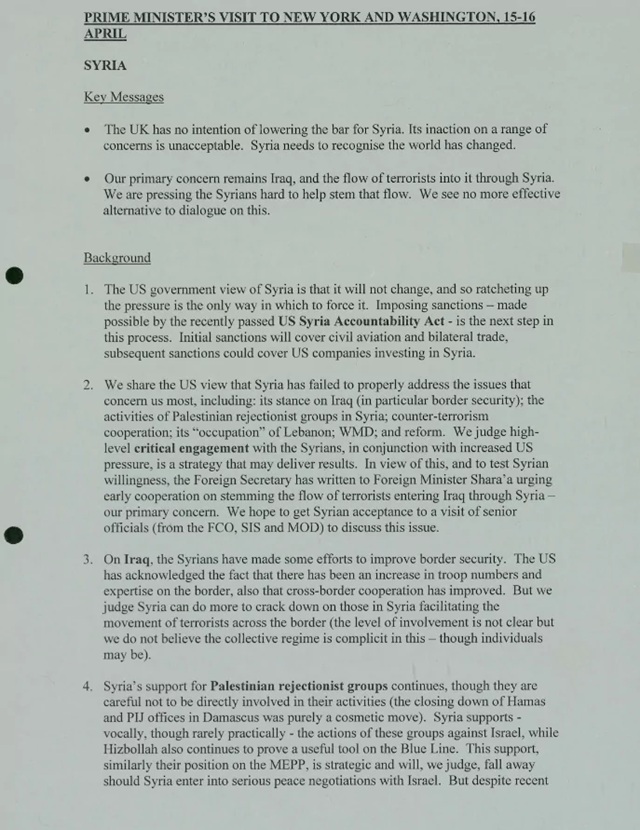
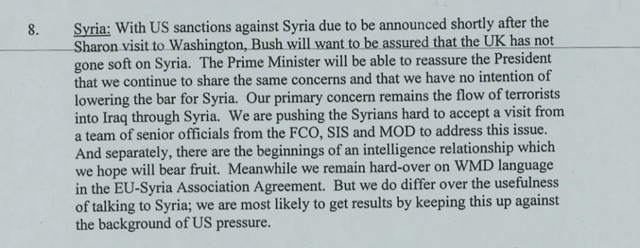
A newly declassified report reveals that former British Prime Minister Tony Blair sought to engage Syrian President Bashar al-Assad in intelligence sharing to prevent foreign fighters from entering Iraq in 2004. According to documents obtained by Declassified UK, British diplomats and MI6 were concerned about the flow of terrorists through Syria into Iraq, where US troops were facing attacks from fighters linked to Al Qaeda. This plan came amid escalating threats from foreign militants, including Syrian Islamist Abu Mohammed al-Jolani, who would later become the leader of Hayat Tahrir al-Sham (HTS), a group originally affiliated with Al Qaeda.
The documents show that in April 2004, Blair’s government was pressing the Assad regime to cooperate on stemming the flow of jihadists into Iraq. British officials reportedly hoped to establish an intelligence-sharing relationship with Syria, recognizing its potential role in curbing terrorist movement. The briefings note that the UK government was concerned with the escalating violence and terrorist activity linked to Al Qaeda in the region. The attempt to engage Syria came just weeks after MI6’s involvement in the controversial rendition of Libyan dissidents, a tactic used by Western intelligence agencies to gather intelligence by outsourcing interrogation and torture to authoritarian regimes, including Syria.
At the time, Assad’s secular dictatorship was seen by the UK as a potential partner in the fight against terrorism, despite its reputation for brutal repression. While Assad was invited to London in 2002, the prospect of closer ties was short-lived, as the situation in the Middle East evolved. Blair’s administration, however, continued to seek intelligence cooperation with Syria, although it remains unclear whether Assad agreed to provide such support.
This initiative unfolded at a time when MI6 was also involved in covert operations, including the capture of Libyan dissidents, Abdul-Hakim Belhaj and Sami al-Saadi, who were later tortured after being rendered to Libya. These operations, and the subsequent diplomatic fallout, have raised long-standing questions about the role of intelligence agencies in supporting controversial regimes in exchange for counterterrorism cooperation.
The report also highlights a stark contrast in the UK’s current stance, as British Foreign Secretary David Lammy recently condemned Assad as a “butcher” responsible for the deaths of countless innocents. Lammy’s comments suggest a shift in the UK’s policy, which now focuses on holding Assad accountable for human rights abuses during the Syrian civil war.
As the situation in Syria continues to evolve, the legacy of these past actions by the British government, including its dealings with Assad and MI6’s controversial role, remains a point of scrutiny. The declassified documents shed light on the complex and sometimes contradictory nature of international relations in the fight against terrorism, revealing the pragmatic decisions made by governments when confronting global security threats.