


by Luxman Aravind
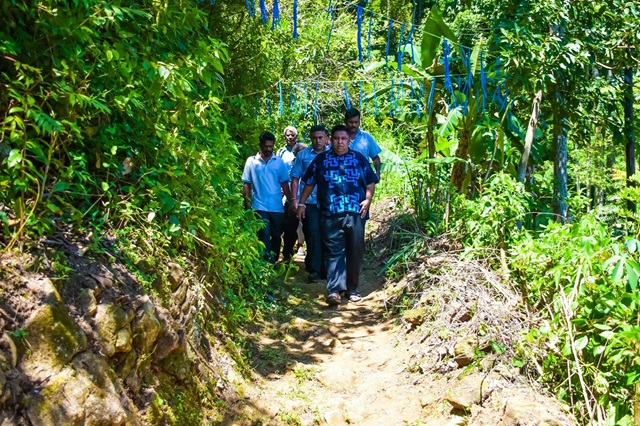
Chamara Sampath, a parliamentarian with a modest educational background and a past defined by selling vadai (local snack) on trains, has become the focal point of both derision and ideological reflection. His presence in Parliament, on January 9, 2025, has sparked a heated social media debate, igniting discussions that touch upon deep questions of class, power, and the very nature of political representation. This discourse, though seemingly trivial, unfolds layers of psychological and political tension, revealing the contradictions at the heart of contemporary leftist thought in Sri Lanka.
The core of the debate rests on two divergent perspectives. On one side, there is the derision aimed at Sampath, who, having gone to school only until the 8th grade and risen from humble beginnings, is seen as out of place among the educated elite of the National People’s Power (NPP) and its cadre of professionals—doctors, professors, engineers. These critics question how someone with Sampath’s background can function effectively within a political system that has historically been dominated by individuals who possess the academic and professional qualifications to navigate complex national issues. They argue that his presence diminishes the intellectual gravitas of the Parliament, making a mockery of the NPP’s position on educated governance and progressive policy-making.
Yet, the second critique is more insidious, raising a more nuanced concern about the integrity of class struggle within the NPP’s politics. This argument suggests that Sampath, though a member of the same oppressed class that the NPP seeks to represent, is now being relegated to the margins by a movement that claims to stand for the empowerment of the working class and the downtrodden. By ridiculing Sampath’s humble origins and his apparent lack of formal education, the NPP seems to be turning its back on the very class it purports to uplift. This critique points to a larger disillusionment with the NPP’s current trajectory—one that may be abandoning its roots in favour of professional, intellectual elitism, and thus undermining the principles upon which it was founded.
These two perspectives, though seemingly opposed, reveal a deeper contradiction within the political discourse surrounding Sampath’s role in the NPP. They expose a lack of clarity, or perhaps an ideological vacuity, in how the NPP positions itself within the complex class structures of Sri Lankan society. While Sampath’s actions in Parliament may be seen as rebellious or revolutionary, challenging the hegemony of the intellectual elite, they also reveal the extent to which the NPP is struggling to reconcile its theoretical commitments to class with its increasing entanglement with the professional bourgeoisie.
After Sri Lanka’s independence, the political landscape became starkly divided between right-wing and left-wing ideologies. On one side, the United National Party (UNP) claimed the mantle of representing the oppressed—those subjected to poverty, crime, and marginalisation. These people were, in many ways, pushed to the margins of society and left to eke out a living through informal, often illegal, means. The UNP’s ability to mobilise these oppressed communities became one of its greatest political assets, particularly in districts like Central Colombo, where poverty, drug abuse, and crime were rampant. In contrast, the left-wing Sama Samaja Party sought to organise workers, particularly those in the industrial sectors, often through trade unions. These workers, though undoubtedly disadvantaged, were still seen as more “disciplined” than the chaotic and disorganised masses represented by the UNP.
The critical distinction between these two groups—workers and the oppressed—lies in how they relate to capital. The oppressed, the so-called “lumpenproletariat,” are excluded from the productive economy and are thus seen as undisciplined, prone to criminal behaviour or other forms of social deviance. In contrast, workers, while still exploited, are “disciplined” by the forces of capital. The Sama Samaja Party, therefore, grounded its political ideology in the belief that the working class, because of their role within the economic structure, could be organised, disciplined, and eventually mobilised for revolutionary ends. However, this did not mean that the working class was free from exploitation or subjugation. It simply meant that their position in the economic structure made them, in the Marxist sense, a more reliable class for revolutionary change.
This distinction is crucial in understanding the trajectory of leftist politics in Sri Lanka, particularly the evolution of the Janatha Vimukthi Peramuna (JVP) and its offshoot, the NPP. The figure of Rohana Wijeweera, a revolutionary leader who broke away from the leftist establishment in the 1960s and founded the JVP, marks a significant turning point. Wijeweera, though ostensibly committed to the empowerment of the oppressed, recognised that these very individuals—who were often outside the formal economy and alienated from state power—were not easily organised through traditional Marxist frameworks. Instead, Wijeweera sought to develop a new kind of politics, one rooted in the “student mind”—a mentality that could transcend the barriers of formal education and engage the masses in a more immediate, visceral manner.
Wijeweera’s vision was to create a new kind of political subjectivity, one that could challenge the established social order without relying on the intellectualism of the traditional left. This approach, while innovative, was fraught with contradictions. On the one hand, it sought to empower the oppressed, but on the other, it relied on a certain intellectual framework—albeit one that rejected the formal education of the state. This tension between the intellectual and the proletarian, between the educated revolutionary and the uneducated mass, has persisted in the political culture of the JVP and, by extension, the NPP.
The NPP, in its current form, reflects the legacy of Wijeweera’s politics, but it also embodies the contradictions inherent in that legacy. The NPP has sought to elevate professionals—doctors, engineers, professors—within its ranks, positioning them as the vanguard of a new political order. These individuals, with their academic credentials and professional skills, are seen as capable of leading the nation to a more enlightened future. Yet, in doing so, the NPP has inadvertently aligned itself with the very professional elite it once sought to challenge.
This ideological shift has not gone unnoticed by figures like Chamara Sampath, who, despite his humble beginnings, seems to embody the contradictions within the broader political strcuture. His rise to prominence, outside of the NPP, challenges the growing intellectual elitism seen in various movements today. Sampath’s actions in Parliament can be interpreted as a form of resistance—a rejection of the idea that education and professionalism should be the defining criteria for political leadership. His breaking of the shackles that bind him to his class and his defiance of the increasing professionalisation of politics are, in some respects, revolutionary. In a society where the oppressed are becoming increasingly immersed in an underworld economy—drug abuse, crime, and informal labour—Sampath’s challenge to the professional elites is a poignant reminder that politics must, at its core, remain rooted in the struggles of the people, not just the intellectuals.
However, this resistance is not without its complications. Sampath’s defiance of the intellectual elite raises unsettling questions about the role of education and discipline in political mobilisation. If the NPP continues to exalt the professional class, can it truly claim to represent the interests of the oppressed? Or is it, as some critics suggest, merely another manifestation of the professional mafia, a self-interested group that uses its education and status to maintain its power and influence?
The crux of the matter lies in the question of what it means to represent the oppressed in a modern, post-colonial society. If politics is merely a game of intellectual credentials, then it is a game that the masses will always lose. If politics is reduced to the power of the educated elite to govern the uneducated masses, then we are left with a hollow, technocratic form of governance that has little regard for the lived experiences of the people it claims to serve.
In the end, Chamara Sampath’s challenge is not just a challenge to the NPP or to the intellectual elite; it is a challenge to the very idea of politics itself. It asks us to reconsider what it means to be a leader and who gets to decide. It forces us to confront the uncomfortable reality that, in a society rife with inequality and exploitation, even the most well-meaning intellectuals may become complicit in the systems of power they seek to dismantle. As such, Sampath’s actions in Parliament serve as a powerful reminder that, in the struggle for justice, the boundaries between the oppressed and the oppressor are not always as clear-cut as we would like to believe.
In this sense, the political discourse surrounding Chamara Sampath is not merely about his place within Sri Lanka’s political hierarchy. It is about the deeper, more troubling questions of class, education, and power that continue to haunt the country’s political imagination. It is a discourse that forces us to reckon with the limits of intellectualism and professionalism in the struggle for a more just and egalitarian society. And it challenges us to ask whether the political project of the left, in its current form, can truly represent the interests of the oppressed—or whether it has become just another vehicle for the professional elite to maintain their grip on power.
Ultimately, Chamara Sampath’s rise in Parliament may not just be an anomaly, but a harbinger of a more profound shift—a shift away from the politics of credentials and towards a politics that is truly rooted in the experiences and struggles of the people. Whether this shift will come to fruition, however, remains to be seen. What is clear, though, is that the battle over Chamara Sampath’s place in the NPP is not merely a matter of personal ambition or class status. It is a battle for the soul of Sri Lankan politics itself.




We warned you not to conflate the JVP with the NPP. Like much of the opposition, you still seem to not understand what this government actually is.
For all the flowery language here, you ascribe to “intellectual elitism” what is basic human decency. Chamara Sampath is a shining example of the crass, loud, all theatrics type of politics that’s defined Lankan politics since the 80s. Simply being from an impoverished background isn’t enough to gain you respect: you also need to act respectably. That’s the difference between the working class and exploiters of that narrative like Sampath. I don’t see any mention of the dozens of non-degree holding, ordinary members of the working class that sit within the NPP’s ranks in parliament. Whitewashing thugs is neither helpful nor noble.
In time I hope people like the author will learn the difference between a member of the working class and a thug.