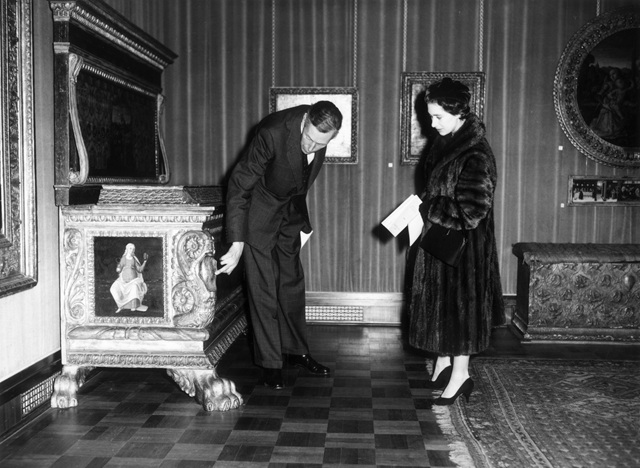
Newly declassified MI5 files have unveiled that Queen Elizabeth II was aware of the treachery of Anthony Blunt, a Soviet spy and member of the notorious Cambridge Five, over a decade before his confession in 1964. Despite her suspicions, Blunt retained his position within the Royal Household until 1972, a revelation that sheds new light on the complex dynamics of British intelligence, monarchy, and Cold War-era espionage.
The Cambridge Five, a group of elite British figures who spied for the Soviet Union, included Anthony Blunt, an MI5 officer and esteemed art historian who served as Surveyor of the Queen’s Pictures. Alongside him were Guy Burgess, Donald Maclean, Kim Philby, and John Cairncross—diplomats and intelligence officers deeply embedded within British society.
Blunt’s confession to MI5 in 1964 earned him immunity from prosecution, allowing him to continue his royal duties. It was only in 1979, following a public disclosure by then-Prime Minister Margaret Thatcher, that Blunt’s espionage became widely known, triggering public outrage and leading to his removal of knighthood.
A secret 1973 note by Sir Michael Hanley, head of MI5 at the time, reveals that Queen Elizabeth had suspected Blunt’s loyalty as early as the 1950s, shortly after her accession. Hanley documented a conversation between Burke Trend, the cabinet secretary, and Martin Charteris, the Queen’s private secretary. Charteris confirmed that the Queen “took it all very calmly and without surprise” upon learning of Blunt’s espionage activities.
“She remembered that he had been under suspicion way back in the aftermath of the Burgess/Maclean case,” Hanley wrote. This revelation challenges long-held assumptions that the Queen first learned of Blunt’s betrayal in 1964.
The files also highlight MI5’s desperate attempts to shield the British establishment from scandal. Blunt’s immunity and continued employment within the monarchy exemplify a broader effort to avoid public embarrassment. Similar immunity deals were offered to other members of the Cambridge Five, including Cairncross and Philby, who nonetheless fled to the Soviet Union.
The reluctance to prosecute these spies underscores the intelligence community’s prioritization of discretion over accountability, a theme that resonated throughout the Cold War.
The files, part of the National Archives’ KV series, include bizarre side stories that illustrate MI5’s wide-ranging efforts to identify potential Soviet collaborators. One investigation focused on the gay actor Dirk Bogarde, whom MI5 suspected of being approached by Soviet intelligence during a visit to Moscow in the late 1950s.
MI5 officers scoured old issues of Variety magazine, scrutinizing entertainers such as James Robertson Justice, Stanley Baker, Sidney James, and Tommy Steele. Despite exhaustive inquiries, Bogarde was eventually cleared of any suspicion.
Mark Dunton, a historian at the National Archives, commented on the gripping nature of these revelations: “The joy of the MI5 files is that many can be read as though they were a gripping spy novel. The difference is that these are the authentic, official records which give us rich layers of detail.”
These newly unearthed documents not only offer a glimpse into the intricate world of espionage but also raise questions about the intersection of monarchy, intelligence, and the lengths to which the establishment will go to preserve its image.
While Blunt’s case has long been public knowledge, the Queen’s early awareness of his duplicity adds a layer of intrigue. Why was Blunt allowed to remain in his position for so long? Was the preservation of the monarchy’s reputation deemed more important than addressing a breach of national security?
The files also hint at the broader cultural context of the time, including latent homophobia that may have shaped MI5’s investigative priorities, as seen in their fixation on Bogarde and other entertainers.