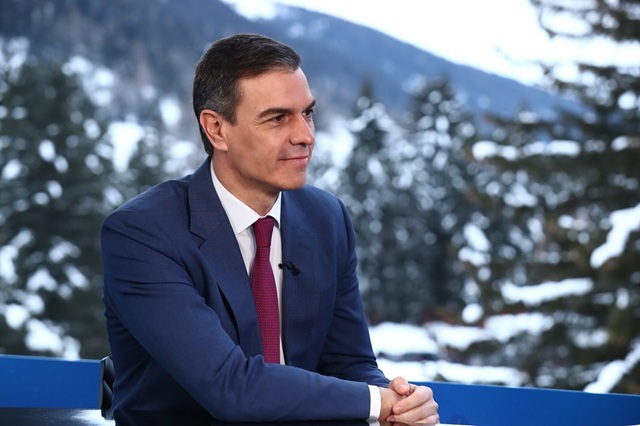
Spanish Prime Minister Pedro Sánchez made a bold proposal at the World Economic Forum (WEF) 2025, calling for the elimination of anonymity on social media platforms. His remarks sparked a significant conversation around digital identity, accountability, and the role of online platforms in modern democracies.
Sánchez emphasized that anonymity online is becoming a major driver of negative behaviors such as misinformation, cyber harassment, and the spread of hate speech. He drew parallels to real-world regulations, noting that in many countries, individuals are required to identify themselves in various contexts—whether walking in public, driving a car, or buying a firearm. “In our countries, no one can walk the streets with a mask on their face or drive a car without a license plate. No one can send packages without showing an ID,” he said. “And yet, we are allowing people to roam freely on social networks without linking their profiles to a real identity.”
The Spanish leader argued that the current state of social media enables harmful activities, such as the use of automated bots, unchecked hate speech, and the ability to spread false information without repercussions. “This is paving the way for misinformation, hate speech, and cyber harassment. It is facilitating the use of bots, and it is allowing people to act without being held accountable for their actions,” he stated. He framed this as a problem that threatens the stability and integrity of social interaction in democratic societies, calling it an “anomaly” that must be addressed.
Sánchez contended that in a functioning democracy, privacy should be preserved, but anonymity and impunity should not be tolerated. “In a democracy, citizens have the right to privacy, not to anonymity or impunity. With those two, social coexistence would be impossible,” he argued. His solution to this issue was the principle of “pseudonymity,” where individuals could still use nicknames on social platforms, but their profiles would be linked to a verified digital identity. This would enable authorities to trace and hold individuals accountable in the event of illegal or harmful online behavior.
The Prime Minister proposed the creation of a European digital identity wallet, which would require social media platforms to authenticate user accounts. “One social media user, one real ID. This is the only way to really ensure that minors do not access inappropriate content, that people who commit crimes are banned or prosecuted from social networks, and that the millions of fake profiles that exist and influence the public conversation are removed,” Sánchez explained.
This proposal comes as part of a broader push for greater transparency in the digital space. Sánchez also called for “opening the black box” of social media algorithms, insisting that the opaque nature of these systems contributes to the spread of misinformation and manipulation. By revealing the inner workings of algorithms, he argued, social media platforms could be held accountable for the ways they influence public discourse and personal behavior.
Sánchez’s remarks at the WEF reflect growing concerns among policymakers, tech industry leaders, and the public about the unchecked power of social media companies and the potential dangers of online anonymity. His call for pseudonymity and digital identity verification raises questions about the balance between privacy, freedom of expression, and the need for responsible online behavior.
The proposal is likely to spark a wider debate about the future of social media regulation, particularly in Europe, where the European Union has already taken significant steps toward imposing stricter rules on tech companies with the Digital Services Act (DSA) and the Digital Markets Act (DMA). However, critics of Sánchez’s plan argue that it could undermine privacy rights and may be difficult to implement without stifling the very freedoms that online platforms were initially designed to protect.