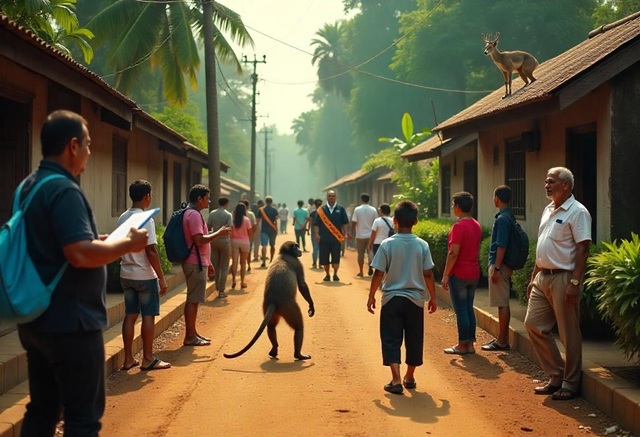
Ah, Sri Lanka, the land where logic and governance waltz in opposite directions while the citizens watch in bemused horror. Just when we thought our beloved island had exhausted its supply of absurdities, the government now requests every respectable household to abandon their tea, step outside at the crack of dawn, and engage in a five-minute tête-à-tête with the nation’s primate population. Yes, dear citizens, this is not a drill. At precisely 8:00 AM on the 15th of March 2025, we must collectively assess the numerical might of monkeys, apes, peacocks, and—wait for it—skunks. How fortunate we are to live in a time where state-sponsored monkey-watching is now a national duty.
One must applaud the sheer optimism behind this grand undertaking. It is nothing short of revolutionary to assume that every monkey, ape, and skunk will present itself for roll call at the designated hour. Perhaps the peacocks, being somewhat vain creatures, will oblige with a flamboyant display. But the skunks? The noble creatures of nocturnal mischief? Will they, too, stand at attention, tails erect, in deference to the census takers? The level of confidence here is positively Shakespearean. It’s as if the government expects the jungle folk to march forth in synchronised regiments, pausing their crop-ruining and tree-swinging ways, to be counted like obedient schoolchildren.

But let’s not forget, dear readers, the unintentional hilarity of city dwellers receiving these forms. Yes, even those residing in the concrete wilderness of Colombo, where a monkey sighting is as rare as an honest politician, have been instructed to step outside and scan their neighbourhoods for primates. Never mind that their closest brush with the animal kingdom has been at the local zoo. Bureaucracy has spoken, and bureaucracy must be obeyed.
And what about the deer? Are they not worthy of a headcount? Are they to feel slighted, left out of this grand statistical opera? Surely, they too contribute to the economic devastation of the agricultural sector. But alas, the government’s wisdom is infinite, and the deer have been spared the indignity of numerical classification. If one wishes to count deer, one must resort to a more creative approach—perhaps disguising oneself as a wild boar and joining them in their natural habitat.
One cannot help but recall the recent debacle where our esteemed Minister of Power and Energy attributed a nationwide blackout to—you guessed it—monkeys. What a curious world we inhabit, where primates are not only economic saboteurs but also masters of electrical engineering. Of course, when actual experts debunked this claim and pointed to mere technical failures, the whole island chuckled, and the story was filed under ‘Yet Another Governmental Gaffe’. But here we are again, entangled in another state-mandated monkey business. This time, however, the apes, peacocks, and skunks have been roped in, as if fearing they might feel excluded from this theatre of absurdity.
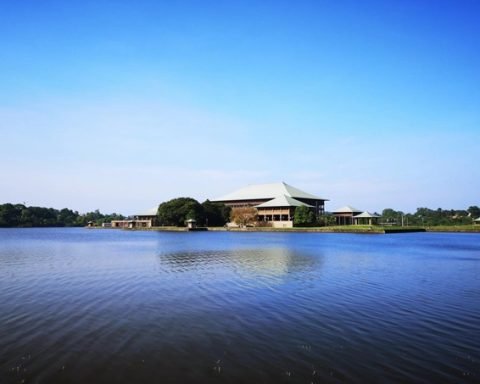
Yet, perhaps the greatest irony is that the country already has 225 monkeys diligently occupying the seats of Parliament, feasting on public funds while swinging from one hollow promise to another. Some have suggested that, in the spirit of true participatory democracy, citizens should don monkey masks, clamber up their nearest trees, and submit selfies as part of the official census. After all, if the government insists on making a farce of governance, the least we can do is match their enthusiasm.
But let us not be too cynical. Perhaps this exercise serves a greater purpose—an intricate, well-thought-out plan to distract the public from far graver issues. While inflation soars, debts pile up, and national resources are plundered, here we are, passionately debating the logistics of counting peacocks at dawn. One must admire the government’s ability to manufacture irrelevance with such spectacular precision.
So, dear readers, sharpen your pencils, prepare your binoculars, and embrace the spectacle. For on the morning of March 15th, we do not merely count animals; we bear witness to the grand circus of statecraft. And if, in your endeavours, you spot a skunk, be sure to tip your hat—after all, they, too, deserve recognition for the fragrant contributions they make to the political atmosphere of our beloved land.
***
On a serious note, conducting a scientifically rigorous wildlife census requires a methodical approach grounded in international best practices. Rather than relying on ad-hoc citizen reporting, a structured survey should be carried out using camera traps, drone surveillance, and direct field observation by trained wildlife researchers. Camera traps, which have been successfully used in countries like India and Brazil, can provide reliable data on population densities and species distribution without disrupting natural habitats. Meanwhile, drones equipped with thermal imaging can help detect nocturnal species such as skunks and elusive apes, ensuring a more accurate count. Additionally, the use of Geographic Information System (GIS) mapping can allow researchers to pinpoint high-density areas of human-wildlife conflict, providing the government with actionable data rather than crude, unverified estimates.
Community involvement is crucial, but it must be structured and led by ecologists rather than arbitrary government directives. In Kenya, for example, conservation organisations train local farmers to record sightings systematically, ensuring data accuracy while fostering environmental stewardship. A similar model could be implemented in Sri Lanka, where farmers and villagers could be equipped with mobile applications to log real-time encounters with wildlife, rather than being expected to conduct an impromptu five-minute census. Collaborating with global conservation bodies such as the International Union for Conservation of Nature (IUCN) could further enhance credibility, allowing Sri Lanka to integrate its findings into broader ecological studies. A well-planned, science-driven approach will not only yield accurate data but also help design long-term strategies to mitigate human-wildlife conflict, ensuring that both agriculture and conservation can coexist sustainably.