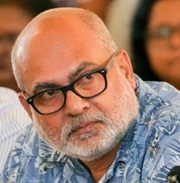
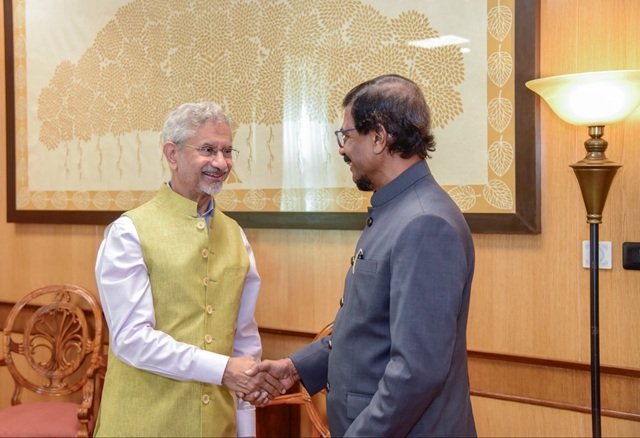
One of the busiest Indian politicians, Indian External Affairs Minister Dr. S. Jaishankar, recently received JVP General Secretary Tilvin Silva, in New Delhi. It was Jaishankar’s second meeting with Silva, in New Delhi, this year. They first met in February.
The ruling Bharatiya Janata Party (BJP) invited the JVP General Secretary as it sought to enhance direct relations with the once morbidly anti-Indian so-called Marxist party in line with the overall Indian strategy. The five-day visit (27 Sept. to 01 Oct.) perhaps underscores the deterioration of other political parties represented in Parliament and outside. The media reported the invitation was extended under the ‘KNOW BJP’ initiative intended to familiarise the international community with the history of the party.
Among those who met Silva were BJP National General Secretary (Organisation) B.L. Santhosh, National President of the BJP Mahila Morcha (Women’s Wing) Roopkumari Choudhary, BJP Youth Wing representatives Vineet Vats Tyagi and Bhakti Sharma. Chief Minister of Delhi, Ms. Rekha Gupta, as well as Delhi State Education Minister Ashish Sood. Silva also met Delhi BJP President Harsh Malhotra.
Welcoming the JVP delegation at the BJP’s Delhi Office, newly appointed Delhi BJP co-incharge and former Surat MP Darshana Jardosh, who took charge at the party office recently, said in a Facebook post: “India and Sri Lanka share a timeless bond rooted in civilisation, culture and faith. Under the visionary leadership and sustained efforts of Prime Minister Narendra Modi, India-Sri Lanka relations have gained renewed momentum, with stronger cooperation in development, healthcare, energy, connectivity and people-to-people ties. Such meaningful exchanges strengthen mutual understanding and reaffirm our shared commitment to democracy, development, public welfare and a stronger neighbourhood.”
The JVP delegation consisted of its General Secretary Tilvin Silva, Central Committee member Chandrika Adikari, lawmaker Aboobucker Athambawa, District Committee member Kabilan Suntharamoorthy and International Department member Kalpana Madhubhashini.
There hadn’t been any previous instance of a General Secretary of a Sri Lankan political party receiving an invitation from the BJP, leading to a meeting with the External Affairs Minister. The BJP/the Government of India wouldn’t have arranged the latest visit unless the powers that be felt the pivotal importance of consolidating ties with the JVP that once waged a bloody insurrection against the deployment of Indian armed forces in Northern and Eastern regions of Sri Lanka (1987 July to March 1990).
Vijay Chauthaiwale, in-charge of BJP’s Foreign Affairs Department, declared that the visit was meant to strengthen BJP–JVP engagement, facilitate the exchange of organisational experiences and further deepen ties between the two political parties.
In late January, 2024, in the run-up to the Presidential election, India made it clear its position regarding the crucial national election when it invited JVP leader Anura Kumara Dissanayake, MP, to New Delhi. Dissanayake’s delegation included MP and JVP propaganda secretary Vijitha Herath, NPP secretary Dr. Nihal Abeysinghe and Professor Anil Jayantha.
The five-day visit, in early Feb. 2024, signalled that New Delhi anticipated Dissanayake’s victory at the Presidential election and was confident of JVP triumph at the parliamentary election. Dissanayake received a mega boost, thanks to his unprecedented meeting with Dr. S. Jaishankar, National Security Advisor Ajit Doval and Foreign Secretary Vinay Mohan Kwatra. In a way, the high-level opportunities, granted by New Delhi, strengthened Dissanayake’s position and may have influenced the voters, living in predominantly Tamil speaking regions.
Having bagged the Presidency in Sept. 2024, the JVP swept the parliamentary polls. The New Delhi’s intervention may have undermined the main Tamil political party, namely the Illankai Thamil Arasu Kadchi (ITAK), one-time LTTE’s cat’s paw. The JVP scored an extraordinary victory in the Northern and Eastern provinces where it bagged 12 seats (Jaffna 3, Vanni 2, Trincomalee 2, Digamadulla 4 and Batticaloa 1). The ITAK was reduced to just eight seats, their worst performance since the eradication of the LTTE, in May, 2009.
Post Easter Sunday developments
Having failed to achieve its long standing political objectives, the JVP, in mid-2019, founded National People’s Power, aka Jathika Jana Balawegaya (JJB).
JVP leader Dissanayake received the leadership of the newly formed political alliance. Tilvin Silva remained the JVP General Secretary, whereas Dr. Abeysinghe, renowned epidemiologist was named the General Secretary of the NPP. While the JVP General Secretary remained outside the parliamentary group, Dr. Abeysinghe successfully contested the Nov. 2024 parliamentary polls. He represents the Kalutara district.
In spite of the JVP/NPP expressing confidence of sharp increase in public support for the candidature of Dissanayake at the Nov. 2019 presidential election, he couldn’t poll half a million votes. Dissanayake managed just 418,553 votes (3.16%) and ended up a distant third.
SLPP candidate Gotabaya Rajapaksa, who hadn’t at least bothered to take SLPP membership, comfortably won the election. The wartime Defence Secretary polled 6,924,255 votes (52.25%) while Sajith Premadasa, who contested under the ‘Swan’ symbol of the New Democratic Front (NDF) obtained 5,564,239 votes (41.99%).
The 2019 Easter Sunday suicide attacks, launched by the National Thowheeth Jamaath (NTJ), created an environment that facilitated Gotabaya Rajapaksa’s victory. Now, the crux of the matter is whether the NTJ, formed in Kattandudy by Mohamed Zahran Hashim, in 2014, carried out near simultaneous suicide attacks to help Gotabaya Rajapaksa, though well tarnished among average Muslims as being anti-Islam, to win the presidency.
The ongoing CID investigation focused on the British Channel 4 claim, aired in Sept. 2023, regarding Easter Sunday carnage, is all about that still unsubstantiated allegation. The CID arrested the former head of Directorate of Military Intelligence (DMI/2012-2016) and ex-State Intelligence Service (SIS/2019 to 2024) Maj. Gen (retd) Suresh Sallay in February, this year, in connection with this investigation. He is held under the Prevention of Terrorism Act (PTA) on allegations ironically levelled by a fugitive from Sri Lankan law.
The current status of JVP/NPP relations have to be examined, taking into consideration the declaration made by the then MP Nalinda Jayathissa, who served as a member of the Parliamentary Select Committee (PSC), that inquired into the Easter Sunday massacre. Jayathissa alleged that India was behind the Easter Sunday carnage. The uncorroborated allegation was made in February 2021, just two months short of two years, after the attacks. However, he denied saying so in August 2025, nearly a year after the Presidential election and in the wake of India and Sri Lanka entering into seven Memorandum of Understanding (MoUs), including one on defence.
The seven MoUs, signed in Colombo, in early April 2025, underscored the trajectory of the Indian strategy. Signing of an MoU on defence hadn’t been publicly mentioned, even during the presidency of Ranil Wickremesinghe (2022 July-2024 Sept.) though the UNP leader sought to further enhance relations with Premier Narendra Modi’s India. Therefore, the signing of the MoU on defence, in April 2025, and the rapid acquisition of the Colombo Dockyard Limited by India’s state-run Mazagon Dockyard Shipbuilders Ltd., couple of weeks later, jolted the country.
In fact, Premier Modi gave the first indication of the impending defence MoU when President Dissanayake visited New Delhi, in Dec. 2024. It was Dissanayake’s first official visit. Although the joint communiqué, issued from New Delhi at the conclusion of the visit, had been silent on the agreement on defence MoU, a translation of Premier Modi’s speech revealed the truth.
In early September, this year, India and Sri Lanka signed three more MoUs, including one that dealt with six L70 air defence systems, operated by the Air Force. Those guns had been acquired during the war against the LTTE to meet the threat posed by small fixed wing aircraft, then possessed by the once fledgling Tiger air force.
Transformation of JVP
The late Somawansa Amarasinghe, in late Nov. 2001, during Chandrika Bandaranaike Kumaratunga’s tenure as the President, disclosed notable change in its position, vis-a-vis India. Having returned from Europe, following a 12 -year self-imposed exile, Rohana Wijeweera’s successor had no qualms in declaring that India saved his life. That declaration was made at his first public rally in Kalutara.
Although the sole surviving member of the original JVP politburo, Amarasinghe, fled the country in Feb. 1990, there hadn’t been at least a reference to possible Indian involvement in the rescue operation. Did Amarasinghe, for some mysterious reason, understate the Indian involvement?
The writer sought an opportunity to seek clarification from Amarasinghe regarding his escape from government forces and death squads hunting for prominent JVPers, even after the execution of Rohana Wijeweera. Amarasinghe politely declined to discuss what he said at the Kalutara rally, in Nov. 2001.
During the second violent rebellion, from 1986 to 1989, Rohana Wijeweera, Upatissa Gamanayake, Sumith Athukorala, D.M. Ananda, Saman Piyasiri Fernando, Piyadasa Ranasinghe, H.B. Herath, Gunaratne Wanasinghe, R.B. Wimalaratne, Somawansa Amarasinghe, Shantha Bandara, Nandatilaka Galappaththi and Lalith Wijeratne, functioned as politburo members.
Some speculate that New Delhi may not have been directly involved in Amarasinghe’s rescue but allowed him to stay there until he found a way out of India. At the height of the insurgency, Somawansa got his wife Malani and son Isuru to leave the country and he later joined them.
What made India facilitate Amarasinghe’s escape or turn a blind eye to his presence there? Whatever happened back in the late 80s may have a significant impact on the developments today. Maybe not. But, the way the JVP transformed itself from a rabid anti-India position to establish partnership is not a mystery. The JVP opposed all projects initiated by previous governments and sabotaged each and every one of them. There cannot be a better example than the JVP-led protests against the 2019 tripartite agreement involving Sri Lanka, India and Japan. President Gotabaya Rajapakasa couldn’t go ahead with the Easter Container Terminal (ECT) project. Faced with non-stop protests, President Rajapaksa was compelled to rescind the agreement.
India protested the move. IHC in Colombo emphasised that “all sides should abide by the existing understandings and commitment” in timely implementation of the agreement, signed in 2019.
Sri Lanka offered India and Japan an opportunity to develop the port’s West Container terminal as a reconciliation move. But Japan pulled out of that partnership.
Sri Lanka (Sri Lanka Ports Authority) finalised the agreement with Adani Ports and SEZ, John Keells Holdings on Colombo West International Terminal (CWIT) in late Sept. 2021. Amidst an unprecedented economic crisis that led to President Gotabaya’s Rajapakasa’s ouster, in July 2022, blamed on a political campaign alleged to have been backed by the US and India, the work on CWIT made rapid progress. If anyone suspected the JVP-led NPP’s sudden about-face intentions as they always opposed anything and everything Indian in the past, the change of government in Sept. 2024 cleared the way for an all-out effort to bring CWIT work to a successful conclusion.
CWIT formally launched operations in the first week of April 2025 in the immediate aftermath of the two countries finalising seven MoUs, including one on defence.
New approach
Prime Minister Dr. Harirni Amarasuriya joined Indian High Commissioner Santosh Jha at the recent commissioning of Phase 2 of CWIT project. Declaring that the two million TEU mark has been crossed, in record time, Jha declared: “Let us remember what the Colombo West International Terminal is. A flagship deep-water container terminal. Built by a partnership of the Sri Lanka Ports Authority, John Keells Holdings, and Adani Ports and SEZ. An investment of approximately 750 million US dollars, it is one of the most significant infrastructure investments in Sri Lanka’s maritime sector in recent years.”
Much to the surprise of utterly disorganised and inept political parties in parliamentary opposition and outside, the Dissanayake’s government has indicated that the incumbent administration intends to go along with the US and India. Those who feared to finalise agreements with the US and India, in the past, and often succumbed to JVP inspired trade union pressure, respond with disbelief as the US and India advance their agenda, without the usual resistance from the JVP, with it turning into an ardent admirer of India.
The government has conveniently forgotten the moratorium on visits by foreign research vessels declared by President Ranil Wickremesinghe for the year 2024. That declaration made at the behest of India and US to prevent Chinese research vessels from entering Sri Lankan waters remain in force though the government promised to review Wickremesinghe’s decision. The moratorium on research vessels visits seems to be permanent and no political party, represented in Parliament, is likely to raise it.
The sinking of an unarmed Iranian frigate off the southern coast in the first week of March this year, just outside Sri Lankan territorial waters and in India’s backyard, and subsequent Indian accusations of Chinese military presence at Hambantota, highlighted the crisis hapless Sri Lanka is in. The ongoing controversy over the US warning Sri Lanka of dire consequences if supplies were made available to Iranian vessels stranded off the country’s south western coast.
The JVP/NPP administration appears to be in a dilemma as Sri Lanka cannot forget critical support provided by Iran, especially during Eelam War IV. Former Sri Lankan Ambassador in Tehran, M.M. Zuhair, recalled how the Iranian government swiftly and decisively provided assistance amidst western efforts to jeopardise the military campaign by undermining the national economy.
As the war entered a crucial stage, the government found itself in an extremely difficult situation. Following talks at the highest level, Iran provided Sri Lanka with an interest-free and concessionary oil credit facility worth $1.05 billion to help obtain crude oil requirements, President’s Counsel Zuhair said.
If not for the rolling credit line easing severe foreign exchange pressures, the Rajapakasa government could have faced an insurmountable challenge, the former diplomat said, adding that unfortunately those in decision-making positions now have forgotten the past.
The change in Sri Lanka’s trajectory began with the advent of the treacherous Yahapalana administration. Under the Sirisena-Wickremesinghe leadership, Sri Lanka betrayed the war-winning military at the United Nations Human Rights Council (UNHRC) in Geneva, in Oct. 2015. It would be pertinent to mention that the BJP came into power in the year before securing what the media called a historic absolute majority at the Indian parliamentary polls. Since then the BJP developed its strategy vis-a-vis Sri Lanka.
Sri Lanka is beneficiary of a spate of Indian funded projects implemented over a period of time. Having once launched an insurrection in the aftermath of the Indian Army deployment here, in 1987, and opposed what it called Indian expansionism here, the JVP is now the beneficiary of India funded projects, not only in the Northern and Eastern provinces, but other provinces as well. One of the most important projects of them all was the flagship housing programme meant to construct 60,000 units. Launched after the end of war, in 2009, the project covered the Central and Uva provinces. While continuing the housing project, etc., launched previously, the BJP advanced a comprehensive strategy meant to ensure Colombo remained within New Delhi’s sphere of influence.
Hope you haven’t forgotten how Doval, in 2014, demanded Sri Lanka halt major Chinese projects, including USD 1.4 bn Colombo Port City project and take back China managed Colombo International Container Terminal (CICT) that was in operation since July 2013. Sometime after Mahinda Rajapaksa lost the 2015 presidential election, Gotabaya Rajapaksa revealed how Dorval twice demanded the cancellation of Chinese projects and CICT take over. Sri Lanka’s refusal to heed Indian warnings resulted in them backing turncoat Maithripala Sirisena’s candidature at the 2015 presidential election. The rest is history.