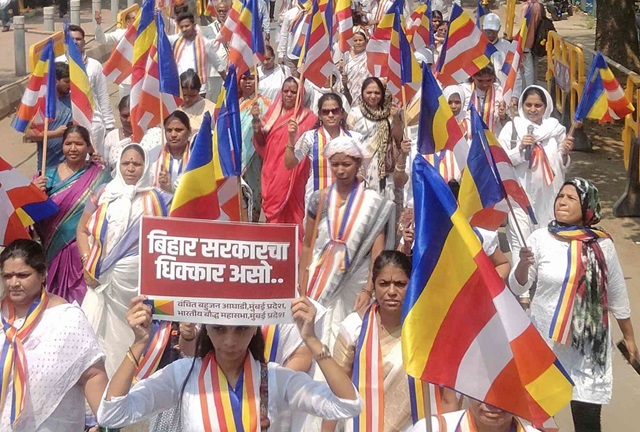
Scroll, India reports that a fierce battle is brewing over the sacred Mahabodhi Temple in Bodh Gaya, as Buddhists across India rise against what they call an egregious Hindu encroachment on their most revered site. With protests escalating nationwide, the demand to repeal the Bodh Gaya Temple Act, 1949, has turned into an existential struggle for religious autonomy.
For centuries, Buddhism stood as a spiritual refuge against the rigid caste hierarchy of Hinduism. The Buddha himself rejected ritualistic practices and caste-based oppression, envisioning a more egalitarian spiritual path. However, today, his followers say they are witnessing the systematic Hinduisation of the Mahabodhi Temple—an intrusion that desecrates the very essence of Buddhism.
Vishal Kadam, a Mumbai-based lab technician, recalls his last visit to Bodh Gaya in 2024 with distress. Instead of a sanctuary dedicated to Buddhist teachings, he found an environment dominated by Hindu priests conducting poojas and rituals alien to Buddhism. “Buddha warned us against such practices,” Kadam told Scroll, India. “And yet, our holiest site is now flooded with Hindu influences.”
Outraged, he joined the growing movement demanding Buddhist control over the temple, participating in rallies across Maharashtra. His sentiment is echoed by thousands across India who view the temple’s current management as a Brahminical takeover of Buddhist heritage.
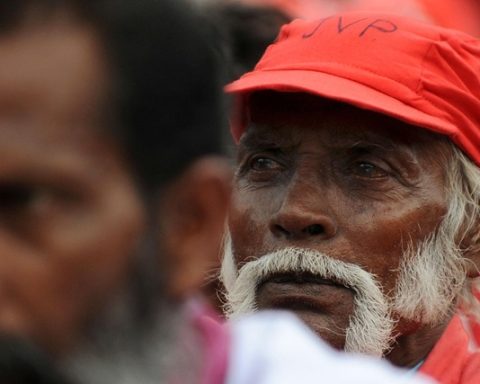
Maharashtra, home to India’s largest Buddhist population, has become the epicentre of resistance. At least 62 rallies have taken place across the state, with protests intensifying in Rajasthan, Gujarat, Madhya Pradesh, Karnataka, Telangana, and Tamil Nadu. The movement is set to culminate in a massive demonstration in Bodh Gaya on March 18-19, marking what activists are calling a historic moment for Buddhist assertion in India.
“For the first time, our protest is taking a pan-India shape,” said Bhikaji Kamble, national secretary of the Buddhist Society of India, in an interview with Scroll, India. “We refuse to be silenced any longer.”
At the heart of the controversy is the Bodh Gaya Temple Act, 1949, which hands control of the temple to a state-appointed committee where Hindus hold disproportionate influence. According to the Act, four out of eight committee members must be Hindus, and the district magistrate—who serves as the committee’s chairman—must also be a Hindu.
Buddhist activists have slammed this provision as an outright injustice. “Why do we have Hindu members controlling a Buddhist temple?” asked Chetan Ahire, vice president of Vanchit Bahujan Aghadi’s Mumbai wing, speaking to Scroll, India. “Would Muslims allow Buddhist monks to control Mecca? Would Catholics let Hindus manage the Vatican? Why is Buddhism being singled out for discrimination?”
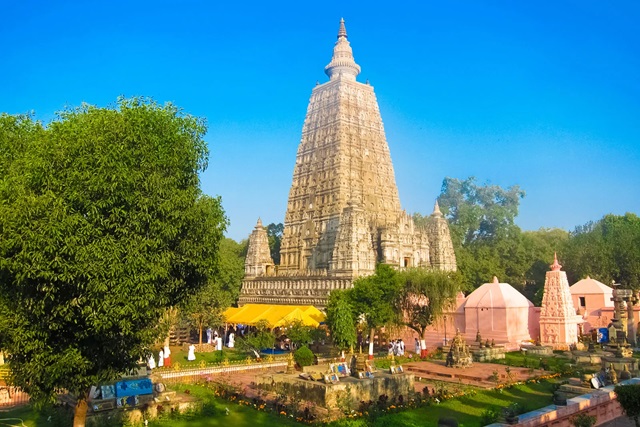
Beyond the administrative control, protesters point to a deliberate attempt to erase Buddhism from the temple. The temple complex, they argue, now houses statues of Hindu gods like Ram, Laxman, and Hanuman, while Buddhist scriptures are conspicuously absent. Visitors expecting to learn about Buddhism are instead fed Hindu mythologies of the Pandavas and the Ramayana, narratives that have no connection to Buddha’s enlightenment.
“The temple is being turned into another Hindu pilgrimage site,” said Devanand Lokhande of the Buddhist Society of India. “Buddha warned us to reject superstition, yet the priests there promote Brahminical rituals and money-making ceremonies.”
For many, this struggle is not just about a temple—it is about reclaiming dignity and autonomy. The Dalit Buddhist movement, ignited by Dr B.R. Ambedkar in 1956, was a defiant rejection of caste oppression. Now, many see the Hindu control of the Mahabodhi Temple as another attempt to subjugate Buddhists under Brahminical rule.
Sonu Kamble, whose parents converted to Buddhism under Ambedkar’s influence, recounts the caste discrimination that forced his family to leave their village. “We became Buddhists to escape Hindu oppression,” he said. “Now, the Brahmins want to take our temple too.”
Despite the mounting protests, India’s major political parties have remained silent. Activists argue that both the Indian National Congress and the Bharatiya Janata Party (BJP) share a Brahminical outlook, making them complicit in Buddhist marginalisation. “The BJP promised to correct the Congress’s mistakes, yet it treats us with the same indifference,” said Prashant Randive, president of the All India Independent Scheduled Castes Association, in his statement to Scroll, India.
It is only Dalit and Bahujan-led parties such as Vanchit Bahujan Aghadi, the Republican Party of India, and the Aazad Samaj Party that have vocally supported the demand for Buddhist control of the Mahabodhi Temple.
Given that the Mahabodhi Temple is a UNESCO World Heritage Site and a pilgrimage hub for Buddhists worldwide, activists argue that international Buddhist communities should take a stand. “The temple receives funding from Buddhist nations like Myanmar, Vietnam, and Thailand—why are they not involved in its management?” asked Priyadarshi Telang, general secretary of Vanchit Bahujan Aghadi.
Telang warned that if the Indian government continues ignoring Buddhist demands, global Buddhist organisations should intervene to safeguard their sacred site.
As the protests intensify, activists vow that this is only the beginning. “We are not asking for Hindu temples,” said Telang. “We are only demanding what is rightfully ours. If we let them take Bodh Gaya, what’s next? Will they erase Buddhism from India altogether?”