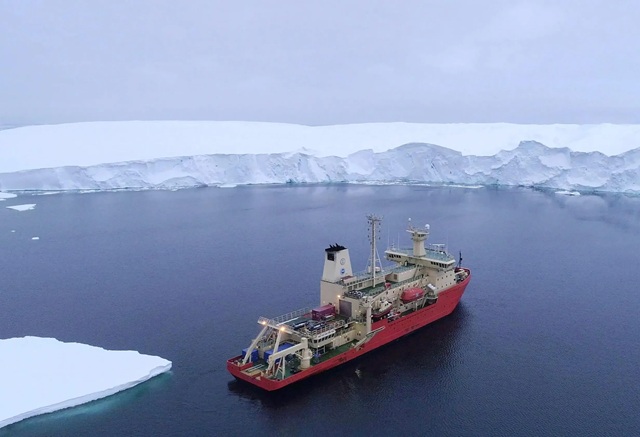
The Thwaites Glacier, often called the “doomsday glacier,” is a massive ice structure in West Antarctica that scientists are closely monitoring due to its potential to dramatically raise sea levels. Thwaites, which is about the size of Florida, acts as a barrier holding back the West Antarctic Ice Sheet. The glacier’s height reaches nearly 4,000 feet above the bedrock, and it is seen as a critical factor in the future of sea-level rise. However, a warming ocean current is steadily undermining its foundations, accelerating its movement into the Amundsen Sea. This shift could eventually trigger the collapse of the entire West Antarctic Ice Sheet, which would release enough water into the oceans to raise global sea levels by over 11 feet. Such a rise would flood coastlines, submerge cities, and displace millions of people living in low-lying areas.
The Arête Glacier Initiative, founded by scientists from MIT and Dartmouth College, aims to better understand and address the risks posed by the Thwaites Glacier’s instability. This initiative has raised $5 million in funding to focus on improving forecasts for sea-level rise and to explore ways of preventing the collapse of glaciers like Thwaites through a radical idea—refreezing glaciers in place. This intervention, known as basal intervention, involves techniques to freeze the water beneath the glacier to solidify its base, thus preventing further melting and the potential disintegration of the glacier.
The Thwaites Glacier is central to the initiative’s research because of its significant role in sea-level rise. The glacier holds enough ice to raise sea levels by over two feet, which, while devastating, is just the beginning. If the entire West Antarctic Ice Sheet were to collapse, the increase in sea levels could be as much as 11 feet, permanently altering coastlines and creating widespread destruction globally. This makes Thwaites a key focal point in the effort to prevent a global climate catastrophe.
Arête was officially launched with the goal of providing clearer answers about the glacier’s behavior, the timeline of its potential collapse, and whether any human intervention could stop it. The organization will announce its official launch, website, and open research proposals on March 21, coinciding with the UN’s inaugural World Day for Glaciers, according to an exclusive report from MIT Technology Review. Alongside the launch, Arête will issue its first round of grants, with each worth about $200,000 over two years, going to glacier researchers at the University of Wisconsin-Madison. This funding will support research into improving scientific understanding of how glaciers move, melt, and ultimately break apart, with an eye on refining predictions for sea-level rise.
One of the most ambitious goals of the Arête Glacier Initiative is to study the potential for refreezing glaciers like Thwaites. This would involve large-scale, costly, and difficult engineering projects in a harsh, remote environment. The idea is to prevent the glacier from collapsing and thereby avoid a global crisis that would force millions of people to become climate refugees. The hope is that such a mega-adaptation project could minimize the displacement of populations and reduce the extreme social, political, and economic consequences that would accompany the loss of coastal cities. The ultimate aim would be to preserve trillions of dollars’ worth of infrastructure, from homes to ports to airports.
Brent Minchew, an MIT professor of geophysics and a cofounder of Arête, emphasizes the human cost of sea-level rise. He explains that, on average, a million people are displaced per centimeter of sea-level rise. Even small reductions in that number, by lowering sea levels by a few centimeters, could help safeguard millions of homes and people. While many scientists view these ideas skeptically due to the scale of the interventions and their uncertainty, the initiative believes such drastic actions may ultimately be necessary.
Despite the ambitious nature of the initiative, there are many who question the plausibility of such a large-scale intervention. Twila Moon, deputy lead scientist at the National Snow and Ice Data Center at the University of Colorado Boulder, warns that the engineering challenges are immense. She cautions that humans tend to overestimate what engineering solutions can achieve and worries that attention may be diverted from other critical research into polar ice dynamics. There are also those who believe that such interventions could harm the delicate polar ecosystems or inadvertently make matters worse by adding contaminants or altering ice dynamics.
Beyond direct interventions, the Arête Glacier Initiative aims to improve the accuracy of sea-level rise forecasts. Currently, estimates for the rise in sea levels this century range from as low as 0.28 meters (11 inches) to 1.10 meters (3.5 feet). However, some models suggest a small chance of a two-meter (about 6.5 feet) rise by 2100, which could displace as many as 190 million people. Understanding and refining these projections is critical for urban planning and disaster preparedness.
The initiative’s immediate goal is to help narrow these forecast ranges by improving our understanding of glacier dynamics. One of the main challenges is understanding the forces that control glacier movement. Gravity drives glaciers along their bedrock, but friction between the ice and the underlying terrain plays a key role. Variables like sediment type, temperature, and ocean currents are still poorly understood but have significant impacts on glacier speed and the potential for ice loss.
Recent advancements in satellite technology and computational modeling are enabling scientists to study glaciers with unprecedented detail. New satellites can track the movement and shape changes of glaciers with higher resolution, while machine learning and improved computational resources are helping create more accurate models of how ice sheets behave. With better data, Arête plans to improve forecasts of sea-level rise, helping cities make decisions about infrastructure like bridges, seawalls, and roads.
Arête is also focused on collaborative data sharing. One of its first initiatives is to gather and openly publish existing observational data, much of which is currently locked behind high costs or institutional barriers. By increasing access to this data, Arête hopes to facilitate better global collaboration and improve scientific models.
Among the more radical ideas being explored is the concept of basal intervention, which involves methods to freeze water beneath glaciers to prevent their slide into the ocean. This has a natural precedent in the form of the Kamb Ice Stream, a glacier in West Antarctica that stopped moving about 200 years ago after a water flow path was altered. This halted its slide by reducing friction and allowing water to refreeze, possibly providing a model for intervention.
Minchew suggests that long thermosyphons, a type of passive heat exchanger, could be used to draw heat away from the glacier’s base and encourage refreezing. While the required project would be vast in scale (potentially requiring as many as 10,000 boreholes over 100 square kilometers), it might be feasible on a smaller scale compared to other global climate adaptation efforts like constructing massive seawalls.
The Arête Glacier Initiative’s work is still in its early stages, and much of the research remains highly speculative. Legal, ethical, and environmental questions abound, particularly regarding intervention in Antarctica, which is governed by international treaties. The technical hurdles of interventions, the cost, and the unknown outcomes remain significant challenges.
However, the idea of geoengineering polar glaciers is gaining traction, as the potential benefits of slowing or halting the collapse of Thwaites are immense. As Minchew puts it, “One thing is challenging—and the other is even more challenging,” highlighting that, even with great unknowns, finding solutions to stop the Thwaites Glacier’s collapse is critical. Inaction could lead to the necessity of even more drastic, global interventions in the future.
The Arête Glacier Initiative, as reported by MIT Technology Review, is pushing forward with a mix of innovative forecasting, data-sharing, and speculative geoengineering solutions. By investigating radical ideas such as glacier refreezing, Arête hopes to mitigate the devastating effects of sea-level rise and safeguard coastal communities. However, much of the science and engineering behind these solutions is still in its infancy, and the initiative faces both fierce skepticism and strong support in the race against time to save glaciers like Thwaites.