by Luxman Arvind
What happens when a nation, once driven by the ideals of governance, finds itself under the control of a group of political novices—youthful and brimming with overconfidence, yet woefully underprepared? Can a government, blind to its own inadequacies, survive the very crises it has failed to prevent? Sri Lanka, a country once recognised for its diplomatic astuteness and political expertise, now faces an unprecedented collapse under the weight of inexperience. How did the promises of a fresh political era devolve into a spectacle of trial and error, where the fate of the nation hangs precariously on the whims of those who can barely distinguish between the homework and the exam? Is this the inevitable fate of every society that dares to trust in untested leadership?
The irony is not lost on those who look at Sri Lanka today—once governed by corrupt regimes, yes, but also by individuals who, despite their flaws, had at least mastered the fundamentals of governance. They understood the mechanics of diplomacy, the intricacies of foreign policy, and the value of solid institutional knowledge. Today, we have not seasoned leaders but boys in positions of power, making reckless decisions, speaking in bombastic terms, yet demonstrating no understanding of the gravity of their roles. This is not merely political incompetence—it is a crisis in leadership, one that threatens to unravel the fabric of the nation. What happens when a country’s government is learning on the job, figuring out how to govern through the mistakes they make along the way?
The resignation of Bandura Dileepa Witharana, a Senior Lecturer at the Open University, and his fracturing relationship with Minister Bimal Rathanayake, marks yet another crack in what is rapidly becoming an unsalvageable regime. This seemingly minor event in Sri Lanka’s political theatre is, in fact, a harbinger of deeper turmoil. Dileepa, who was once a mentor and enabler of Harini Amarasuriya, has quietly distanced himself from the current political project. The implications are profound. In a political system that has increasingly relied on opportunistic alliances, this new fissure within the ‘renaissance government’ signals something far more insidious. What is unfolding behind the scenes is not merely the departure of an uncorrupted academic, but the collapse of a fragile political edifice. How long can these alliances endure when those who once built them begin to pull away, disillusioned with the very foundations of their creation? While Harini’s perspective on the fate of her closest partner remains unknown, this development certainly points to widening contradictions within the government. Is President Dissanayake’s ‘Sister in Parliament‘ on the brink of revolt sooner than anticipated?
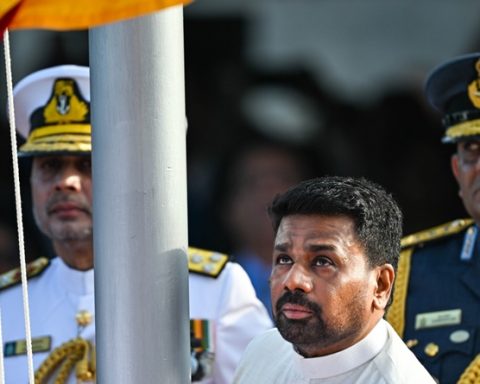
Even as Dissanayake continues to hold court with his oratory and charm, his grip on power is precarious at best. President Dissanayake’s skill in speaking to the masses, his ability to weave a narrative of hope and promise, masks a fundamental failure to address the issues at hand. What does it say about a leader who has garnered public trust based on promises, only to fail in delivering? Can empty words sustain a nation for long? Sri Lanka finds itself in a paradox—while Dissanayake remains a figurehead, an embodiment of hope for many, his failure to translate rhetoric into action will only spell doom for the nation. Will the people continue to follow a leader whose only currency is the ability to speak eloquently — a skill he has honed for decades as his full-time profession — or will they begin to demand the tangible results they were promised?
On the diplomatic front, Sri Lanka’s international standing is deteriorating at an alarming rate. The United States, China, and India—once crucial allies and partners—have all begun to distance themselves from the government. Sri Lanka, once an important player in regional diplomacy, now struggles to maintain even the most basic of relations with its neighbours. The growing tensions with the Maldives over trivial matters such as visa issues, a problem so simple it could have been solved years ago, epitomise the government’s crippling ineptitude. The Maldives, once a nation where Sri Lanka enjoyed cordial ties, now finds itself at odds with Colombo over avoidable mistakes. Similarly, Malaysia’s displeasure further illustrates the breakdown of diplomatic norms. How long can a country exist in isolation, alienating the very powers it once worked closely with, without paying a devastating price?
The government’s diplomatic failures go beyond minor irritations. They reflect a deeper, more insidious problem: a government that simply cannot govern. These foreign relations fiascos are just the tip of the iceberg. With each passing day, the international community loses faith in a government that cannot even fulfil its most basic promises. But there’s more. At the heart of Sri Lanka’s diplomatic debacle lies a power structure that is riddled with contradictions. Those who once pledged transparency and accountability have filled their ranks with individuals whose loyalties are not to the people, but to their own personal ambitions. The appointment of an individual with no diplomatic experience — one who is related to a self-proclaimed messiah and suddenly joined Dissnayake upon his victory — to a high-ranking post, exposes the hollowness of the government’s claims to reform. Are we witnessing the same corrupt practices under a different guise?
Meanwhile, Dissanayake, ever the populist, continues to thrive in an environment of ambiguity. His mastery of the narrative, his ability to weave a story of progress and change, hides a fundamental truth: he is losing control. Is it not strange, then, that a man who commands a parliamentary majority—159 members, to be precise—feels the need to cling so desperately to power, attempting to micromanage every aspect of governance, even when the country demands much more than his symbolic leadership? Shouldn’t a president, backed by such overwhelming support, be able to delegate and trust in those around him to carry out the business of the state? Why does Dissanayake remain so deeply enmeshed in the minutiae of governance, when his inability to act decisively on key issues is what is most needed?
This behaviour, reminiscent of the leaders of authoritarian regimes elsewhere, only serves to deepen the nation’s crisis. The pattern is clear: the more control is consolidated, the more disconnected the government becomes from reality. Sri Lanka, under Dissanayake, is walking down a well-trodden path—a path that leads to the self-destruction of democratic institutions. The echoes of China’s governance model, under Deng Xiaoping, are discernible, but they are a poor fit for Sri Lanka’s political landscape. Dissanayake, for all his attempts at emulating authoritarian success, lacks the political genius of figures like Deng, who understood the art of statecraft and pragmatism. What Dissanayake fails to realise is that the mistakes of history are not easily forgotten. Leaders who fail to grasp the complexities of governance often end up, not as liberators, but as tyrants in disguise.
The current government, with its hollow promises, opportunistic alliances, and foreign policy blunders, is a reflection of a political class that has forgotten the lessons of the past. The blood of Sri Lanka’s past leaders, those who fought for the nation’s independence and dignity, stains the present in a cruel irony. Just as they were once responsible for the nation’s greatest achievements, so too are today’s leaders responsible for its current degradation.
The question is, how long will the people of Sri Lanka continue to support a government that fails them at every turn? How long will they remain passive in the face of a regime that seems more interested in consolidating power than in solving the country’s pressing issues? The collapse of the present government is not a matter of if, but when. And when it falls, the repercussions will be felt far beyond Sri Lanka’s borders. Will the nation rise from the ashes, or will it burn itself into oblivion? Only time will tell.