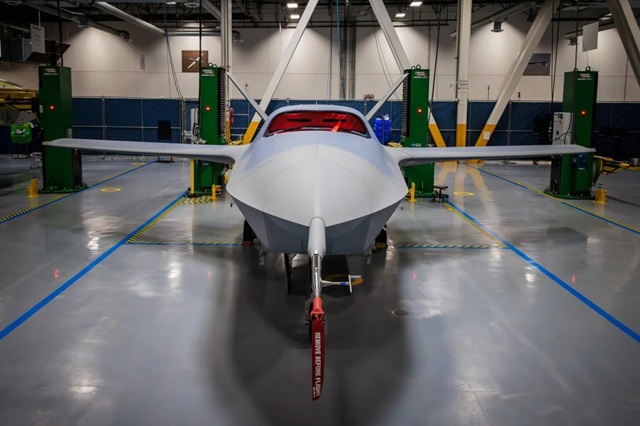
The United States has revealed the first public images of its new unmanned combat aerial vehicle (UCAV), the YFQ-42A, marking a key milestone in the U.S. Air Force’s push for next-generation warfare capabilities. The drone is part of the Collaborative Combat Aircraft (CCA) program, which aims to pair advanced drones – known as “loyal wingmen” – with crewed fighter jets to enhance operational reach and lethality in contested airspace.
U.S. Air Force Chief of Staff General David Allvin shared the image on social media this week, calling it the “world’s first look” at the new UCAV. “No doubts these uncrewed fighters will put our adversaries on notice!” Allvin wrote, describing the drones as “cost-effective” and “truly lethal.”
The CCA program is central to the Pentagon’s strategy of integrating manned-unmanned teaming (MUM-T) in future air campaigns, particularly in potential conflict zones like the Indo-Pacific. The YFQ-42A, developed by General Atomics, and the YFQ-44A from Anduril are currently undergoing ground testing, with flight trials scheduled for later this year. If successful, mass production could begin by 2026, with up to 1,000 drones expected to be operational by 2029.
These drones are designed to accompany sixth-generation fighter jets such as the Boeing-built F-47, part of the Air Force’s Next-Generation Air Dominance (NGAD) initiative. Boasting a combat radius exceeding 1,000 nautical miles – nearly double that of the F-22 Raptor – the F-47 represents a leap in range, survivability, and integrated AI capabilities. The CCAs, with ranges over 700 nautical miles, are intended to fly ahead of manned aircraft, providing early threat detection, electronic warfare capabilities, and even air-to-air engagement.
Defense analysts say this approach could help the U.S. offset China’s numerical superiority in aircraft and provide a tactical edge in high-risk zones like the Taiwan Strait. “They will fly at higher speeds and with improved manoeuvrability, meaning they will be able to operate alongside with manned aircraft,” said Kelly Grieco of the Stimson Center. “This opens new opportunities for collaboration between these drones and manned fighter jets.”
Timothy Heath, a senior defense researcher at the RAND Corporation, emphasized the transformative nature of these platforms. Unlike older drones, the CCAs are built from the ground up to survive contested environments using stealth and AI, reducing the need for constant remote piloting. “This promises to improve the overall effectiveness of unmanned aircraft,” he said.
Meanwhile, China is not standing still. Since late 2024, prototypes of sixth-generation fighters believed to be the J-36 and J-50 have been observed in test flights near facilities operated by Chengdu and Shenyang Aircraft Corporations. While Beijing has not officially confirmed its own loyal wingmen program, state broadcaster CCTV aired footage in 2022 showing J-20 jets accompanied by GJ-11 stealth drones, hinting at parallel developments.
“The gap is narrowing,” said Heath, noting that China’s AI advances could accelerate its UCAV capabilities. A future conflict near Taiwan, he warned, might involve “air-to-air battles between largely unmanned aircraft as well as waves of attacks against ships and ground targets.”
Kostas Tigkos of Janes defense consultancy added that high-volume CCA deployment could allow U.S. forces to saturate contested airspace and outmaneuver enemy defenses. “MUM-T will increase the range of detection and allow manned assets to remain safely outside the engagement range of enemy missiles,” he explained.
Beyond sheer numbers, autonomy will be key. Tigkos noted that next-gen CCAs will rely less on ground-based command systems, improving responsiveness and resistance to electronic warfare. Features such as “fly-by-sensor” and “fly-by-signature” will allow these drones to dynamically adjust flight paths for both attack and evasion.
Analysts broadly agree that while the U.S. currently leads in certain critical technologies – including aircraft engines and advanced avionics – China’s rapid military modernization poses a growing challenge. The operationalization of CCAs is seen as a vital step in ensuring American air dominance in a changing geopolitical landscape.
“This is an evolving concept,” said Tigkos. “But in any future engagement – whether over Taiwan or elsewhere – CCAs will be essential to securing air superiority, increasing survivability, and sustaining combat power over extended missions.”
As the race to develop AI-enhanced airpower intensifies, the skies over the Indo-Pacific may soon be dominated not by dogfights between pilots, but by autonomous squadrons of intelligent machines, flying in deadly coordination with their human counterparts.