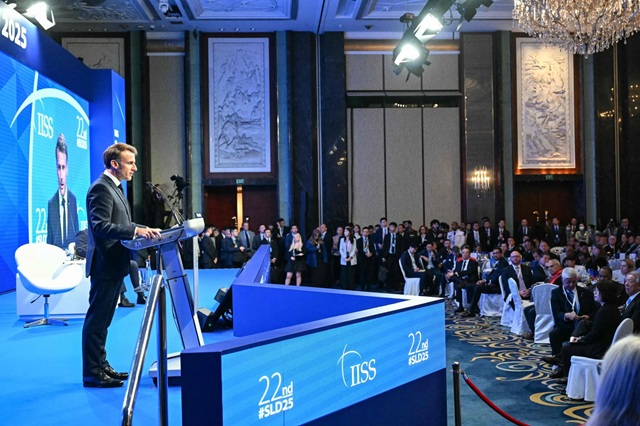
French President Emmanuel Macron issued a powerful call for consistency in global responses to conflict, warning against double standards in international diplomacy during a keynote address at the prestigious Shangri-La Dialogue on Friday evening.
Macron, the first European leader to headline the annual Asia-Pacific security summit, took aim at what he called the “big risk” of overlooking universal principles in reacting to conflicts such as Russia’s war in Ukraine, Israel’s military actions in Gaza, and China’s assertiveness in the South China Sea.
“If we allow Russia to seize part of Ukraine without consequences,” Macron said, “how would we respond to a similar act in Taiwan or the Philippines? What is at stake in Ukraine is our global credibility.”
The French president’s remarks underscored his central message: that a rules-based international order must apply universally—not selectively—if it is to remain credible.
His critique extended to the conflict in Gaza, where he warned that failure to hold Israel accountable for its actions, even while condemning Hamas, would “kill our own credibility in the rest of the world.” Macron emphasized that consistent application of international law and values was essential for sustaining peace and global trust.
Macron’s speech resonated with the broader theme of the 22nd edition of the Shangri-La Dialogue, which convened leaders and experts from 47 nations in Singapore to address pressing regional and global security challenges. Notably, China did not send its Defence Minister Dong Jun this year, instead delegating representatives from its National Defence University.
Amid escalating regional tensions, Macron balanced criticism with diplomacy, stating that France remained a “friend” of China, even if their interests sometimes diverged. Addressing the “elephant in the room,” he said France would be cautious about intervening in any conflict involving China in the Indo-Pacific, stressing that France’s role was not to replace regional actors but to support their sovereignty and capacity.
Macron also addressed the broader implications of European engagement in Asia. “We will never sell what we cannot deliver,” he said, ruling out overpromising on military support while affirming Europe’s commitment to peace and partnership in the region.
In an appeal for greater international cooperation, Macron proposed a “coalition of independence”—a framework that promotes sovereign decision-making, open trade, and shared values across Europe and Asia. He warned against “revisionist countries” seeking to impose their will on free nations and called for a united front to resist the use of force as a tool of domination.
His speech was complemented by deepening bilateral ties with Singapore. During his two-day state visit marking 60 years of diplomatic relations, Macron and Singaporean leaders upgraded their partnership to a Comprehensive Strategic Partnership—the highest level of bilateral engagement for the city-state with a European nation. Agreements were signed in key areas such as defence, artificial intelligence, legal cooperation, and transport.
Macron’s visit also had a personal touch. On Thursday night, he and Singapore Prime Minister Lawrence Wong were seen enjoying local cuisine at the iconic Lau Pa Sat hawker centre, warmly engaging with the public. Earlier on Friday, Macron received a ceremonial welcome at Parliament House and attended a state banquet hosted by Singapore President Tharman Shanmugaratnam.
As the Shangri-La Dialogue continues through the weekend, Macron’s address is likely to spark important conversations about the global order, and whether the world’s leading democracies can back their words with actions—consistently and credibly.