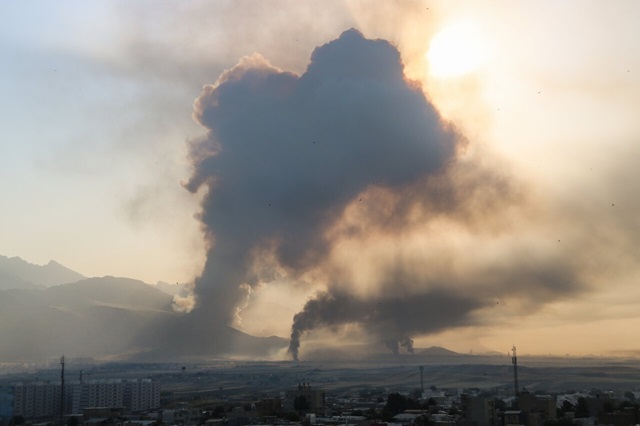
Prime Minister Netanyahu’s military operation targeting Iran’s nuclear command has stunned the region and triggered a mix of euphoria and anxiety across Israel. According to a detailed report from Haaretz, the coordinated strikes by the Mossad and the Israel Defense Forces (IDF) successfully eliminated key Iranian generals and nuclear scientists, striking a significant blow to Tehran’s nuclear ambitions.
Initial celebrations erupted after the operation revealed the deaths of senior figures such as Mohammad Bagheri, Iran’s armed forces chief of staff, and Hossein Salami, commander of the Revolutionary Guards Corps. The Israeli public saw this as a justified retaliation for decades of hostile rhetoric from the Islamic Republic.
However, the mood quickly shifted as Iran retaliated with a massive missile barrage against Israeli cities. Haaretz reports that about 200 ballistic missiles were launched in multiple waves, causing casualties and infrastructure damage despite interceptions by Israeli, U.S., and Jordanian defenses. Notably, Western allies like Britain withheld support during this escalation.
Behind the scenes, the Haaretz investigation reveals the complexity of Israel’s preparations. Over more than a year, Mossad operatives embedded themselves deep within Iran, assembling a network of agents, safe houses, and even clandestinely assembling drones on Iranian soil. These drones played a critical role in the operation, reminiscent of the Ukrainian drone strikes on Russian bases earlier in 2025.
The Israeli Air Force reportedly flew hundreds of sorties, targeting key nuclear sites including the uranium enrichment facility at Natanz, the Parchin military base linked to nuclear testing, and a major scientific complex near Isfahan. Iran’s deeply fortified Fordow facility also experienced explosions, though with reportedly limited damage.
Despite the tactical success, a senior former Mossad operative quoted by Haaretz cautioned that the broader strategic impact remains uncertain. Iran, enriched to 60 percent uranium purity, remains a nuclear threshold state, and the decision to weaponize rests with Supreme Leader Ayatollah Ali Khamenei. The operative noted that Netanyahu’s prior political maneuvers, including the withdrawal from the 2015 nuclear deal, helped bring the region to this precarious point.
U.S. President Donald Trump is said to have played a role in the deception operation that allowed Israel’s surprise strike, while also maintaining the façade of ongoing nuclear negotiations with Iran.
Haaretz underscores the sentiment within Israeli intelligence that “a war is measured by how it ends,” expressing concern that even a devastating opening strike may not prevent Iran from advancing toward nuclear weapons. The report highlights the fragile balance Israel faces: using military force to delay Iran’s program while hoping for a negotiated settlement brokered by the U.S.
As tensions simmer and Iran signals defiance by quickly appointing successors to the slain commanders, the question remains—will this latest chapter in the Israeli-Iran conflict alter the trajectory of Iran’s nuclear ambitions or only deepen the cycle of violence?