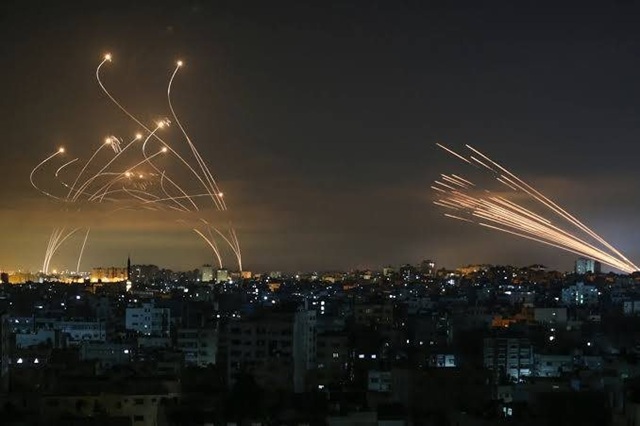
For over a decade, Israel’s Iron Dome has been mythologized as an impenetrable force field—an engineering marvel capable of swatting rockets from the sky with pinpoint precision. But the latest escalation with Iran has torn through that illusion. Far from being invincible, the Iron Dome has shown alarming vulnerabilities when confronted with modern warfare’s evolving playbook. What once was hailed as a shield now increasingly resembles a sieve.
Originally developed to counter short-range, unguided projectiles like Qassams from Gaza or artillery shells from Hezbollah strongholds in southern Lebanon, the Iron Dome thrives on intercepting simple, predictable threats. It excels in chaotic but manageable situations. But today’s battlefield is no longer confined to crude rockets lobbed over border fences. The new era is defined by speed, coordination, and deception—and here, the Dome begins to crack.
Iran’s assault didn’t just involve brute force—it demonstrated strategic sophistication. The Islamic Revolutionary Guard Corps (IRGC) executed a textbook saturation attack designed to overwhelm Israel’s multi-tiered air defense system. More than 100 Shahed drones filled the skies, followed by decoys mimicking ballistic missiles, and capped off by advanced Fattah hypersonic weapons—missiles so fast and agile that even top-tier interceptors like the Arrow 3 and Patriot PAC-3 systems struggle to track, let alone destroy them.
Iron Dome is only the lowest tier of Israel’s three-layer missile defense system. Ideally, it shouldn’t even be engaging with advanced threats. When it is, it suggests that the higher-tier defenses—Arrow 2 and Arrow 3—have failed, whether due to technical faults, radar interference, depleted interceptors, or sheer overload. These upper-tier interceptors are highly specialized and extremely expensive. They weren’t built to counter the kind of massed, multi-vector onslaught Iran deployed. The result? Iron Dome was overworked and underperforming, tasked with intercepting threats far beyond its original design—ultimately acting as a last and inadequate line of defense.
The consequences were stark. Video evidence and regional reports suggest that Israel’s interception rate plummeted to a dismal 10–15%. Meanwhile, Iranian missiles struck sensitive military installations, including the Israeli Defense Ministry and airbases housing F-35 and F-16 fighter jets. In some cases, Israel’s own air defenses reportedly struck fake targets planted by Iran—suggesting Tehran had even outwitted the radar and targeting systems with decoys and electronic warfare.
The physical limitations of the Iron Dome also came into play. Its coverage area is limited—just 144 square kilometers—making it nearly useless in the face of swarm-style attacks. Compounding the issue is reload time: Iranian Fattah hypersonic missiles can reportedly reach Israel in just seven minutes, while the Iron Dome takes around eleven minutes to reload. The timing mismatch is a lethal flaw in a war where minutes, even seconds, decide outcomes.
This latest confrontation shows that Iran has learned from past encounters. Its updated tactics are no longer just about launching missiles—they’re about overwhelming, deceiving, and puncturing layers of defense in one coordinated blow. The psychological effect is no less significant than the physical damage: a system once seen as a national security linchpin now appears porous, fallible, and stretched to its limits.
The Iron Dome still has a role in defending against crude, short-range threats. But the myth of its omnipotence is gone. In this high-tech battlefield, the Dome isn’t a shield—it’s a warning.