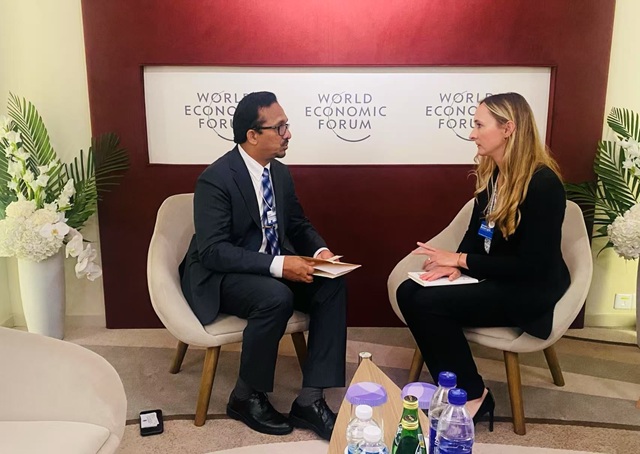
At the World Economic Forum 2025, Sunil Handunneththi, Minister of Industry and Entrepreneurship Development of Sri Lanka, presented the country’s current trade agenda during a focused discussion with Kimberly Botwright, Head of Trade Policy at the WEF. The dialogue centered on Sri Lanka’s ongoing efforts to strengthen trade partnerships, modernize its trade policy, and address structural and regulatory challenges.
Minister Handunneththi noted that Sri Lanka, as an island economy with a liberal trade policy, is engaged in active negotiations to expand its trade agreements, including with China and Singapore. He emphasized Sri Lanka’s commitment to a rules-based international trade system and institutional reform, referring to current tariff discussions with the United States.
Sri Lanka’s geographic position in the Indian Ocean was presented as a practical advantage in global supply chain diversification. As the current chair of the Indian Ocean Rim Association (IORA), Sri Lanka seeks to play a stable role in regional trade frameworks and logistics networks.
The Minister outlined the country’s shift toward market diversification, with efforts underway to reduce reliance on traditional markets such as the United States. Sri Lanka is exploring new regional trade opportunities, including a proposed agreement with Indonesia, to engage more with Asian and African economies.
In terms of sectoral development, the government is prioritizing value addition in key exports like apparel and tea. This includes adopting ESG (Environmental, Social, and Governance) standards and supporting sustainable manufacturing practices, in line with WEF’s focus on responsible trade.
The discussion also covered Sri Lanka’s compliance with international labor and environmental standards, particularly in sectors sensitive to regulatory changes in the U.S. and EU. The Minister highlighted the role of ethical certifications in maintaining market access and proposed broader cooperation on renewable energy and sustainable ocean-based industries.
Structural trade challenges were also addressed. Minister Handunneththi requested support in resolving tariff and non-tariff barriers and called for technical assistance in upgrading digital trade infrastructure, including single-window systems and e-commerce access for small and medium-sized enterprises.
Finally, Sri Lanka’s ongoing trade policy modernization was shared, with reference to its alignment with standards under regional trade frameworks such as CPTPP and RCEP. The Minister invited WEF to facilitate stakeholder dialogues involving investors and Sri Lankan exporters, including groups such as the Joint Apparel Association Forum (JAAF) and seafood industry representatives.
To support continued engagement, Sri Lanka proposed establishing a joint WEF–Sri Lanka Task Force to monitor progress on these priorities. The Minister concluded by stating that Sri Lanka is focused on building a stable, rules-based trade environment that supports long-term economic participation across regions.