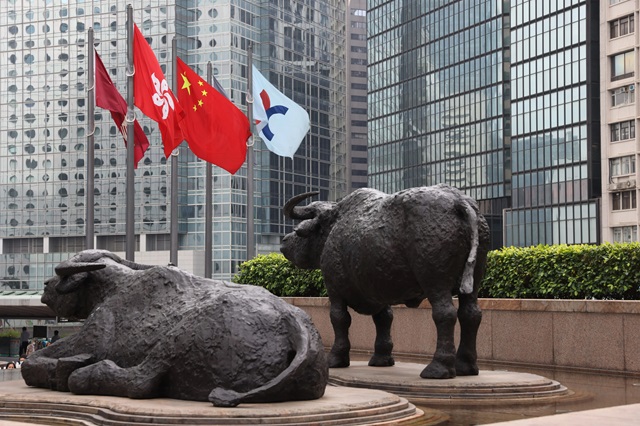
Hong Kong’s stock market is outpacing mainland China’s by its widest margin since the global financial crisis, highlighting how weak economic recovery and ongoing U.S.-China trade tensions are dampening investor confidence on the mainland, according to reporting from the Financial Times.
The Hang Seng Index has soared more than 20% so far in 2025, while mainland China’s CSI 300 has remained flat—marking the largest performance gap between the two since 2008. The Financial Times attributes Hong Kong’s bull run to a wave of record investment from mainland China, particularly in technology giants like Alibaba and Tencent, which are listed in Hong Kong but not on the mainland exchanges.
In contrast, the mainland’s A-share market, which leans heavily on traditional sectors such as industrials, property, and energy, has struggled under the weight of economic headwinds. Persistent deflationary pressures, weak consumer sentiment, and a prolonged real estate slump have dragged on investor appetite.
“A-shares better represent the broader Chinese economy,” Dong Chen, chief Asia strategist at Pictet Asset Management, told the Financial Times. “You look at the broader economy—it is still bottoming but not picking up yet. Fundamentally, we need stronger stimulus.”
Early optimism in 2025 that Beijing would launch major fiscal support has faded, with few substantial measures emerging. While Premier Li Qiang recently pledged stronger efforts to stimulate consumption and support real estate, analysts remain unconvinced.
“In reality, the stimulus policy support for property and consumption is still limited and narrow,” said Winnie Wu, chief China equity strategist at BofA Global Research. Wu added that recent efforts, such as a trade-in programme for consumer electronics, merely pulled forward spending rather than driving new demand.
Retail investors—who make up the majority of trading volume in mainland China—have remained largely on the sidelines. Margin trading in A-shares, a key indicator of retail investor sentiment, has been stagnant since April. Daily turnover in Shanghai and Shenzhen has also declined following a brief February rally sparked by the release of the DeepSeek AI model.
“The mainland market won’t take off until retail jumps in with both feet,” said Ajay Rajadhyaksha, global chair of research at Barclays.
Years of falling home prices have also eroded household wealth, undermining confidence. A significant portion of Chinese household assets is tied up in real estate, and the government’s efforts to curb developers’ debt have led to a wave of defaults.
Adding to the uncertainty are worsening U.S.-China relations. Juliana Hansveden, emerging markets portfolio manager at Ninety One, told the Financial Times that Beijing may be holding back on aggressive stimulus due to the fragile state of trade talks with the Trump administration.
Foreign interest in Chinese equities has also diminished. The Financial Times noted that ETF outflows from Chinese equities domiciled in North America and Europe totaled $1.6 billion so far this year. Authorities have made tracking even more difficult by suspending disclosure of northbound trading data through the Stock Connect programme in 2024.
“For a lot of U.S.-based investors, China is just a no-go,” said Pictet’s Chen.
Despite the bearish outlook on the mainland, some investors see opportunities. Hansveden emphasized a bottom-up strategy, targeting innovative companies with strong fundamentals. George Molina of Franklin Templeton Investments noted that Chinese and Hong Kong equities remain among the few markets still trading below pre-COVID levels, offering attractive valuations.
“From a valuation perspective, it is cheap… you can’t ignore it,” Molina said.
As Hong Kong’s tech-driven rally continues to gain momentum, the disconnect with mainland China underscores deeper concerns about the health of the world’s second-largest economy—and raises questions about whether policy efforts in Beijing can regain investor trust.