
A reasonable period has passed since the election of a new President and government by the people, who were expecting a prosperous era free of corruption and violence. It is not difficult to understand the extent of the expectations people had for the betterment of our society.
Unfortunately, it seems that the hopes of the people are shattering, and their dreams are fading day by day. However, some still believe that the situation will improve in the near future. Hence, discussions are ongoing on many issues, including educational and constitutional reforms.
My understanding of Sri Lankan politics suggests that we have been on the wrong track. I am sorry to say that we have not understood the true nature of the crisis. The problem has little relevance to the Constitution, the Executive Presidential system, Commissions (such as the Police Commission), educational reforms, the electoral system, party politics, the value of the rupee, foreign currency reserves, the energy crisis, the underworld, public security, national defence, or any other such matter.
The problem is entrenched in us as individuals and citizens. We often blame politicians for bad governance, but we must understand that voters are the root cause of many of the maladies in our society. Voters elect politicians to govern, and those who come to power select bureaucrats, including judges, who then demonstrate partiality and prejudice.
If we were to select the top ten countries in the world where people have the least attitudinal and commonsensical development, our country would certainly be among them. I won’t waste much time justifying this proposition, as I have done so on many occasions.
Nevertheless, let me briefly provide some rationale to support my assumption. In terms of attitudes, we are very racist and ethno-nationalist. I admit that most people and peoples in the world harbour racist and ethno-nationalist tendencies, but not to the extent we see today here. Both the Sinhalese and the Tamils are in the same boat. This is the reason behind the disaster facing both communities.
In terms of commonsense, we also demonstrate a very low level. We are unable to understand the cause-and-effect relationships of socio-political phenomena, rationally and scientifically. As a result, we have made wrong judgements one after another.
We have a very educated population; some of our fellow countrymen are highly qualified. Unfortunately, most of them possess neither good qualities nor an adequate level of commonsense. Education does not necessarily make a person commonsensical. What is the reason for this unfortunate situation? The brief answer is that the architects of our free educational policies and system did not fully understand the objectives of universal education.
Therefore, it is a waste of time to expect our societal problems to be solved through constitutional reforms or other adjustments. Nothing will work until we address the two aforementioned issues: attitudinal collapse and lack of commonsense. The politics of the day must focus on addressing these issues through political education.
The suggested educational reforms are ineffective because the reformists have no clear idea what they should reform. History is a useful subject because a proper understanding of a people’s past can help enhance internationalism and eliminate racial and ethno-nationalist attitudes. Yet both proponents and opponents of making history a compulsory subject hardly appreciate this important aspect of history education.
It is also doubtful whether we have not only teachers but also historians capable of preparing textbooks that achieve this broad objective of learning history. For most of our people, history education means glorification of their tribal past.
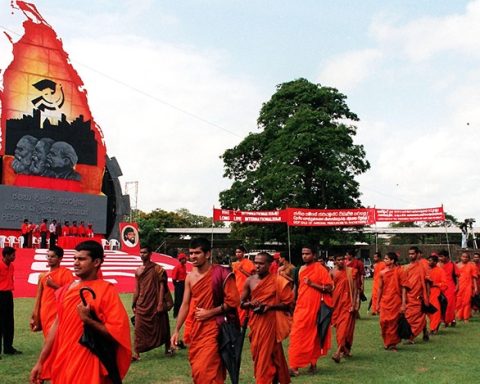
We must attempt to change the attitudes of our citizens and enhance their commonsense through literature, music, and other means. The JVP or NPP cannot achieve this because they have a criminal and racial history. Neither have they apologised for their past crimes or for popularising misinterpretations of socio-political issues.
Therefore, the responsibility for developing a qualitatively advanced citizenry lies with civil society—composed of broad-minded citizens, albeit a very thin social stratum.
It seems some people still tend to place trust and faith in the JVP/NPP government. People expected genuine change when they elected this President and government. I do not blame ordinary people, as they lack the political literacy to understand that the leaders of the JVP and NPP have very little understanding of politics and economics.
However, those who have studied or read politics should have realised that a kindergarten political movement like the JVP/NPP cannot solve the problems our people and country have faced for decades.
Members of the JVP/NPP know how to lie; they have exposed themselves as big liars. There is no transparency when they conduct national and international affairs. Many clandestine affairs exist; they deceive both Sinhalese and Tamils repeatedly. They have no vision for the future, no mission for the country, and no realistic programme to solve the problems of our people.
Reportedly, the government’s lifespan will be very short. Not only internal reports but also scientific political analyses suggest that the coalition (Malimawa) will soon split. The path to collapse will differ significantly from the end of Gotha. Many grievances among police officers, the three forces, and the bureaucracy could precipitate this collapse.
Under these circumstances, I see no point in presenting proposals and expecting positive outcomes from this government. Nevertheless, I do not oppose efforts towards reform, because I believe it is better to light at least one candle than to curse the darkness.