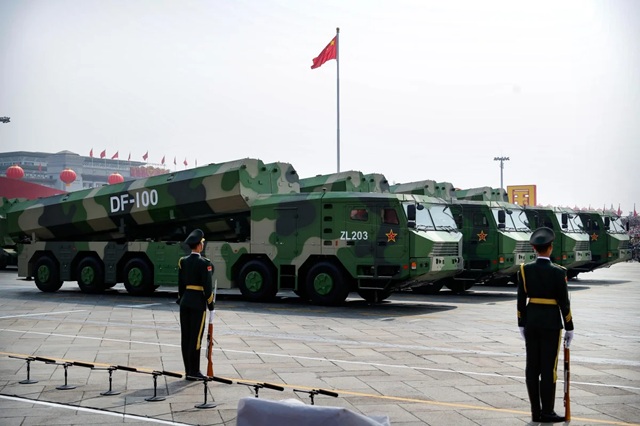
China has released rare video footage of its DF-100 supersonic cruise missile, offering new insights into the weapon’s capabilities in what analysts say is a calculated show of strength aimed at deterring US military forces in the Asia-Pacific.
The two-minute segment, aired Tuesday as part of the final episode of a People’s Liberation Army (PLA) documentary, marked only the second time the DF-100 has been shown in action since its debut at the 2019 National Day parade. The previous clip, lasting just two seconds, was quickly deleted from official channels.
State media, including China News Service and outlets affiliated with Xinhua, confirmed the missile’s identity under the headline “Rare public release of DF-100 cruise missile launch video.” The broadcast formed part of commemorations for the PLA’s 98th anniversary and precedes a large-scale military parade in Beijing on September 3 marking the 80th anniversary of China’s victory over Japan in World War II.
The footage depicted a rocket force brigade conducting a pre-dawn cable communications drill under simulated enemy jamming. Notably, the missile launch appeared to take place near an urban setting — a departure from the PLA’s usual remote desert test sites. Analysts said the location underscored the DF-100’s mobility and survivability.
“If it can be launched close to urban areas, it will be more difficult for adversaries to locate, identify, target and destroy it,” said Yun Sun, director of the China program at the Stimson Center.
High-Speed, Long-Range Capabilities
First displayed in 2019 — albeit under the CJ-100 designation — the DF-100 boasts a range of 3,000–4,000 kilometers, a cruising speed of Mach 4, and the ability to strike targets within roughly 40 minutes of launch. Its reach includes Taiwan, Japan, South Korea, US bases in Okinawa and Guam, and American carrier groups operating west of the second island chain.
According to specifications revealed at the 2024 Zhuhai Air Show, the missile employs a three-stage propulsion system: a solid rocket booster for launch, a supersonic combustion ramjet for sustained near-space flight, and a high-altitude booster for terminal acceleration. Its aerodynamic design features elongated wings for stability and maneuverability, and a specialized warhead for evasive low-altitude strikes.
Military analysts say the DF-100 is capable of hitting both moving and fixed targets, including high-value command centers, critical infrastructure, and naval vessels. Song Zhongping, a former PLA instructor, described it as “one of the PLA’s trump-card weapons” due to its precision strike capabilities and survivability.
Strategic Messaging Amid Tensions
James Char of Singapore’s Nanyang Technological University said the DF-100 can be deployed from land-based launchers or air-launched via H-6N bombers, potentially extending its strike range to 6,000 kilometers.
Experts believe the timing of the release serves as a signal of resolve amid rising regional tensions and recent US military activity. “The rocket force may have faced internal upheavals, but its hardware capability still makes it a formidable force,” said Sun.
Yang Zi, a research fellow at NTU’s S. Rajaratnam School of International Studies, said the move was designed to “project strength in a time of increasing global disorder” while concealing sensitive technical details through selective blurring of the footage.
The DF-100 remains the world’s only known land-based cruise missile capable of sustaining full-flight supersonic speeds at Mach 4, combining inertial navigation, terrain matching, scene matching, and BeiDou satellite guidance to achieve meter-level accuracy.