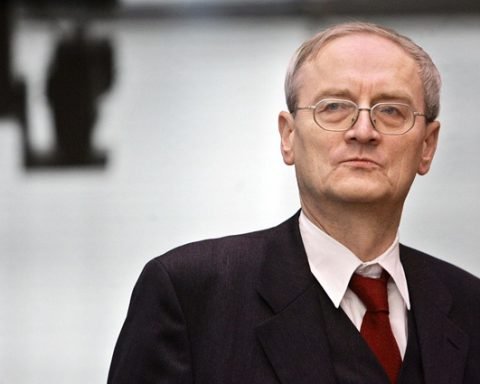
The American sculptor Jim Sanborn, creator of the world-renowned Kryptos sculpture at the headquarters of the Central Intelligence Agency (CIA), has revealed plans to hand over the last unsolved section of its code to an artificial intelligence system. The disclosure comes as the 79-year-old artist approaches his 80th birthday and reflects on a career defined as much by secrecy as by sculpture.
Sanborn, who lives and works on a private island in the Chesapeake Bay, is best known for Kryptos — a copper screen installed in Langley, Virginia in 1990 and perforated with letters that conceal four hidden messages. While three of the four coded sections (known as K1, K2 and K3) were solved decades ago by cryptographers and intelligence agencies, the final passage, K4, has resisted all attempts at decryption for 35 years. It has become one of the most famous unsolved ciphers in the world.
Speaking at his Maryland studio, Sanborn admitted the unsolved riddle has dominated his later life. He described the burden of holding a secret that thousands of codebreakers — from amateur sleuths to professionals at the US National Security Agency — have tried and failed to uncover. “Secrecy is power, that’s the unfortunate reality,” he remarked. “And I have been resented for having this secret.”
Sanborn now says he will entrust the solution of K4 to an artificial intelligence system capable of verifying correct answers without disclosing the cipher itself. The plan, outlined in a letter addressed to “Kryptos fans, detractors, sleuths, geniuses, CIA employees, cryptographers and miscellaneous provocateurs,” makes clear that the secret will be sold to the highest bidder at an auction later this year. The sale, to be held by Boston-based RR Auction, is expected to raise as much as half a million dollars.
According to Sanborn, the system will act as a kind of digital custodian, ensuring the integrity of K4’s secrecy while protecting its meaning. “I sincerely hope the new owner will choose to keep K4 a secret,” he wrote. “If they don’t, then what’s the point? Power resides with a secret, not without it.”
Kryptos has long fascinated codebreakers and artists alike. The first three sections were cracked using traditional cipher techniques such as Vigenère substitution and transposition, but K4 has defied experts, even within the intelligence community. Sanborn himself has released only sparse clues over the years — including references to “Berlin”, the “Berlin clock”, and “east northeast” — but maintains that the text remains intact and solvable.
The sculptor’s guarded stewardship of the cipher has not been without controversy. He has received death threats from would-be solvers, envelopes of suspicious white powder, and even unexpected visitors at his island retreat. For a time, he charged $50 to answer cryptographic submissions, simply to manage the overwhelming correspondence.
Now in fragile health and with no heirs to inherit his artistic and cryptographic legacy, Sanborn insists the time has come to pass responsibility on. By entrusting the solution to a machine, he hopes to preserve both the mystery and the power of Kryptos.
As Financial Times reports, Sanborn’s decision comes at a moment when artificial intelligence is increasingly claimed to have the ability to solve complex problems — a trend he meets with both scepticism and fascination. “The thing about AI is it’s lying, it’s telling you what you want to hear,” he said, dismissing recent online claims that chatbots had cracked K4. Yet, paradoxically, his final act will involve entrusting his life’s greatest secret to that very technology.
The auction is scheduled to coincide with the 35th anniversary of Kryptos. If successful, the sale will mark the transfer of one of the world’s most enduring unsolved puzzles — and perhaps the beginning of a new chapter in the strange intersection of art, secrecy, and codebreaking.