by A Warrior
The pain I am enduring is neither poetic nor performative; it is a raw, unrelenting testament to service rendered and now forgotten. We fight a war—not for accolades, not for applause, but because duty demanded it. One may argue that it was our job, and in a sense, that is true. Yet how many of you would willingly choose this profession, a calling that exacts the highest toll upon body, mind, and spirit? To witness comrades fall beside you, to carry the weight of the wounded across merciless terrain, all while the enemy’s gaze remains fixed upon you—this is no abstract trial of courage. It is the lived reality of those who must endure not only combat but the haunting spectres of loss, guilt, and the ineffable burden of survival.
Men in white, their faces etched with a deeper anguish than the bloodied soil they tread, confront the chaos of human destruction in ways civilians cannot fathom. Fighting wars in oceans, jungles, and mountains alike is an unimaginable task. Thirty years of relentless vigilance, and we finally eradicated the enemy. That was in May 2009. Victory, however, did not translate to recognition. The commercialised euphoria of war—the post-conflict celebrations and political manoeuvres—rendered our sacrifices invisible. The world applauded selectively, praising nations for upholding human rights rhetorically, yet remaining silent when children were conscripted into death, when women became instruments of terror. Innocents suffered while elites in distant capitals toasted to the comforts of their lives. History is littered with such ironies; one need only recall the post-war narratives of the First World War, where soldiers returning from the trenches found themselves neglected by the very nations they had defended, or the Kurdish fighters in Syria whose struggles were lauded only when politically convenient.
Today, I am a veteran. Yet, one must understand the ordinariness of that status. To the broader society, we are invisible relics, our identities defined solely by the medals we wear, if they are remembered at all. The tides of politics, ever capricious, have reshaped the landscape in which we once fought. Principles once extolled—loyalty, honour, sacrifice—have been relegated to the realm of sentimentality. Who truly remembers the work we accomplished? Who recognises that in the crucible of combat, lives were not merely lost but defended?
Conversations among veterans reveal the depth of disillusionment. “Sri Lankans are very ungrateful people,” one might say in passing. Another responds with bitter detachment, “I feel that we were born on the wrong land,” while yet another mutters, “All heck, we did nothing meaningful for this nation.” These statements are not hyperbole; they are the cumulative echo of decades of service met with societal indifference. First casualty of any war is truth, and yet the second is recognition, the third, dignity.
How then are veterans to reconcile justice and revenge? I know that if someone transgressed, unrelated to the conflict itself, proper judicial procedure must follow. Arrest and investigation, not suspicion or vendetta, must define the nation’s response. Yet, in a world where narrative often substitutes for fact, vendetta becomes convenient. The wronged are punished not for their misdeeds but for the needs of collective forgetfulness, political expediency, or historical convenience.
Consider the words of John F. Kennedy: “As we express our gratitude, we must never forget that the highest appreciation is not to utter words, but to live by them.” It is precisely this absence of living gratitude that wounds veterans most acutely. And what of historical precedent? The GI Bill in the United States post-World War II transformed the lives of millions of soldiers, providing housing, education, and employment opportunities. It recognised that those who serve are not merely instruments of war but citizens whose reintegration is vital to national cohesion. The island known as the Pearl in the Indian Ocean might do well to remember such lessons.
Poetic testimony too bears witness to the unspoken burdens of service. Wilfred Owen, writing from the mud of the Western Front, lamented: “My friend, you would not tell with such high zest / To children ardent for some desperate glory, / The old Lie: Dulce et decorum est / Pro patria mori.” Sweet and fitting it is to die for one’s country, they said; yet we live, enduring, carrying wounds that are not visible, and often facing a society that cannot reconcile the paradox of survival with neglect.
Operations etched into memory remain uncelebrated in the public sphere. Amphibious assaults, counter-insurgency campaigns, and prolonged jungle patrols exact a toll that cannot be captured in glossy reports. One recalls Operation Jayasikuru, the grueling months of night raids, the close-quarter encounters where hesitation could mean death. These operations demanded not only physical endurance but moral fortitude—the constant balancing of mission success with the preservation of innocent life. Yet these are the stories that vanish from national consciousness, replaced by sanitized narratives that do not offend, do not challenge, and certainly do not recognise the veterans’ enduring scars.
The global historical record teems with such dissonance. Consider the recognition of the Gurkhas, whose loyalty and bravery were acknowledged only after decades of legal and political struggle. Or the Kurdish peshmerga, whose victories were celebrated internationally while their return to ordinary life remained unsupported and perilous. It is the same across continents and centuries: societies valorise service in abstraction, but forget it in practice.
Even literature recognises this paradox. Ernest Hemingway, in A Farewell to Arms, depicts soldiers whose personal suffering is eclipsed by the broader machinery of war. Likewise, the veterans of the island in the Indian Ocean find that their sacrifices are rendered peripheral, their experiences compressed into rhetoric or, worse, obscured entirely. And yet, we persist. We endure the loneliness, the sense of invisibility, the societal amnesia that surrounds our deeds.
Yet there is anger, and with anger comes reflection. We are admonished to forgive, to move beyond bitterness. But when the very fabric of societal memory denies our existence, when our comrades’ sacrifices are trivialised in favour of political expediency, when children conscripted into terror are remembered by the world only as instruments of a narrative, how can forgiveness be anything but a private solace? One must reconcile the personal with the historical, the moral with the political, if only to survive the lingering aftermath of war.
It is not merely the absence of gratitude that wounds; it is the inversion of moral expectation. The world celebrates victories selectively. Elites in distant lands enjoy the comforts of their freedom while those who fought to secure it are marginalised, critiqued, or, at worst, vilified. Foucault’s notion of power, exercised through narrative and institutional authority, manifests here with cruel precision. Soldiers, once instruments of national sovereignty, become disposable relics when inconvenient truths must be buried.
We veterans are left with memory as both shield and burden. Memory of operations, of the fallen, of the unbearable moral choices imposed by circumstance. Memory of friends and foes alike, where compassion and enmity coexisted in ways that civilian imagination cannot accommodate. Memory of a nation’s indifference, its rhetorical celebration of justice and human rights, contrasted against its inattention to the very agents who defended those ideals.
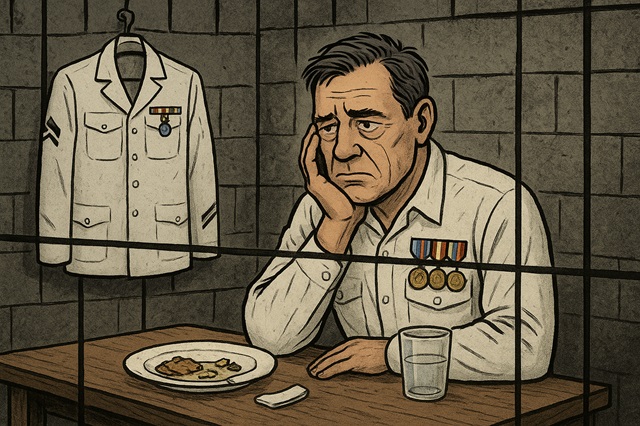
And so I sit, behind the bar, not in leisure but in reflective confrontation with a society that has rewritten its priorities. The pain I endure is not physical alone; it is existential. It is the slow erosion of recognition, the selective amnesia of a nation that once demanded everything of us, yet now asks nothing in return. And I ask: must the highest tribute to service be invisibility? Must the cost of war be perpetual neglect?
The truth remains stubbornly simple: we served because it was required, we sacrificed because it was demanded, and yet our society now turns its back as if time alone can absolve memory. Perhaps, as Owen wrote, we shall continue to endure, quietly cursing the old lie that it is sweet and fitting to die for one’s country. Yet we also endure with dignity, because without it, the weight of survival becomes unbearable.
The lamentation of being a veteran in an ungrateful nation is therefore not merely complaint—it is moral indictment. It is historical critique. It is urgent, uncomfortable, and inescapable. For until a nation truly lives by the words of Kennedy, until it honours the living as much as it celebrates the abstract ideals of heroism, veterans will remain suspended between sacrifice and oblivion, witnesses to a society that refuses to reckon with the full measure of its debt.