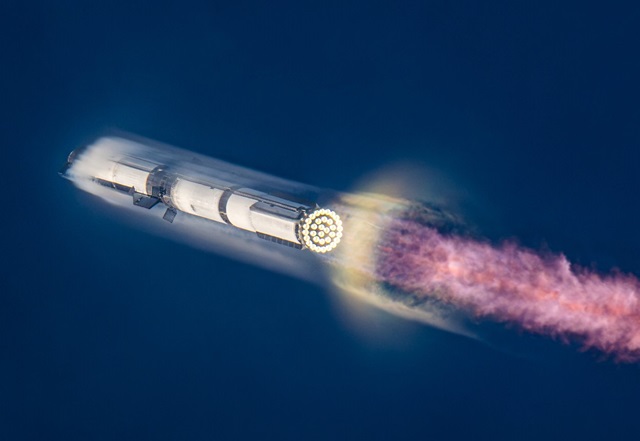
SpaceX’s colossal Starship rocket has completed its 10th test flight, marking a major milestone for Elon Musk’s space company and reinforcing its dominance in the commercial space industry.
The 400-foot-tall heavy-lift rocket lifted off from Starbase in South Texas, successfully avoiding the fiery fate of previous attempts. During the mission, the upper-stage Starship spacecraft separated from its Super Heavy booster and deployed eight dummy Starlink satellites into orbit. The spacecraft then reignited its Raptor engines in space, re-entered Earth’s atmosphere—scorching its heat tiles and flaps in the process—and splashed down in the Indian Ocean. Meanwhile, the booster conducted its own maneuvers before safely dropping into the Gulf of Mexico.
The successful mission represents a turning point for SpaceX after a series of costly setbacks. Earlier this year, a “major anomaly” caused a June test to explode on the launch pad, while in May engineers failed to deploy satellites during the ninth test. Previous flights ended with the vehicle spinning out of control and disintegrating over the Caribbean, prompting months-long grounding orders from the Federal Aviation Administration.
The latest achievement underscores the pivotal role Starship plays in Musk’s broader ambitions: securing NASA contracts, supporting lunar and Martian exploration, and expanding SpaceX’s Starlink internet network. With a payload capacity of up to 250 metric tonnes, Starship is the most powerful rocket system ever built, enabling the launch of larger, next-generation Starlink satellites essential for global coverage.
The vehicle first reached orbit in late 2023, wowing audiences when its reusable Super Heavy booster was caught by “Mechazilla,” a pair of giant robotic arms at Starbase. However, repeated technical failures had cast doubts over its future until this latest breakthrough.
SpaceX’s high-risk, rapid-development strategy—losing more than a dozen rockets en route to today’s success—has propelled it far ahead of rivals. Its Falcon 9 vehicle and thriving Starlink business underpin a market dominance that Amazon founder Jeff Bezos’ Blue Origin and aerospace giants Boeing and Lockheed Martin have yet to match. The company’s strong performance has driven its valuation toward $400 billion, according to recent reports.
SpaceX is also expected to benefit from a new executive order signed this month by U.S. President Donald Trump, aimed at easing regulations for commercial space operators. The move marks a reversal from earlier threats by Trump to cancel SpaceX’s government contracts following a political clash with Musk over summer budget negotiations.
For now, SpaceX’s latest flight offers a crucial validation: that Musk’s bold gamble on the world’s largest rocket may finally be paying off.