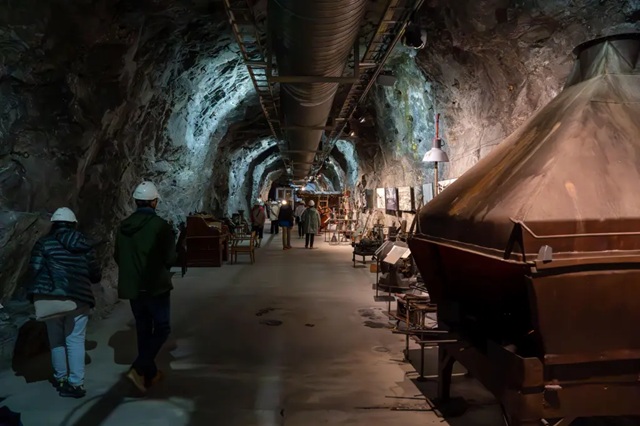
Nearly a mile beneath the frozen Arctic surface, Sweden’s Kiruna mine — the world’s largest iron ore operation — may hold the key to Europe’s technological future. Beyond its canteens serving pea soup and the robotic “dog” Speja that inspects blast sites, the mine is advancing towards the Per Geijer deposit, believed to be one of Europe’s most promising caches of rare earth metals.
According to a report by The Times UK, the discovery could be transformative for Europe’s efforts to loosen its reliance on China, which currently dominates global rare earth production. These 17 elements, critical to technologies ranging from wind turbines and fiber-optic cables to weapons systems, are overwhelmingly sourced from Beijing. China produces about 90 percent of the world’s heavy rare earths and recently tightened export controls on several key minerals.
Niklas Johansson, a senior vice-president at LKAB, the state-owned company that operates Kiruna, said the deposit could meet up to 20 percent of Europe’s annual demand. “Almost all new technology depends on rare earths. And today, China more or less controls the market,” Johansson told The Times UK.
The potential is vast: LKAB estimates there could be as much as two billion tonnes of rare earths in the deposit. Because the minerals are interlaced with high-grade iron ore, revenue from iron extraction could help finance the costly and technically complex rare earth separation process.
However, experts caution that significant challenges remain. Separating rare earths from surrounding minerals — which often include radioactive elements — requires expertise that has largely vanished in Europe. Today, only two facilities on the continent retain the technical capability: one in La Rochelle, France, and another in Sillamäe, Estonia.
Efforts are underway to revive European know-how. A French start-up, Carester, supported by state and Japanese investment, is developing a recycling and refining plant expected to handle up to 15 percent of global demand for heavy rare earths. Germany has also launched new recycling operations in Bitterfeld-Wolfen, the historic hub of its chemical industry.
Still, analysts warn that competing with China’s massive scale could be difficult. Jens Gutzmer of the Helmholtz Institute told The Times UK that Europe’s weakness lies not in geology but in “money and political willpower,” with Beijing capable of launching a price war to undercut new entrants.
Some experts suggest diversification may be the more realistic goal. “In 2030 European manufacturers will be able to buy all the tonnage of the various rare earth elements that they need [from Australia],” said Harald Elsner of the German Federal Institute for Geosciences. “It’s up to them to buy it … because in the long run it will be much more expensive to rely on the Chinese.”
For now, the gravel-tracked tunnel towards Per Geijer inches forward at five meters a day. If LKAB’s estimates hold true, commercial mining could begin in the 2030s — a development that could reshape Europe’s technological independence for decades to come.