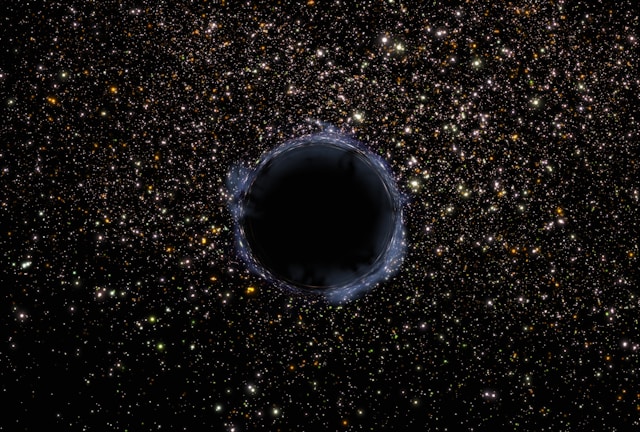
A team led by Prof. Mao Jirong from the Yunnan Observatories of the Chinese Academy of Sciences, alongside international collaborators, has provided compelling evidence of standing shocks in low-angular-momentum black hole accretion flows. The study, published in The Astrophysical Journal, employed advanced general relativistic magnetohydrodynamic (GRMHD) simulations to identify these stationary shock phenomena near black holes.
Accretion—the process by which matter spirals into compact objects under strong gravitational fields—is a cornerstone of high-energy astrophysics and critical for understanding galaxy formation and evolution. Since the Event Horizon Telescope’s landmark capture of a black hole shadow in 2019, probing the dynamics of matter near the event horizon has been a central focus of astrophysical research.
Standing shocks, defined by their fixed positions within accretion flows, had long been theorized but remained unconfirmed. Using both two- and three-dimensional MHD simulations framed by general relativity, Prof. Mao’s team demonstrated that in low-angular-momentum accretion modes, shocks form consistently near black holes and maintain a stable position throughout the accretion process. This discovery provides the first robust evidence for the existence of standing shocks in such systems.
The researchers also found that standing shocks occur in “standard and normal evolution” (SANE) accretion disks but are absent in “magnetic arrested disk” (MAD) configurations. This distinction refines current models of black hole accretion and offers insights into how magnetic fields influence inflowing matter.
Importantly, the study connects standing shocks to quasi-periodic oscillations (QPOs), a well-documented astrophysical phenomenon. Oscillating shocks accelerate charged particles, and the radiation from these particles aligns with the periodic X-ray signals observed in binaries and active galactic nuclei, providing a potential explanation for QPO origins.
“This study advances our understanding of accretion physics, a field central to unraveling black hole behavior and galaxy evolution,” said Prof. Mao.
The research was supported by the National Key R&D Program of China, the Natural Science Foundation of China, and the Yunnan Revitalization Talent Support Program, marking a significant contribution from the Chinese Academy of Sciences to the global study of high-energy astrophysics.