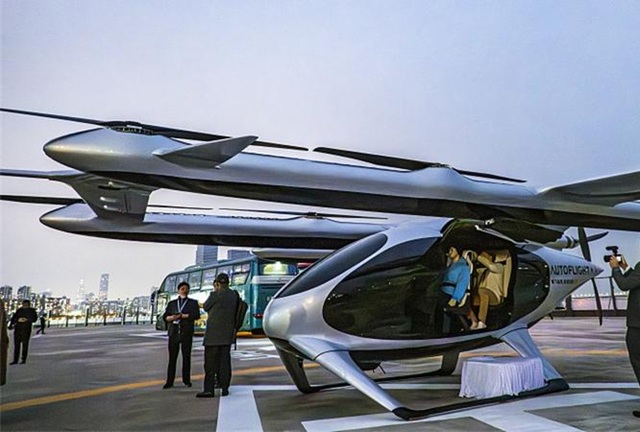
A Chinese-made automated electric air taxi took off in Africa for the first time this week, marking a significant step in the global expansion of China’s low-altitude aviation sector. The flight, which took place during the Aviation Africa Summit and Exhibition in Kigali, Rwanda, drew attention from industry leaders representing 34 countries. The event showcased emerging technologies that aim to transform air transport in regions facing urban congestion and environmental challenges.
The aircraft featured in the demonstration was an unmanned electric vertical take-off and landing vehicle (eVTOL) produced by EHang Holdings, a Nasdaq-listed technology firm headquartered in Guangzhou, southern China. The successful test flight was organized by the Rwandan government in partnership with China Road and Bridge Corporation, a state-owned construction and engineering enterprise. According to the state-run Xinhua News Agency, the collaboration is intended to enhance Rwanda’s capabilities in implementing advanced aviation technologies.
The Rwanda Heart of Africa promotional Facebook page emphasized that the partnership seeks to “reinforce Rwanda’s position on the continent at the forefront of implementing cutting-edge aviation technology.” Rwanda, a landlocked nation with a population of around 14.2 million and a burgeoning tourism industry, is actively pursuing investments in air transport as a solution to traffic congestion and rising air pollution. Reports from African media outlets indicate that the government is seeking “investment and technology partners” to build a more efficient and sustainable air mobility sector.
China’s role in the low-altitude aviation market has expanded rapidly in recent years. The country has identified the sector as a high-potential emerging industry and has supported its development through favorable policy measures. Research by Hurun, citing data from China’s Civil Aviation Administration, estimates that China’s low-altitude economy could reach 1.5 trillion yuan, or approximately 210 billion US dollars, by the end of 2025. In addition to domestic expansion, Chinese aviation firms are increasingly exploring opportunities overseas. In July, a Thai company signed a 1.75 billion US dollar agreement to purchase 500 Chinese eVTOLs, while a buyer in the United Arab Emirates agreed to acquire 350 aircraft manufactured by Shanghai TCab Technology for 1 billion US dollars.
Despite the sector’s growth, experts caution that Africa’s relatively low income levels compared with other regions may limit market potential. Chen Zhiwu, chair professor of finance at the University of Hong Kong, suggested that looser regulatory frameworks in African countries could allow for “more experimentation” by Chinese aviation companies. Meanwhile, Bulelani Jili, assistant professor at Georgetown University and an expert in Africa-China relations, pointed out that electric air taxis would not directly compete with new vehicles, but rather with the continent’s established second-hand vehicle market. He explained that the success of new aviation technologies in Africa would depend on how well they complement existing transportation solutions.
The Rwandan infrastructure minister, quoted by Xinhua, remarked that the flight demonstrated the country’s “dedication to fostering a safe, progressive regulatory environment for advanced air mobility.” The event was covered by South China Morning Post, which reported on the growing international interest in Chinese low-altitude aviation products and their potential role in reshaping transport infrastructure in developing regions such as Africa.