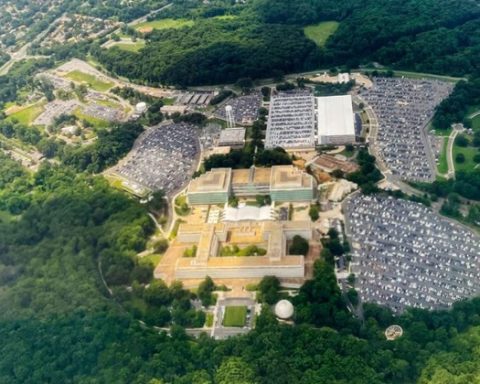
For more than three decades, the encrypted Kryptos sculpture at CIA headquarters has fascinated codebreakers and art lovers alike. Designed by artist Jim Sanborn and unveiled in 1990, the piece contained four coded passages, three of which were solved long ago. The final one, known as K4, resisted every attempt to decode it—until a chance discovery in a museum archive abruptly upended the mystery.
Writer and researcher Jarett Kobek, a casual admirer of the Kryptos puzzle, had once tried and failed to solve the code himself. But earlier this year, when Sanborn announced plans to auction off his private archive—including what he claimed was the long-secret solution—Kobek noticed a peculiar clue in the auction listing. The description mentioned “copies of coding charts used to code Kryptos” stored at the Smithsonian. Intrigued, Kobek enlisted his friend, Washington, D.C.–based playwright and journalist Richard Byrne, to check the archives.
What Byrne found there stunned them both. Among Sanborn’s old papers were five sheets of notes filled with letter grids that, when combined with previously released clues, revealed the long-sought plaintext of K4—the 97-character message that had eluded cryptographers for decades. On September 2, Kobek pieced the information together and realized what he had found. The next day, he emailed Sanborn with the news.
The artist was floored. “I was like, ‘Kryptos is being kidnapped,’” Sanborn said later. He quickly rushed to the Smithsonian and ordered the relevant folders sealed for 50 years, blaming a “monstrous mistake” he made years ago while submitting his archive during a health scare. He had included the plaintext among other coded notes to prove to the CIA that the sculpture’s contents were appropriate, never realizing the file would become public.
The discovery threw Sanborn’s planned auction into chaos. RR Auction, the firm managing the sale, had promised bidders “exclusive access” to the full solution. When Kobek and Byrne’s find became public, the listing was hastily edited and legal letters began to fly. Kobek said he was asked to sign a nondisclosure agreement that would have given him a portion of the auction’s proceeds, but he refused. “I don’t want his money,” he said, adding that continuing to sell the materials as exclusive could constitute fraud.
As of late October, the bidding had reached $137,859—well below early estimates of $300,000. The auction, now recast as offering insight into “K5,” a supposed extension of Kryptos, is scheduled to close on November 20. Sanborn insists that while the plaintext may have been exposed, the true cryptographic key—the method behind the code—remains known only to him. “The key is the main thing being auctioned,” he said. “Nobody knows the key but me.”
For many in the global Kryptos community, the discovery has blurred the line between solving a mystery and merely revealing its contents. Even though K4’s text has been recovered, the code itself has not been “cracked.” Elonka Dunin, a longtime Kryptos expert, said the find has not diminished the sculpture’s allure. “There are many people who’ve come up with answers,” she said. “The first question we ask is, ‘What’s your method?’ If they don’t have one, they just get booed out of the room.”
Still, Sanborn’s blunder has sparked a deeper debate about ownership, secrecy, and art in the digital age. A secret hidden in plain sight for 35 years may now be sealed away for another half-century—but the mystery of Kryptos, and the obsession it inspires, shows no sign of fading.