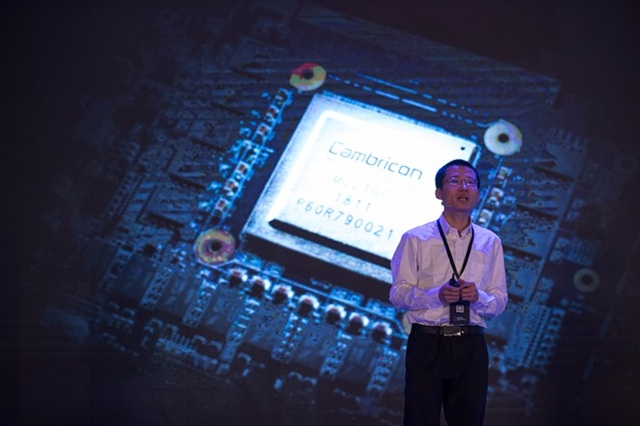
Cambricon Technologies Corp. is preparing an aggressive production surge that would more than triple its output of artificial intelligence chips in 2026, positioning the company to seize market share from Huawei and capitalize on Nvidia’s forced retreat from China, according to information reported by Bloomberg. People familiar with the plan said the Beijing-based chip designer intends to deliver about 500,000 AI accelerators in 2026, including up to 300,000 units of its most advanced Siyuan 590 and 690 processors. The chips will rely primarily on Semiconductor Manufacturing International Corp.’s “N+2” seven-nanometer manufacturing process.
The planned expansion highlights the rapid ascent of China’s domestic chipmakers after Beijing discouraged the use of Nvidia products this year, part of a broader national effort to insulate the country from U.S. technology restrictions. Huawei is also preparing to double its production of high-end AI chips, while another contender, Moore Threads Technology Co., is debuting new hardware as it seeks to enter the rapidly growing sector. Nvidia CEO Jensen Huang acknowledged in November that his firm is now effectively blocked from the Chinese market, a shift he said would accelerate the rise of local competitors such as Huawei and Cambricon.
Few companies have benefited as visibly from U.S. sanctions as Cambricon. The firm reported a fourteen-fold increase in revenue during the September quarter and has seen its market value grow ninefold since 2021. It already counts ByteDance Ltd. as its largest customer, representing more than half of all orders, and is on track to secure additional contracts from major Chinese AI spenders such as Alibaba Group Holding Ltd. in the coming years, Bloomberg reported. Whether Cambricon can meet its ambitious production goals will depend heavily on chip yields at SMIC, which is still several generations behind Taiwan Semiconductor Manufacturing Co. in manufacturing efficiency.
SMIC’s yield rate for Cambricon’s latest 590 and 690 chips is only about 20 percent, meaning four out of every five silicon dies are deemed unusable. Analysts estimate that TSMC’s cutting-edge two-nanometer process — roughly seven years more advanced — achieves yields of at least 60 percent. Another significant bottleneck is the supply of high-bandwidth memory chips, a technology still dominated by foreign manufacturers. Huawei’s new 910C accelerators, for example, rely on memory from Samsung Electronics Co. and SK Hynix Inc.
Bloomberg Intelligence analysts warn that even with Cambricon, Huawei and Baidu ramping up output, China’s domestic supply of AI accelerators remains insufficient to satisfy explosive demand. Low yields on advanced seven-nanometer chips will likely remain a drag on the industry for the foreseeable future. Yet geopolitical pressures and continuing uncertainty over access to Nvidia technology are pushing Chinese companies inexorably toward homegrown suppliers, accelerating the emergence of two parallel global AI ecosystems divided between China and the United States.
Cambricon’s prominence gives it leverage as it negotiates for manufacturing capacity at SMIC. Founded in 2016 by computer scientist Chen Tianshi, the company is regarded as one of the leading beneficiaries of Beijing’s push for technological self-reliance — an effort expected to draw nearly $100 billion in combined corporate and government spending this year. It is now part of a rapidly expanding domestic chip industry that includes Hygon Information Technology Co., MetaX, and rising startups such as Moore Threads.
As China advances its ambitions in AI, domestic chip supply will be crucial for companies ranging from DeepSeek to Alibaba seeking to compete with global leaders like OpenAI and Google. President Xi Jinping and senior Communist Party officials have repeatedly condemned U.S. export controls targeting advanced AI chips, vowing to accelerate homegrown innovation to reduce China’s exposure to Washington’s policy decisions.