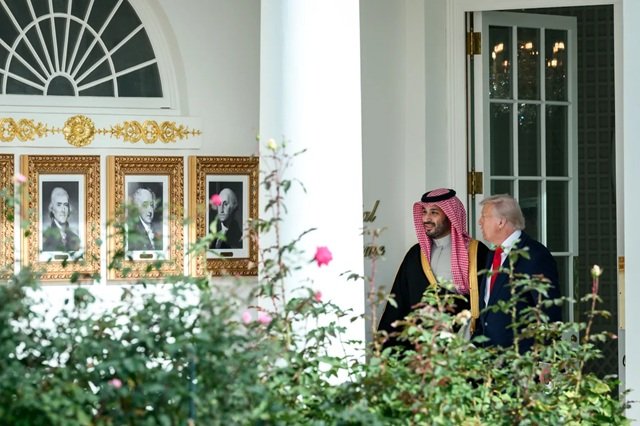
As Donald Trump continued his attacks on Iran earlier this month, a potentially transformative security agreement was quietly taking shape in Saudi Arabia.
On 7 August, Pakistan, Saudi Arabia and Turkey signed the Mecca Joint Defence agreement, a Nato-style mutual defence pact declaring that an attack on one member will be considered an attack on all. The agreement brings together three states with considerable military, economic and strategic weight at a moment when confidence in the existing regional security order is under growing strain.
The timing is significant. All three countries have been the targets of Iranian retaliatory attacks across the Middle East since US-Israeli strikes killed supreme leader Ayatollah Ali Khamenei in February. Turkey possesses Nato’s second-largest army after the United States, Saudi Arabia is the world’s second most oil-rich nation, and Pakistan is a nuclear power that has also acted as a broker between Washington and Tehran during the conflict.
The Independent, whose reporting and analysis provide the basis for this account, described the agreement as a potentially major shift in the global order. Rather than simply representing another regional defence arrangement, analysts cited by the publication see it as evidence that important US partners are increasingly seeking the ability to protect their own interests without depending entirely on Washington.
Donald Trump himself praised the agreement on Sunday, describing it as an example of countries “finally being able to defend themselves in a more meaningful way”. Yet the strategic significance of the pact extends beyond burden-sharing.
Hugh Lovatt, a senior policy fellow at the European Council on Foreign Relations, described the realignment as “a response to the conflict and a way for some of these actors to try and secure themselves”. He also linked it to what he described as Israel’s increasing regional aggressiveness.
The concern is not confined to the current confrontation with Iran. Lovatt said Israeli attacks on Doha in Qatar last year during the war in Gaza “shook the region”, with Turkish and Gulf officials telling him they feared they could be next.
Israel has launched strikes in several countries, including Syria, Lebanon, Iran, Yemen and Qatar, according to Acled data analysed by Al Jazeera, while continuing attacks in Gaza and the occupied West Bank. Lovatt argues that Tel Aviv’s “hegemonic ambitions” are increasing perceptions of threat among countries across the region.
The United States, meanwhile, faces its own credibility problem.
“The US remains indispensable for the region, but it is also unpredictable and unreliable,” said Galip Dalay, a senior research fellow for the Middle East and North Africa at Chatham House.
That perception represents a sharp challenge to the regional vision associated with Trump’s Abraham Accords, signed in 2020 to normalise relations between Israel and several Arab states. Dalay argues that the central weakness of that vision was its failure to incorporate the Palestinian question and its lack of a clear framework for non-Arab state actors.
In his assessment, the new agreement signals “a post-Abrahamic regional reordering” and represents the failure of the Abrahamic vision, although he stresses that it is not inherently anti-Israel.
The distinction is important. Pakistan, Saudi Arabia and Turkey are not forming an alliance explicitly designed to confront Washington or Israel. All three maintain close relations with the United States, and the agreement does not amount to a formal rejection of American influence.
Instead, it reflects an attempt by regional powers to create additional security options.
All three countries have expressed reluctance to normalise relations with Israel. Saudi Arabia and Pakistan have effectively banned Israeli citizens from entering their countries. At the same time, they are not aligned with Iran’s network of armed groups, including Hezbollah in Lebanon, the Houthis in Yemen and Hamas in Palestine.
That places the Mecca group in a distinctive middle position. It is neither part of Iran’s proxy network nor an extension of the US-Israel security architecture.
Lovatt describes it as a “counter-Abraham Accords axis”, while stressing that the group is not strictly religious despite the idea of a “Muslim Nato”.
The emerging arrangement also fits comfortably with one of Washington’s longstanding demands: that regional allies assume greater responsibility for their own security.
Turkey and Saudi Arabia, Lovatt argues, are rising middle powers seeking to influence the geopolitical order in their own interests. From a US strategic perspective, that need not necessarily be threatening.
If the three countries had aligned themselves with Russia or China, the calculation would be different. Instead, the pact is an intra-regional alignment involving states that remain close to Washington.
It could therefore serve American interests by encouraging regional partners to shoulder more of the burden of defence. Rather than requiring the United States to provide security guarantees for every contingency, regional states would increasingly develop mechanisms to protect themselves.
The complication is Israel.
Israel’s own ambitions to become a Middle Eastern “superpower”, as described by Netanyahu, could bring the alliance into tension with Israeli strategic objectives. Relations between Ankara and Tel Aviv are already strained, with Netanyahu accusing Turkey of having “aggressive aspirations”.
Saudi Arabia represents a more positive actor from Israel’s perspective, but the future direction of Riyadh’s policy cannot be guaranteed.
The agreement’s practical significance, however, remains untested.
The Houthis have continued attacking Saudi targets since the pact was signed, but the mutual-defence commitment has not yet faced a crisis comparable to the situations for which Nato’s Article 5 was designed. Nato itself has invoked Article 5 only once, following the 9/11 attacks in 2001.
Turkish President Recep Tayyip Erdogan has directly compared the Mecca agreement with Nato’s collective-defence principle, saying that it “applies in a similar way”. He has also made clear that the arrangement could expand.
“This is not limited solely to the Kingdom of Saudis, Turkey, and Pakistan,” Erdogan said. “Other countries may also join us. Egypt too, if it wishes, can join the agreement with these three countries. The doors are open to Egypt.”
That possibility could make the agreement more consequential than its current membership suggests. Egypt would add another major regional military power and further broaden the emerging security framework.
Yet the pact’s most important function may not ultimately be military.
Lovatt argues that the greatest value of the alignment could lie in diplomacy. Nato, he notes, is more than a collection of countries cooperating militarily. The Mecca arrangement could similarly give its members greater influence by allowing them to coordinate their positions on major regional questions.
“This alignment has the most value and could be the most impactful in the diplomatic sphere,” Lovatt says, “where these countries act together in pursuit of a common regional vision.”
That may be the agreement’s deeper significance.
The Mecca pact does not mark the disappearance of American power from the Middle East, nor does it create an explicitly anti-American or anti-Israeli bloc. But it does reveal a region in which influential states are increasingly unwilling to leave their security entirely in the hands of external powers.
Pakistan, Saudi Arabia and Turkey remain partners of Washington. They may even advance one of Washington’s own goals by accepting greater responsibility for regional defence. Yet the very decision to establish their own collective security mechanism reflects a broader change: the Middle East’s most powerful regional actors are seeking more control over the rules that determine their security.
The agreement may therefore prove less important as a military alliance than as a declaration of strategic intent. At a time of confrontation with Iran, anxiety over Israeli military reach and uncertainty over American policy, three established regional powers have chosen to build another pillar of security around themselves.
The question now is whether that pillar remains a diplomatic instrument or becomes the foundation of a genuinely new regional order.