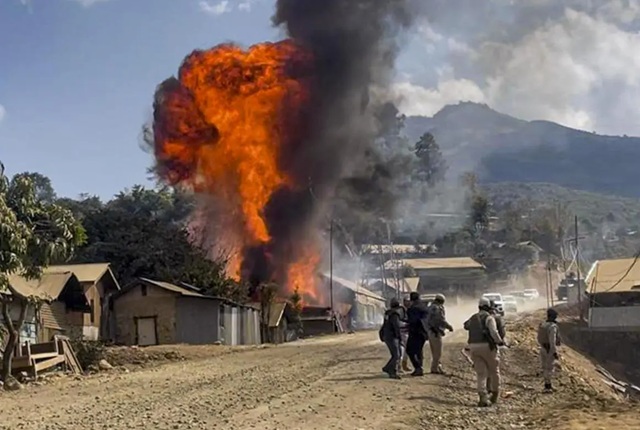
Manipur is quietly arming itself into a deeper deadlock. Between July 2023 and February 2026, amid ongoing ethnic violence and a severe law-and-order crisis, the State government issued over 7,227 new arms licences, according to Right to Information (RTI) disclosures obtained by Frontline India. This surge in licensed firearms coincides with the three-year-long Kuki-Zo–Meitei conflict, which erupted in May 2023, claiming over 270 lives and displacing thousands. The disclosures raise urgent questions about the State’s role in the proliferation of weapons and its ability—or willingness—to maintain a monopoly over force.
The issue of sophisticated weaponry among civilians has been a recurring concern throughout the violent phase of the conflict. Investigative reports and public scrutiny initially linked these arms to mass looting of police armouries, which reportedly saw over 6,020 weapons stolen since May 2023. Authorities have claimed that recovery operations, particularly during the period of President’s Rule between February 2025 and February 2026, have returned a majority of the looted stocks. Yet the issuance of over 7,000 new licences suggests a parallel, state-fuelled expansion of civilian armament, further complicating disarmament efforts and undermining the rule of law.
RTI data indicate a sharp 20.58 per cent increase in registered arms holders during the two-and-a-half-year period. In July 2023, Manipur had 35,117 registered licence holders; by February 2026, this number had risen to 42,344. The sheer scale of this proliferation highlights both a governance deficit and a growing reliance on civilian defence. Raj Kumar Nimai, a retired IAS officer, explained that in areas where state protection is absent, residents often seek licensed firearms to secure villages. “The crisis is due to the government’s inability to impose the rule of law,” he said. “It forgets that only the state has the legitimacy to use weapons to enforce law. The government was unable to enforce [its rule] when violence was used by various groups.”
On the ground, the blurring of community defence and civil militarisation is stark. In buffer zones separating the Meitei and Kuki-Zo communities, civilians patrol perimeters with firearms, citing official licences as legal justification. Villagers say these measures are necessary to protect homes and property, but the normalisation of armed civilian presence is fuelling mistrust and fear. Former IPS officer S.R. Darapuri warned of the political dimensions of the arms surge, noting that “Meiteis are in the majority in Manipur and have a higher representation in the government, so there is a possibility that the administration is supporting one particular community.” The absence of a community-wise break-up of the licences fuels apprehension over potential demographic bias and partisan favouritism.
Political opposition has been swift in condemning the surge in licensing. K. Meghachandra Singh, leader of the Congress Legislature Party (CLP) in Manipur, told Frontline India that the State’s licensing policy “signals either a complete failure of governance or a dangerous shift towards normalising the militarisation of civil society.” He added that instead of issuing thousands of new licences, the government should focus on neutral security deployment and disarmament of illegal weapons. Singh urged transparency, calling for public disclosure of the vetting criteria and a district- and community-specific breakdown of licences, warning that perceptions of disproportionate distribution could further erode trust and inflame divisions.
The surge in arms licences is particularly striking when compared to the broader North-East region. While the region recorded a 7.28 per cent increase in licensed firearms during the same period, Manipur alone accounts for more than half of this growth. Other states such as Assam, Sikkim, and Tripura actually reduced licences, highlighting Manipur’s exceptional and alarming trajectory in civilian armament.
The context of these developments is shaped by Manipur’s political turbulence since 2023. The State transitioned from the administration of former Chief Minister N. Biren Singh to President’s Rule, before returning to a popularly elected government supported by three Kuki-Zo MLAs. Despite these shifts in leadership, ethnic tensions remain high. The Kuki-Zo community continues to press for a separate administration, thousands of displaced persons remain in relief camps, and while fatalities have decreased, peace is far from secured.
Frontline India has reached out to both N. Biren Singh, who headed the Home Department until the imposition of President’s Rule, and the current Director General of Police, Rajiv Singh, for clarification on the rationale and vetting process behind the surge in licences. Responses are pending, but the data already point to a dangerous pattern: the State, in attempting to maintain law and order, appears to have abrogated its monopoly on force, providing civilians with legal access to firearms in an already volatile environment.
Experts caution that this approach risks entrenching militarisation, perpetuating cycles of retaliatory violence, and making conflict resolution far more difficult. The interplay of community defence, partisan politics, and official licensing is transforming Manipur into a heavily armed society where civilians, rather than trained security forces, increasingly bear the responsibility of protecting life and property.
As Manipur struggles with this uneasy status quo, the wider lesson is clear: civilian armament in conflict zones is rarely a neutral act. Without robust, impartial governance, the issuance of thousands of firearms licences is likely to prolong conflict, exacerbate communal divides, and undermine prospects for reconciliation. The State’s decision to arm civilians, rather than disarm illegal weapons and strengthen neutral security mechanisms, underscores a fundamental governance failure that threatens to turn Manipur’s fragile peace into a permanent deadlock.
The situation in Manipur serves as a cautionary tale for other regions confronting ethnic violence: in the absence of effective state control, official sanctioning of weapons can escalate instability rather than contain it. As the Kuki-Zo–Meitei conflict continues, the surge in state-issued licences signals not a return to order but the formalisation of a militarised society, where the distinction between protector and combatant has all but disappeared.
Frontline India’s investigation into the surge of licences provides crucial insight into the dynamics of civilian armament in conflict zones, revealing how governance decisions, whether deliberate or negligent, can profoundly shape the trajectory of communal violence and the prospects for peace.