In the wake of collective trauma and personal upheaval, an unexpected source of healing has emerged for many older Israelis: dance. What began as a modest initiative for non-professional women over 50 has evolved into a powerful movement blending art, therapy, and resilience. As reported by Haaretz, participants describe dance not merely as physical activity, but as a profound emotional release—one that has helped some navigate depression, fear, and the lingering psychological scars of October 7.
For Smadar Elad, a psychotherapist, the journey began nearly a decade ago with a sleepless night and a chance encounter online. At 63, she had never danced before. Yet a Facebook post by choreographer Galit Liss inviting older women to join a workshop stirred something deeply within her. She recalls feeling an immediate, almost physical pull. Within days, she joined the class in Tel Aviv, stepping into a world that would quietly reshape her life.
At first, Elad kept her new passion secret, telling even close family members that she was attending a course on aging rather than dance. Raised as a second-generation Holocaust survivor, she internalized a message of restraint and invisibility. Expression—whether physical or emotional—was discouraged. Dance, for her, was not just unfamiliar; it was transgressive. But over time, the weekly sessions became essential. The fear of judgment faded, replaced by a growing sense of liberation.
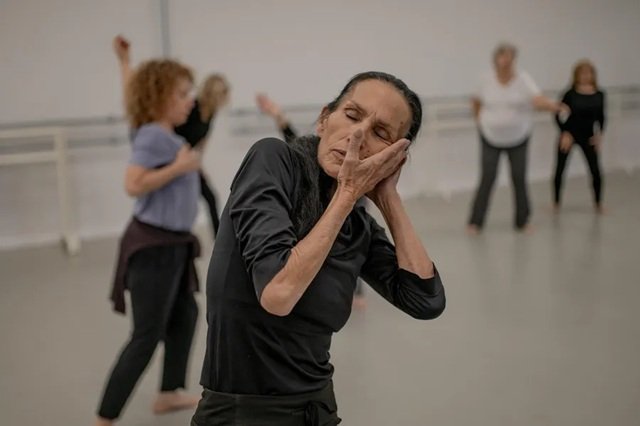
Her transformation deepened when she joined “Blue Zone,” a performance piece created by Liss that places the aging female body at its center. The show challenges conventional ideals of youth and beauty, presenting older women as they are—marked by time, yet vibrant and expressive. Through rehearsals and performances, Elad says she shed layers of inhibition, eventually embracing a newfound confidence and clarity. She describes feeling sharper mentally and more present physically after dancing, a reversal of the decline often associated with aging.
The program that nurtured this transformation is rooted in a philosophy shaped by personal loss. Liss began exploring the potential of dance and aging after her brother’s death from cancer. His final reflections on finding happiness even in suffering led her to question the meaning of life and the role of the body in expressing it. She turned to older individuals, believing their lived experiences held untapped depth. What began as an artistic inquiry became a structured method now practiced by hundreds.
At a community center in northern Tel Aviv, Liss’s school draws around 200 participants weekly. Most have no prior dance experience. In classes, they move barefoot across the floor—crawling, rolling, floating—discovering new ways of inhabiting their bodies. Observers often describe the scenes as unlike conventional dance, marked less by technique and more by authenticity and emotional presence.
The impact extends beyond women. In recent years, a men’s group was introduced, bringing together participants aged 60 to 80. For many, it represents their first encounter with dance, challenging long-held notions of masculinity and self-expression. Eyal Friedlander, a 69-year-old artist, says the experience was transformative. After October 7, he found himself struggling with depression. Dance, he explains, offered a way to reconnect with himself. It allowed him to express emotions that had long remained dormant and provided a sense of uplift he had not anticipated.
Others echo similar sentiments. Participants describe entering a meditative state during sessions, where physical limitations recede and focus shifts inward. For some, chronic pain diminishes while dancing. For others, the weekly gatherings offer a vital social connection, reinforcing a sense of belonging and purpose.
Scientific perspectives support these experiences. Research conducted by clinical psychologist Daniela Aisenberg-Shafran highlights the importance of activity, meaning, and acceptance in successful aging. Dance, particularly in a community setting, appears to fulfill all three. It combines physical movement with cognitive engagement and social interaction, while also fostering a sense of identity and continuity.
The stories emerging from the program illustrate its broader significance. Ilana Shparer, an 80-year-old from a community near the Gaza border, recounts returning to dance after surviving a traumatic attack on October 7. Confined for hours in a safe room during the violence, she experienced lasting physical and emotional tension. Dance became a way to release that contraction, to reclaim her body and reaffirm her will to live. Though she says the pain has not entirely disappeared, the act of moving has brought moments of lightness and freedom.
For many participants, dance also challenges societal perceptions of aging. Long viewed as a period of decline, later life is reimagined here as a stage of creativity and growth. The performances themselves—featuring older bodies in motion—serve as a quiet but powerful form of resistance against ageism. They assert that expression, beauty, and vitality do not belong exclusively to the young.
The movement has expanded beyond Israel, with workshops held in Europe, adapting to different cultural contexts while maintaining its core principles. Yet its resonance remains particularly strong in a society grappling with ongoing conflict and collective trauma. In this environment, the body becomes both a repository of pain and a medium for healing.
What emerges from these stories is not simply a narrative about dance, but about the human capacity to adapt and find meaning under pressure. Whether confronting personal histories, societal expectations, or national crises, participants are using movement to rewrite their relationship with themselves.
As one dancer put it, stepping out of class brings a sense of lightness that is difficult to articulate. In those moments, the weight of age, fear, and memory seems to lift, replaced by a fleeting but powerful sense of possibility.