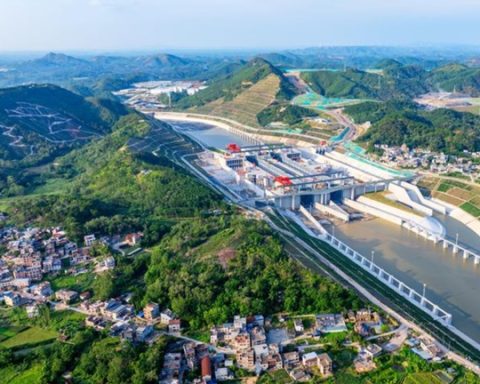
China has shifted from being Africa’s largest financier of major infrastructure projects to becoming a net collector of debt repayments, marking a significant transformation in its financial relationship with the continent as large loans issued over the past two decades mature.
A new analysis by Oxford Economics Africa, drawing on data from Boston University’s Global Development Policy Centre and its own calculations, found that Chinese loan commitments to Africa have declined dramatically. Lending fell from a peak of US$28.8 billion in 2016 to just US$2.1 billion in 2024, the lowest annual level recorded in nearly two decades.
The decline reflects a broader change in Beijing’s approach to overseas development finance. While China remains Africa’s largest bilateral creditor, it is now recovering substantial repayments from loans extended during the height of its infrastructure financing programme.
According to Oxford Economics Africa, citing data from the One Campaign, China provided African governments with US$30.4 billion in financing between 2010 and 2014. Over the past five years, however, Beijing has received US$22.1 billion in net debt repayments, making Africa a net repayer rather than a net recipient of Chinese financing.
In the analysis published on 31 July, Oxford Economics Africa economist Christian Franken said Beijing is now managing an extensive existing loan portfolio rather than pursuing rapid expansion.
“Beijing is now focused on managing a mature loan book rather than expanding it,” Franken said.
Despite the reduction in new lending, China continues to exert significant influence over Africa’s debt landscape. Franken noted that Beijing remains the continent’s largest bilateral creditor, with its position playing an important role in debt restructuring efforts under mechanisms such as the G20 Common Framework.
He pointed to differing experiences across African economies. Zambia has made notable progress in restructuring its debt obligations, while Angola has reduced its oil-backed debt to China from US$16.3 billion in 2020 to US$6.8 billion by mid-2026. Ethiopia’s debt restructuring process, however, remains stalled.
Oxford Economics Africa said the reduction in lending reflects Beijing’s stated shift towards a “small and beautiful” strategy. Rather than financing large-scale infrastructure through policy banks, China is increasingly supporting more selective investments in digital infrastructure, renewable energy and industrial estates, with funding often channelled through regional development banks.
Data compiled by the Development Finance Observatory illustrates the changing financial flows. Chinese financing to low-income and lower-middle-income African countries declined from US$26.5 billion in 2018 to US$5.1 billion in 2024. During the same period, debt-service payments increased from US$10.6 billion to US$17.4 billion before rising further to US$25.2 billion in 2025.
Franken said the trend does not signal the end of Chinese investment in Africa but instead reflects a fundamental shift in how financing is being provided. He argued that African governments are increasingly gaining access to Chinese capital under less concessional terms and with a stronger emphasis on commercially viable projects.
Aly-Khan Satchu, a Nairobi-based geoeconomics analyst, described the transition as “a game of swings and roundabouts”. He argued that countries successfully reducing their debt burdens are strengthening their financial positions and could be well placed to benefit if Chinese lending expands again in the future.
The evolving nature of China’s lending model has also been examined by Yufan Huang, a predoctoral fellow with the China Africa Research Initiative at the Johns Hopkins School of Advanced International Studies. Huang said Chinese policy banks differ from many traditional bilateral lenders because institutions such as the Export-Import Bank of China and the China Development Bank are expected to operate on commercial principles despite serving broader government objectives.
According to Huang, only about 17 per cent of China’s lending to Africa between 2000 and 2021—including zero-interest loans and preferential export buyer’s credits—was directly coordinated through the Chinese state. Most overseas lending, he said, is undertaken by banks expected to select projects based on commercial returns rather than government direction alone.
Huang added that China’s Ministry of Finance has declined to compensate state-owned lenders for losses in order to avoid creating “moral hazard”. Combined with defaults experienced in countries including Zambia and Ethiopia, this has made Chinese banks more cautious, prompting them to scale back lending in much the same way as commercial financial institutions.
Nevertheless, Huang argued that the slowdown should not be interpreted as a withdrawal from Africa. Instead, he said, Beijing’s capacity to expand official overseas financing is constrained, noting that China’s annual foreign aid budget amounts to only around US$3 billion. While Chinese financing continues to play a significant role across the continent, the relationship is increasingly characterised by selective investment, commercial discipline and debt management rather than the large-scale infrastructure lending that defined the previous decade.