Daniel McKinnon knows better than most that artificial intelligence can change a career. For years, the 40-year-old engineer worked for Meta developing AI systems, initially helping improve speech recognition for the company’s Llama model before moving into projects involving Meta’s Ray-Ban smart glasses and AI chips. Eventually, the technology he helped develop became part of a much larger ambition: replacing human labour on an unprecedented scale.
In May, Meta eliminated about 8,000 jobs, roughly 10 per cent of its workforce, as chief executive Mark Zuckerberg sought to make the company more efficient and compensate for enormous investments in artificial intelligence. McKinnon was among those whose careers were abruptly brought to an end. He now plans to use his severance package to establish a biotechnology start-up, naturally with AI at its core.
Yet he is less concerned about his own future than about what artificial intelligence could mean for millions of others. “I programmed my own career ending,” he reflects, while acknowledging that the technology could soon do far more than replace engineers like him.
The question explored by DER SPIEGEL is therefore considerably larger than whether particular occupations will disappear. If machines become capable of performing increasingly complex cognitive work, what happens to an economic system built around human labour? And if the profits generated by AI accrue primarily to the relatively small number of companies and individuals controlling the technology, what happens to the social contract that has sustained modern democracies?
The transformation is already visible. AI systems can write and assess computer code, translate conversations in real time, analyse medical images, prepare tax returns and control increasingly sophisticated machines. The technology is moving beyond automating repetitive physical tasks towards activities once regarded as uniquely dependent on human education, judgement and expertise.
Some of Silicon Valley’s most influential figures envisage an extraordinary future. Anthropic co-founder Dario Amodei has predicted that AI could contribute to unemployment reaching as high as 20 per cent by 2030. Elon Musk has argued that ultimately almost every form of human work could become replaceable. Investor Vinod Khosla has suggested that 80 per cent of jobs could potentially be taken over by AI from 2030 onwards.
Such predictions remain forecasts, not certainties. But they are consistent with the scale of the technological change now under way. Goldman Sachs estimated in 2023 that AI could make the equivalent of 300 million full-time jobs automatable, while the International Monetary Fund calculated in 2024 that about 40 per cent of jobs worldwide were exposed to AI, rising to 60 per cent in advanced economies.
Demis Hassabis, the head of Google’s DeepMind, has described the coming transformation as potentially ten times larger and faster than the Industrial Revolution. Historian Yuval Noah Harari has argued that the fundamental difference is that humans are not merely creating new tools but increasingly creating autonomous actors capable of performing tasks themselves.
The consequences could be particularly severe for the middle classes. Lawyers, architects, teachers, doctors, psychologists, journalists, engineers, investment bankers and other highly educated professionals have traditionally occupied some of the safest positions in advanced economies. AI threatens to reach precisely those occupations because much of their work involves processing information and applying specialised knowledge.
That possibility is already unsettling a younger generation entering the labour market. Elizabeth Tatishev, a 23-year-old graduate in computer science and neuroscience, believed her education would provide a secure career. Instead, after sending approximately 200 job applications without success, she returned to live with her parents and took work in a coffee shop.
Her experience reflects a wider anxiety. According to figures cited by DER SPIEGEL, employment among young workers in AI-exposed occupations has fallen by 16 per cent compared with the pre-AI period. Mathias Albert, a sociologist at Bielefeld University, describes the younger generation as a “lost generation” shaped by the cumulative shocks of the pandemic, inflation, economic insecurity, climate change and now artificial intelligence.
The traditional economic response to technological disruption offers some reassurance. The “compensation theory” holds that jobs destroyed by technological progress are eventually replaced by new occupations. More productive factories, for example, have historically created new forms of employment and raised wages and living standards.
But AI may be different because it can learn, make decisions and perform cognitive tasks rather than simply operate machinery. Labour economist David Autor argues that AI can either strengthen human expertise or turn that expertise into an interchangeable commodity. Tasks involving relatively short sequences of decisions may be particularly vulnerable, while work requiring long chains of interdependent reasoning, context and judgement may prove harder to automate.
At the same time, the ownership of AI is becoming increasingly concentrated. Nvidia, whose chips underpin much of the technology, has experienced extraordinary growth in market value. Meta controls platforms used by billions of people, while OpenAI’s ChatGPT reaches hundreds of millions. A small group of technology executives therefore possesses not only enormous wealth but also significant influence over information, infrastructure and the direction of technological development.
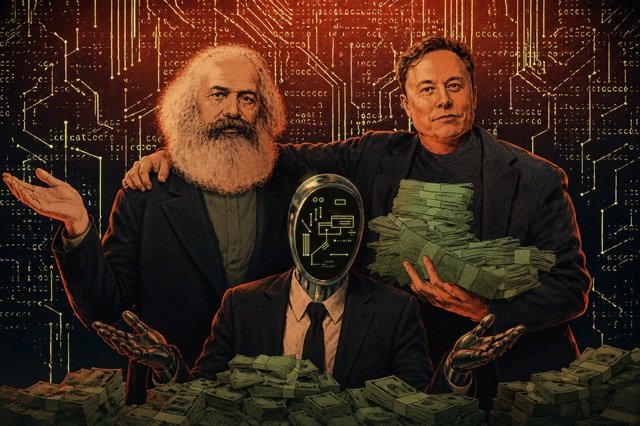
That concentration raises an older question in a new form: whether capitalism can remain socially stable when capital becomes increasingly detached from human labour.
Karl Marx argued that capitalism continually pushes companies towards greater productivity and efficiency, encouraging them to replace labour with machinery. AI appears to extend that process from factories into offices and professions. If companies eventually require only a small number of human employees to generate enormous profits, the relationship between work, income and social status could be fundamentally altered.
Economist Thomas Piketty has warned that AI could become a new mechanism for concentrating wealth. Historian Sven Beckert similarly argues that capitalism is not a natural or permanent system but a historical arrangement that has repeatedly changed. If AI benefits a very small minority while harming large sections of society, he says, it could ultimately call capitalism itself into question.
Resistance is already emerging. In New York, the Neo-Luddites have declared a “Summer of Ludd”, organising events against the growing power of technology companies and promoting offline alternatives. Protests have also emerged around AI data centres in parts of the United States. What once appeared to be an overwhelmingly enthusiastic public embrace of AI is becoming more complicated as communities confront its economic, environmental and social consequences.
Yet abandoning technology is neither realistic nor necessarily desirable. AI could eliminate tedious work, increase productivity and create new forms of prosperity. The central question is who receives those benefits.
Various solutions are being proposed. Bernie Sanders has advocated partial public ownership of AI capital. Musk has supported forms of universal basic income. Piketty has proposed much more progressive taxation. OpenAI chief Sam Altman has discussed taxing robots. Billionaire Nicolas Berggruen proposes something different: a “universal basic capital” system under which citizens would collectively own stakes in the companies benefiting from AI.
The principle is straightforward: if artificial intelligence becomes one of the principal sources of future wealth, ordinary citizens should possess some ownership of that wealth rather than depend entirely on wages that technology may progressively undermine.
Governments therefore face a choice that extends beyond regulating algorithms. They must decide how the economic gains from AI are distributed, how technological power is constrained and whether democratic institutions can retain meaningful authority over companies that may become more powerful than many states.
McKinnon’s experience offers an unsettling symbol of the transition. He helped build technologies that are now contributing to the automation of the very work he once performed. For him, the irony is personal. For society, the implications could be much larger.
The AI revolution may ultimately prove to be another technological transformation in which new industries create more opportunities than they destroy. But if machines become capable of replacing a substantial share of human expertise while ownership remains concentrated among a small technological elite, the old promise that education and hard work lead to security may no longer hold.
The issue, then, is not simply whether AI will take people’s jobs. It is whether societies can redesign their economic institutions quickly enough to ensure that technological progress remains broadly shared.
As DER SPIEGEL’s examination makes clear, the future of work and the future of capitalism are increasingly becoming the same question.