Ivanka Trump still remembers the moment vividly. Five years ago, she has said, she and her husband, Jared Kushner, were sailing off the Albanian coast on a friend’s yacht when Sazan suddenly appeared. They swam towards the island and, according to her account, climbed its hills “barefoot”. From there, she saw a lagoon on the mainland surrounded by “beautiful white sandy beaches”. She immediately thought it could become “an incredible project”.
That is how Ivanka Trump described the discovery in a video podcast on 31 May. But the story took on a darker dimension when, one day earlier, a video filmed at the same lagoon appeared online. It showed demonstrators near barbed wire and security guards dragging a protester lying helpless on the ground by both arms across the beach.
The contrast has become emblematic of the controversy surrounding the project, which has fuelled a wave of protests across Albania. The account comes from German news magazine Der Spiegel, which has investigated the development, the disputed land surrounding it and the allegations now being examined by Albanian authorities.
Since early June, citizens have gathered almost every day in Tirana’s Skanderbeg Square. The crowds grew from hundreds to thousands and eventually tens of thousands, an extraordinary mobilisation in a country of fewer than three million people. Demonstrations have also taken place in Berlin, London, Stockholm, Brussels, Milan and elsewhere, reflecting the reach of Albania’s diaspora.
The initial focus was the proposed luxury resort backed by the Trump family in southern Albania. Much of the planned development lies in or near protected areas that are home to threatened birds and other wildlife. But as more questions emerged about the project, the demonstrations broadened into a challenge to a political system that protesters say has for decades allowed powerful interests to obtain what they want.
The paper flamingos carried through the streets have become the symbol of the movement. What began as opposition to a single development has evolved into what Der Spiegel describes as a wider system crisis, putting Prime Minister Edi Rama under growing pressure. Rama has governed Albania since 2013 and has positioned the country as a prospective European Union member by 2030.
At the centre of the controversy is Sazan, Albania’s largest island. Covering about five and a half square kilometres, it occupies a strategic position between the Adriatic and Ionian seas. For much of the Cold War it was a heavily restricted military base, inaccessible to ordinary civilians. Today visitors can reach it from Vlora for €25.
The island retains the physical remnants of that past: rusting cranes, damaged containers and abandoned military buildings. A narrow concrete path winds uphill through pine, juniper, blackberry and oleander. Signs warn visitors not to leave the path because unexploded ordnance is reportedly scattered across large parts of the island.
The remains of homes once occupied by around 3,000 military personnel stand alongside a cinema, school and restaurant, their structures increasingly reclaimed by vegetation. The surrounding Karaburun-Sazan marine national park provides a striking backdrop.
Kushner has described Sazan as “one of the most untouched and unique coastlines I have ever seen”. In 2024, he published preliminary visions for a luxury development featuring sand-coloured bungalows with extensive glass fronts, a luxury yacht marina and infinity pools overlooking the sea.
Plans for the mainland around the village of Zvërnec are even more ambitious. They include additional berths for large yachts, a wellness centre, a water park, a golf course and residences for thousands of wealthy buyers. The estimated investment is about €4 billion.
Kushner’s investment company, Affinity Partners, told Der Spiegel through a public-relations firm that the project was not an Affinity project and that Kushner was involved only “as a private person”. A long-time business associate, Asher Abehsera, described through his role as head of Sazan Real Estate Development LLC in Qatar, said the aim was to create a “world-class destination” celebrating Albania’s “natural beauty” and creating jobs.
The Albanian government’s role is central. Rama chairs the National Territorial Council, the ministerial body that has the final say on major investments and strategic infrastructure projects. Sazan itself is not a private island but remains state-owned.
In 2024, Albania changed legislation to make development in sensitive coastal and protected areas considerably easier. In December, shortly after Donald Trump’s re-election, a government committee chaired by Rama granted the project “strategic” investment status under another controversial law. The government has denied changing the legislation because of Kushner’s plans and said the amendments did not alter the legal status of the affected areas.
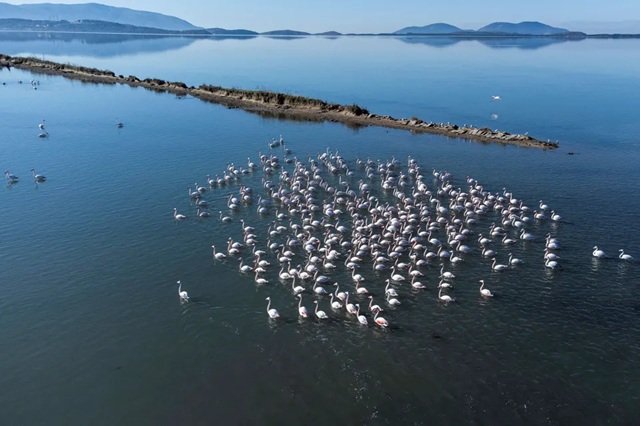
The most contentious part of the project, however, concerns the Narta Lagoon. Covering more than 40 square kilometres, it is among the Mediterranean’s richest coastal ecosystems. Thousands of flamingos live there, alongside endangered species including the Dalmatian pelican and lesser kestrel. The area is also a refuge for the Mediterranean monk seal, while sea turtles lay their eggs in surrounding dunes. The Vjosa, one of Europe’s last wild rivers, reaches the Adriatic nearby.
For decades, ownership of land around the lagoon has been disputed. Communist authorities began confiscating private property without compensation from the mid-1940s onwards, and descendants of former owners have spent more than three decades seeking restitution. The land records are incomplete and contradictory, with some documents dating to the Ottoman period.
One claimant, Petraq Balliu, says a court confirmed in 2003 that his documents were genuine and that he had a legal claim to more than 200 hectares around the lagoon. Subsequent rulings were overturned. Balliu attributes this to corruption.
Another claimant is Artur Shehu, an Albanian-born businessman with a US passport who lives in Miami. His family has also pursued ownership claims, despite documented use of forged documents in proceedings. His lawyer told Der Spiegel that Shehu sold land he considered legally acquired to investors from Qatar last May for €68 per square metre. With at least 200 hectares involved, the transaction would have been worth hundreds of millions of euros.
In March 2026, while the ownership dispute was still before the courts, the National Territorial Council granted a development permit for the Kushner/Trump project on the contested land. The government said it did not assess land disputes, which were a matter for the judiciary.
The controversy intensified after construction activity appeared to begin near the lagoon. Balliu said he encountered a metal fence when he visited the land in May and found a newly constructed gravel road cutting through a pine forest. He also alleged that bulldozers had destroyed parts of the dunes where sea turtles lay their eggs.
After videos of the construction spread in late May, authorities stopped the work, rapidly removed the fence and opened an investigation into a security guard accused of excessive force. But by then the dispute had already become a national protest movement.
In June, Albania’s Special Prosecution Office against Corruption and Organised Crime, known as SPAK, announced the results of a five-year investigation into an international network allegedly involved in cocaine trafficking and money laundering. Arrest or house-arrest orders were issued against 20 people, including Shehu.
According to investigators, some suspects allegedly smuggled cocaine from Latin America into Europe, while others are accused of laundering profits through property and construction projects across Albania. Investigators said land around the Narta Lagoon had been acquired through forged documents and that some transactions had been supported by political authorities. SPAK has seized numerous properties, villas and large sums of money.
Shehu’s lawyer rejects the allegations as politically motivated, saying his client had never engaged in illegal activity or drug trafficking. There is no indication that Jared Kushner or Ivanka Trump were involved in the alleged criminal activity.
Rama has dismissed questions about the coastal project as “Bullshit” and responded to protesters demanding his resignation with “Fuck you!”. His government has maintained that the SPAK investigation does not provide a legal basis for cancelling the development permit and that the investors acquired the land legally. The purchase price has been frozen pending judicial clarification.
Kushner’s representatives have said they currently assume that the land acquisition was legal but will respect “every lawful procedure”. Abehsera has previously said that if illegal activity surrounding the land is proven, the investors “will withdraw from the purchase agreement”.
The Albanian project is not the first Trump-family development in the Balkans to encounter serious opposition. In Belgrade, Kushner had proposed transforming the bombed former Yugoslav army headquarters into a Trump Tower luxury hotel. That project faced weeks of protests and investigations into government officials over alleged corruption and document forgery. In December 2025, the Trump family abandoned the plan.
In Albania, however, the Sazan and Narta developments remain unresolved. What began with Ivanka Trump’s memory of an apparently untouched island has become a far larger dispute involving disputed land, a protected ecosystem, alleged organised crime, political power and the limits of development in a country still wrestling with the legacy of its communist past. For now, the island remains largely a landscape of abandoned military buildings, rocks and sand. Around it, the paper flamingos continue to rise above Albania’s streets.